Kamis, 09 Mei 2019

Facebook’s co-founder: ‘It’s time to break up Facebook’ - The Washington Post


Stickers bearing the Facebook logo are pictured at Facebook Inc's F8 developers conference in San Jose, California, U.S., April 30, 2019. REUTERS/Stephen Lam (Stephen Lam/Reuters)

Chris Hughes, a co-founder of Facebook, is calling for the breakup of the social media juggernaut, citing the threat of the platform’s unchecked power and that of founder Mark Zuckerberg.

In an op-ed published Thursday in the New York Times, Chris Hughes, who helped form Facebook in a Harvard dorm, joined the growing chorus of lawmakers and advocates demanding the U.S. government rein in Facebook. Despite its myriad scandals — Russian propagandists exploiting the platform to spread misinformation and sway U.S. elections, the sharing of millions of users’ personal data with the political data firm Cambridge Analytica and companies like Amazon, Microsoft and Netflix — Facebook’s reach continues to grow.

“For too long, lawmakers have marveled at Facebook’s explosive growth and overlooked their responsibility to ensure Americans are protected and markets are competitive,” Hughes wrote. “It is time to break up Facebook.”

Hughes’s calls come as Facebook faces yet another controversy after an AP investigation revealed that the platform automatically generates videos and pages that elevate extremist groups.

The op-ed painted a stark portrait of Facebook’s dominance: The company is worth half a trillion dollars and its products are regularly used by billions of people. By Hughes’s estimates, Facebook commands “more than 80 percent of the world’s social networking revenue.”

Another major social networking platform hasn’t been founded since 2011, and despite the movements like #deleteFacebook, it’s almost impossible to avoid, with many people eschewing the core platform in favor of Instagram or WhatsApp, not realizing they are Facebook subsidiaries. The apparent avalanche of disasters hasn’t dented Facebook’s finances; its earnings per share increased 40 percent last year, despite a torrent of public failures.

“Because Facebook so dominates social networking, it faces no market-based accountability,” Hughes wrote. “This means that every time Facebook messes up, we repeat an exhausting pattern: first outrage, then disappointment, and finally, resignation.”

No aspect of Facebook is more troubling than Zuckerberg’s total authority, Hughes wrote, calling it “unprecedented and un-American.” Zuckerberg controls 60 percent of the company’s voting shares and has ultimate oversight over Facebook’s algorithms, its privacy settings and community guidelines. He has the money and power to copy, buy, or squash his competitors. While Hughes defended Zuckerberg as a “good, kind person,” he cast him as a man hellbent on domination, even when it imperils the American public and democracy.

"I’m angry that his focus on growth led him to sacrifice security and civility for clicks,” Hughes wrote.

Hughes wants the government to correct the FTC’s “biggest mistake” by forcing Instagram and WhatsApp to split from Facebook and become competitors once again. Hughes also wants the government to create an agency to monitor tech companies to ensure healthy regulation. Zuckerberg himself has called for regulation in a March op-ed published in The Post.

“Lawmakers often tell me we have too much power over speech, and frankly I agree,” Zuckerberg wrote, also citing privacy, data protection and election integrity as other areas in need of government oversight. Hughes argues Zuckerberg is only interested in regulation that is “friendly” to Facebook’s interests.

Legislators on both sides of the aisle have made a case for federal intervention with Facebook. Sen. Elizabeth Warren (D-Mass.) has made the breakup of American tech giants a pillar of her presidential campaign.

“Today’s big tech companies have too much power -- over our economy, our society & our democracy,” Warren said in a tweet Thursday. “They’ve bulldozed competition, used our private info for profit, hurt small businesses & stifled innovation.”

Sen. Ted Cruz (R-Texas) has said he’d hit tech companies with antitrust violations or fraud charges, arguing they unfairly censor right-leaning speech. This week, two top senators urged the FTC to go beyond its expected $5 billion fine against Facebook for its privacy practices, calling for tough punishments and accountability measures.

“The public is rightly asking whether Facebook is too big to be held accountable,” Sen. Richard Blumenthal (D-Conn.) and Sen. Josh Hawley (R-Mo.) wrote in a letter to FTC Chairman Joseph Simons. “The FTC must set a resounding precedent that is heard by Facebook and any other tech company that disregards the law in a rapacious quest for growth.”

Let's block ads! (Why?)


https://www.washingtonpost.com/business/2019/05/09/facebooks-co-founder-its-time-break-up-facebook/

2019-05-09 14:33:57Z
52780290199878

Chevron walks away from Anadarko Petroleum deal, will collect $1 billion breakup fee - CNBC

Chevron said Thursday it will not submit a new offer to acquire Anadarko Petroleum, walking away from the deal after Occidental Petroleum pulled ahead in a battle to take control of the driller with prized assets in the top U.S. shale oil field.

The decision means Chevron will collect a $1 billion breakup fee, a windfall that it could use to purchase another driller in the Permian Basin, the engine of the American oil drilling boom.

Shares of the San Ramon, California-based oil major jumped about 3% in premarket trading following the announcement.

Anadarko announced on Monday that its board had unanimously decided that Occidental's revised $38 billion bid was superior to a $33 billion Chevron buyout. Anadarko said it intended to break its agreement with Chevron and strike a deal with Occidental if Chevron did not submit a better offer.

Occidental, with backing from Warren Buffett's Berkshire Hathaway, offered to pay 78% cash and 22% stock for Anadarko, while the Chevron transaction was structured as a 75% stock and 25% cash deal.

"Winning in any environment doesn't mean winning at any cost. Cost and capital discipline always matter, and we will not dilute our returns or erode value for our shareholders for the sake of doing a deal," Chevron Chairman and CEO Michael Wirth said in a statement.

Chevron surprised the market on Thursday by announcing that it still intends to raise its share buyback program to $5 billion per year. Two weeks ago, Chevron executives told analysts the increase was contingent on the deal closing.

By taking control of Anadarko, Chevron stood to acquire the driller's vast acreage in the Permian region stretching from western Texas to southeastern New Mexico. Chevron is a major player in the Permian and plans to double its production from the basin by 2023.

The deal also would have combined Chevron and Anadarko's offshore operations in the Gulf of Mexico, a source of precious cash flow. Chevron also prized Anadarko's liquefied natural gas export project in Mozambique, which would have expanded its footprint in the growing LNG market.

However, Chevron was outmaneuvered by its much smaller rival. After Occidental put in a higher bid, it secured a $10 billion investment from Berkshire Hathaway and arranged to sell Anadarko's African operations to French oil giant Total for $8.8 billion.

Those arrangements allowed Occidental to increase the cash component of its offer, which in turn meant the company would not have to put the transaction to a shareholder vote. That cleared up uncertainty about Occidental's ability to close the deal.

Occidental's battle is not over yet though.

Some of the company's stockholders are angry that they will not get to vote on the deal and are concerned that their investment will be diluted if Buffett exercises his option to buy up to 80 million shares of Occidental. Occidental CEO Vicki Hollub has also come under criticism for agreeing to pay a steep 8% annual dividend on Buffett's preferred stock investment.

Despite technically losing, some analysts applauded Chevron for avoiding a bidding war.

"Chevron did exactly the right thing and walked away, and the client feedback has been raining in positive," said Mizuho Securities analysts Paul Sankey. "The generalists particularly hated that the last decently performing sector in energy — mega-cap oil — was potentially losing its capital discipline."

Let's block ads! (Why?)


https://www.cnbc.com/2019/05/09/chevron-will-not-raise-offer-for-anadarko-petroleum-company-says.html

2019-05-09 13:47:05Z
52780289249746

With new Fit technology, Nike calls itself a tech company - TechCrunch

In 1927, Charles Brannock, the son of a local shoe company owner in Syracuse, N.Y., invented the Brannock Device. The steel measurement tool with five scales has been the most effective way in the U.S. to find an accurate shoe size.

Industry-wide, 60% of consumers are wearing the wrong-sized shoes. Not only is there a discrepancy among different styles of shoes (high heels to leather boots), sizing can often differ from brand to brand within one type of shoe (like adidas sneakers to Nike sneakers) and even silhouette to silhouette within a singular brand.

For instance, I’ve owned Nike React Epic sneakers with Flyknit technology in a women’s size 10. I have men’s suede Nike Air Max 95s in a 9.5. All of my men’s Air Jordan 1s are comfortably a men’s size 8.5, but I have a women’s pair in an 11, and my Air Jordan 4s are an 8. Meanwhile, my Nike Air Max 720s feel decidedly too small at a men’s 8.5. And this is all within one brand.

During the 92 years since its introduction, the birth of the internet, and some other society-altering technological advances, the Brannock Device has somehow remained uncontested. Until now.

This summer, Nike will introduce Nike Fit, a foot-scanning solution designed to find every person’s best fit. Conceptually, Nike Fit falls somewhere between “why would we reinvent the wheel” and “we don’t even need that wheel.”

Nike Fit uses a proprietary combination of computer vision, data science, machine learning, artificial intelligence and recommendation algorithms to find your right fit. With sub two-millimeter accuracy through dozens of data points, measurements are fed into the machine learning model that accommodates every detail of every Nike silhouette down to the materials that were used, the lacing systems and other critical aspects of fit. This is then paired with AI capabilities to learn a wearer’s personal fit preference and how they relate to the population as a whole.

Users can either find their size with the augmented reality feature in the Nike app or, soon, visit participating stores to use the technology. I recently had the opportunity to do both.

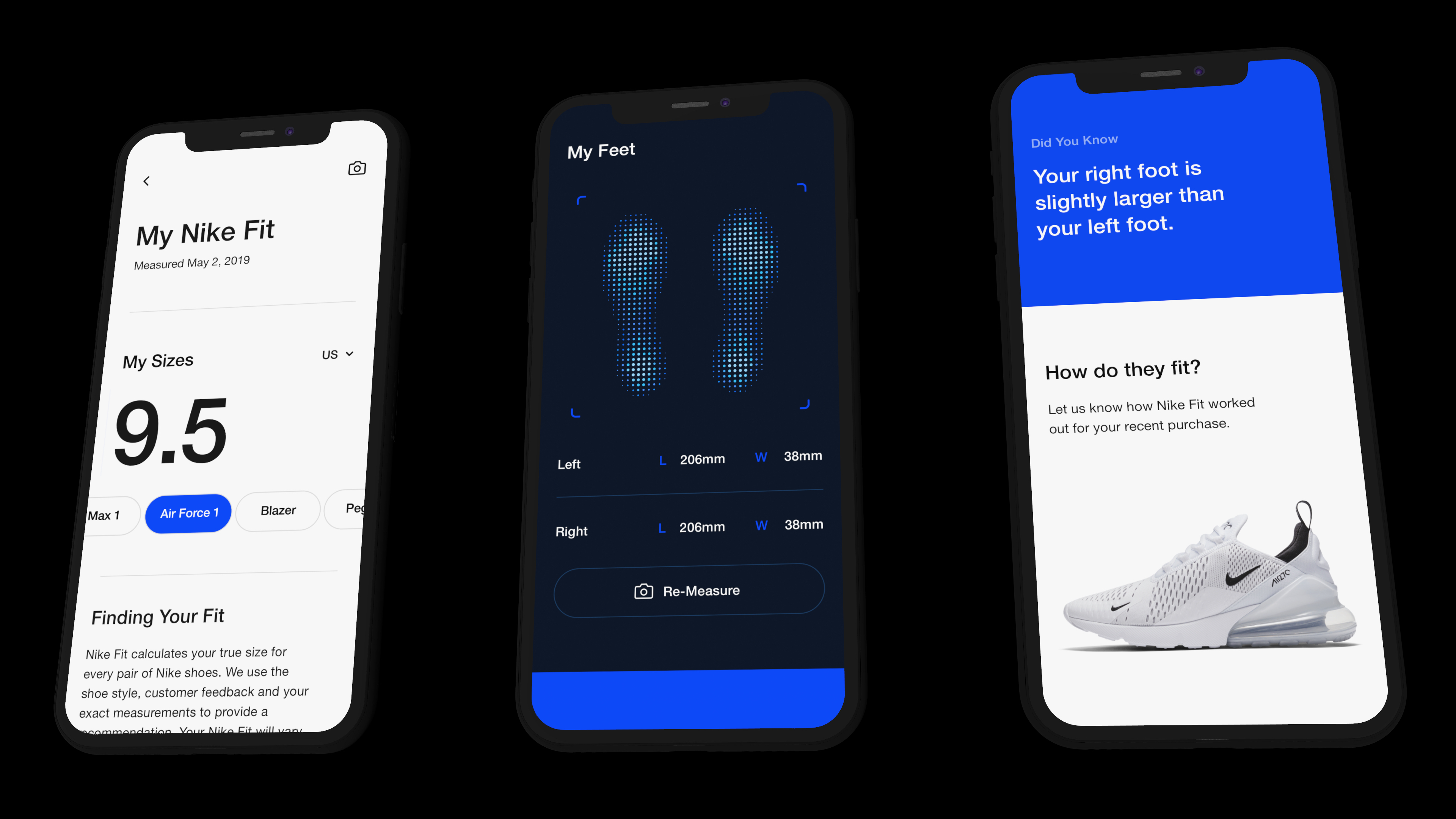
Within the Nike app, I used my phone’s camera to capture an empty space where the floor meets the wall as a point of reference, with the app’s guidance ensuring a level plane. I stood with my heels against the wall I captured as my reference point and pointed the camera down at my feet as if to take a photo. Once my feet were properly aligned with the outline guide within the app, I simply touched the button that looks just like I’m taking a photo.

In seconds, this action scans the feet and collects 13 data points, the best of the 32 points Nike is capable of capturing. Despite all of the data being collected, users will only be offered the length and width measurements, down to the millimeter, of each foot individually.

“Augmented reality is a new type of experience for a lot of consumers and sets a lot of challenges for them,” says Josh Moore, Nike’s vice president of design and user experience. “We’ve been doing a lot of experiments and creating new features in our SNKRS app over the last few years where we really learned a lot about how to use augmented reality successfully. Specifically, we know we have to guide our users through the journey at their own pace so they can comprehend as they go.”

“We’re talking about phones with cameras measuring your feet,” Moore continues. “It’s a new type of experience where you’re using your device, the device’s camera, the 3D space around you, and you’re using your body. There’s no common UX pattern for this.”

The in-store experience differs in a few ways. It wasn’t enough to simply have great technology, it also had to reduce friction within the in-store buying process. The idea is to reduce the amount of time associates spend going back and forth grabbing sizes from the stock room in order to ensure time spent with customers is higher quality and more efficient.

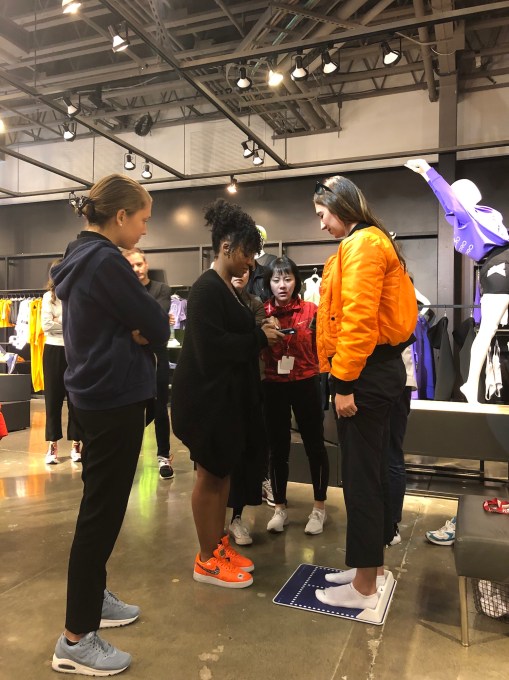
At the Retail Lab on Nike’s campus, I stood on a mat while a Nike sales associate scanned my feet with a handheld iTouch device. With the measurements taken (my right foot is 1 millimeter longer than my left, while my left is 1 millimeter wider than my right), the associate can provide a range of sizes for me, which includes where my best fit could fall in any shoe in Nike’s catalog. Once they look up the shoe I’m interested in, the app will offer the best fit size for my measurements and that shoe. If it’s available, they’ll bring out that size, and if there is any disbelief, they’ll bring out the size you’d like to try, as well.

Trying the Nike Fit experience at the Retail Lab on Nike’s campus

Whether using the app to find the right fit and make a purchase or going into the store, associates and customers can record which size is purchased, as well as other personal preferences around fit.

“Before a shoe arrives onto the market, it will already be trained into the solution. But since the solution encompasses both machine learning and AI, its accuracy out of the gate is astonishing and just gets even better,” says Michael Martin, vice president of Nike direct products, growth and innovation.

With more data, Nike will not only have continual improvements of an individual’s fit preferences, it will also learn the greater population’s preferences around each specific model, offering insight on creating better-fitting shoes. 

In development for just over 12 months, Nike Fit was being tested in three stores — one each in Seattle, Dallas and Pasadena, Calif. — only six months after Nike acquired Israeli startup, Invertex, whose entire mission was to create scans of the human body for better fit customization.

“Fundamentally, at this stage, Nike is a technology company. It’s a technology company that builds upon its historical strengths in footwear design, storytelling and inspiration, and it’s able to use those in combination to solve problems that no one else can solve,” says Martin. “We think this is arguably our biggest solution to date.”

Despite being for footwear right now, the technology created for Nike Fit has the potential to change retail in a lot of ways. One can imagine women being able to use the tech to find the right bra size. It could also make buying denim easier. As individualism and inclusivity have become marketing tools, custom fit seems like a natural next step, but until now, there hasn’t been a clear-cut solution.

Nike Fit will be introduced in select stores in the U.S. and within the Nike app in early July 2019, with Europe to follow later in the summer.

Nike has always had a place in the conversation alongside the likes of Apple when upper echelon branding and storytelling is discussed. With the introduction of Nike Fit, Nike just does it — again.

Let's block ads! (Why?)


https://techcrunch.com/2019/05/09/with-new-fit-technology-nike-calls-itself-a-tech-company/

2019-05-09 11:31:19Z
52780290305999

Stock futures fall as Trump says China 'broke the deal,' fueling trade war worries - CNBC

U.S. stock index futures were lower on Thursday morning after President Donald Trump said China "broke the deal" at a rally Wednesday evening, fueling worries the U.S. and China will be unable to hatch a trade agreement before new tariffs go into effect at midnight.

Futures on the Dow Jones Industrial Average fell about 184 points, indicating a negative open of more than 95 points. The S&P 500 and Nasdaq were also set to open lower. The Dow is down about 540 points and the S&P 500 has lost more than 2% this week after Trump threatened to raise tariffs on more Chinese goods over the weekend.

Shares of Intel fell another 2.4% in premarket on Thursday after sinking nearly 5% in the previous session as the chipmaker said it sees both revenue and earnings per share growing in the "single digit" percentage range over the next three years. BMO downgraded the stock to market perform from outperform on Thursday, saying it sees the stock "treading water at best."

"By the way, you see the tariffs we're doing? Because they broke the deal. They broke the deal," Trump said at a rally in Florida Wednesday evening. "So they're flying in, the vice premier tomorrow is flying in — good man — but they broke the deal. They can't do that, so they'll be paying."

China claimed it will retaliate if the higher levies are imposed. However, the Chinese delegation is still in Washington this week to negotiate a deal. Despite Trump's amped-up rhetoric, the White House claimed on Wednesday China still wants to make a deal, which kept the market temporary afloat.

Thursday is "a pivotal day," said Ed Mills, public policy analyst at Raymond James, in a note. "We believe Chinese officials will be looking to delay Friday's tariff increase in order to continue conversations as to the appropriate level of commitments in key areas. However, the market reaction over the last couple days gives Trump some leeway to maintain an aggressive tone."

Traders will also keep an eye on upcoming data releases. There will be international trade figures, weekly jobless claims, and producer price index numbers out at 8.30 a.m. ET.

In terms of earnings, Softbank, Norwegian Cruise Line, Booking Holdings, Dropbox, and News Corp. will be updating investors throughout the day.

— CNBC's Silvia Amaro contributed to this report.

Let's block ads! (Why?)


https://www.cnbc.com/2019/05/09/stock-market-us-china-trade-tensions-continue.html

2019-05-09 10:58:58Z
CAIiEExOc08xklXHIG-s655X3XYqGQgEKhAIACoHCAow2Nb3CjDivdcCMJ_d7gU

Shares sink as U.S.-China trade talks go to the wire - Investing.com

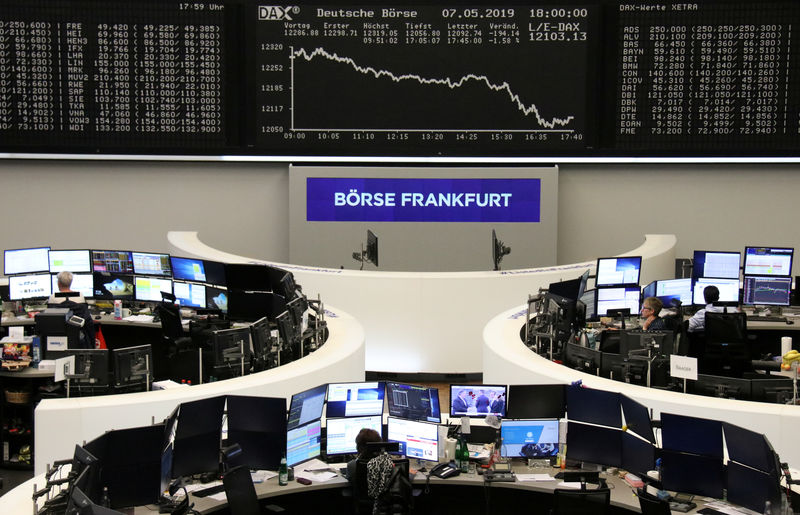
© Reuters. The German share price index DAX graph at the stock exchange in Frankfurt © Reuters. The German share price index DAX graph at the stock exchange in Frankfurt

By Marc Jones

LONDON (Reuters) - World shares tumbled for a fourth day running on Thursday after a warning from U.S. President Donald Trump that a long-worked-on trade deal with China was in serious danger.

Chinese Vice Premier Liu He was heading to Washington for two days of talks but Trump's insistence that China "broke the deal", and then Beijing's response that it would retaliate against tariffs were ratcheting up the stakes.

Europe's main stock markets sank almost immediately after a torrid day for Asia had battered 1.8 percent off China and more than 3 percent off South Korea, which is often seen as the bellwether for how this trade war hits home.

Both countries' currencies were hit too, the won skidding to a more than two-year low and the yuan to a four-month trough, which kept traders buying the traditionally safe Japanese yen and U.S. and German bonds instead.

"Markets remain on edge ahead of the Chinese vice premier’s visit to Washington today," Rabobank analyst Bas van Geffen said.

"Doubt that this tariff increase can be avoided is growing," he added as Goldman Sachs (NYSE:) also put the chance of a hike at 60 percent.

If talks do fall short, Washington has promised to raise tariffs on $200 billion of Chinese goods to 25 percent from 10 percent at 12:01 a.m. ET (0401 GMT) on Friday. For economists, the worry is that it will further slow the global economy.

Kazuhiko Fuji, senior fellow at RIETI, a Japanese government-affiliated think-tank, said the trade talks looked fragile.

"I would suspect the U.S. will just hand China an ultimatum. No wonder the U.S. yield curve is almost inverting again," he said.

The yield spread between three-month U.S. government bonds and the 10-year notes shrank to 3 basis points, compared with about 15 basis points a few weeks ago.

The closely watched spread turned negative in late March, spooking investors, who read the development as portending a recession.

The benchmark stood at 2.4423 percent in Europe, having touched its lowest level in five weeks of 2.426 percent on Wednesday.

Wall Street futures pointed to a 0.85 percent lower start after a choppy previous session had seen the Jones Industrial close fractionally higher but the and Nasdaq drop 0.2 percent and 0.3 percent.

TAXI!

As well as the trade headlines, traders will also be closely watching the pricing on ride-hailing firm Uber's initial public offering, which is set to be the biggest of the year so far.

"In the event of a complete breakdown in talks and higher tariffs, we would expect this to see U.S. stocks trade 10–15 percent below their highs and a fall of around 15–20 percent in the Chinese market," Mark Haefele, global chief investment officer at Global Wealth Management at UBS, said.

In the currency market, the Japanese yen surged to a three-month high of 109.64 yen while China's yuan fell half a percent to hit a four-month low of 6.838 and was headed for its worst four-day decline in a year.

Sterling, meanwhile, tried to brush off signs that Brexit talks between Britain's government and the main opposition party may soon collapse to claw back above the psychologically key $1.30 level.

Commodity markets also felt the U.S.-China trade strains.

futures dropped 0.6 percent to $69.92 a barrel, while U.S. West Texas Intermediate crude also retreated 0.6 percent to $61.75 despite a surprise fall in stockpiles.

Benchmark London hit its lowest in nearly three months, going as low as $6,111 a tonne.

Let's block ads! (Why?)


https://www.investing.com/news/stock-market-news/asian-stocks-tank-on-nearing-tariff-threat-drag-down-europe-1861940

2019-05-09 09:14:00Z
52780290069937

Asian stocks tank on nearing tariff threat, drag down Europe - Investing.com

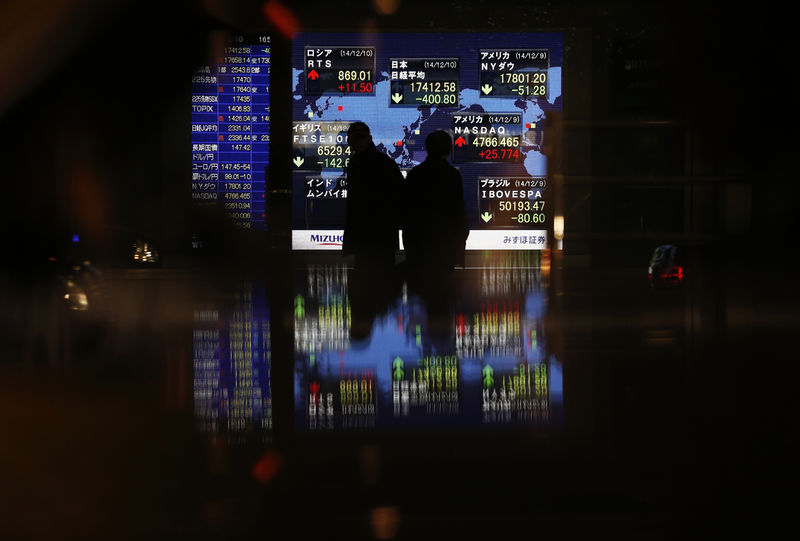
© Reuters. FILE PHOTO: Passersby are silhouetted in front of an electronic board displaying Japan's Nikkei average and various countries' stock price index outside a brokerage in Tokyo © Reuters. FILE PHOTO: Passersby are silhouetted in front of an electronic board displaying Japan's Nikkei average and various countries' stock price index outside a brokerage in Tokyo

By Tomo Uetake and Noah Sin

SYDNEY/HONG KONG (Reuters) - Asian shares fell to eight-week lows on Thursday as investors waited to see whether Chinese and U.S. trade negotiators can salvage a deal to stave off the threat of fresh U.S. tariff increases, which would damage global economic growth.

Chinese Vice Premier Liu He is set for talks in Washington on Thursday and Friday with U.S. officials who have complained that Beijing has backtracked on earlier commitments.

An agreement could avert a sharp increase in U.S. tariffs on Chinese goods that President Donald Trump has threatened to impose on Friday. China has threatened to retaliate, raising the risk of a major escalation in the bruising trade war between the world's two largest economies.

"If Trump's threat becomes reality, it will be a game changer for the global economy. This is the worst-case scenario we modeled last year that resulted in recession conditions in the United States, a rapid reduction of growth in China, and slower global trade," said Steve Cochrane, chief APAC economist at Moody's Analytics in Singapore.

European stocks are set to open lower, with pan-region down 0.5 percent, and German down 0.4 percent, and futures 0.3 percent lower in early trade.

In Asia, MSCI's broadest index of Asia-Pacific shares outside Japan dropped over 1 percent to its lowest level since March 11.

Stocks extended earlier losses in Asian trade after U.S. President Donald Trump told a rally of supporters that China had "broke the deal" and would be paying for it.

The Chinese market tumbled and hovered close to its 2-1/2-month lows. Shanghai shares slid 0.8 percent, the blue-chip CSI 300 dropped 1 percent, and Hong Kong's lost 1.7 percent.

Japan's average shed 0.9 percent to a five-week low, South Korea's fell over 2 percent while the Australian benchmark added 0.5 percent.

Trump has threatened to raise tariffs to 25 percent from 10 percent on $200 billion worth of Chinese imports at 12:01 a.m. ET (0401GMT) on Friday. Beijing has vowed to retaliate, without giving details.

Kazuhiko Fuji, senior fellow at RIETI, a Japanese government affiliated think-tank, said the talks are looking fragile.

"I would suspect the U.S. will just hand China an ultimatum. No wonder the U.S. yield curve is almost inverting again," he said.

The yield spread between three-month bills and the 10-year notes shrank to 3 basis points, compared with about 15 basis points a few weeks ago.

The closely-watched spread turned negative in late March, spooking investors, who read the development as portending a future recession.

The benchmark stood at 2.469 percent, having hit its lowest level in five weeks of 2.426 percent on Wednesday.

Wall Street shares ended a choppy session flat to lower overnight, with the rising marginally, the and the dropping 0.2 percent and 0.3 percent, respectively. ()

In the currency market, sterling weakened on signs that Brexit talks between Britain's government and the main opposition party may soon collapse.

The pound fell below the psychologically key $1.30 level, touching a six-day low overnight, and last traded at $1.3019.

The against a basket of six major peers was down 0.06 percent at 97.561, with other major currencies also confined to well-trodden ranges. The euro was little changed at $1.1194 and the Japanese yen edged up 0.2 percent against the greenback to 109.92 yen .

In the commodity market, oil prices dropped on Thursday amid concerns over the escalating Sino-U.S. trade battle, despite a surprise fall in stockpiles.

futures dropped 0.6 percent to $69.92 a barrel, while U.S. West Texas Intermediate (WTI) crude also retreated 0.6 percent to $61.75 per barrel.

Shanghai industrial metals fell in early trade on Thursday, while benchmark London hit its lowest in nearly three months, as investors sought safety ahead of the trade talks.

Let's block ads! (Why?)


https://www.investing.com/news/stock-market-news/asian-stocks-tank-on-nearing-tariff-threat-drag-down-europe-1861940

2019-05-09 06:11:00Z
52780290069937

Rabu, 08 Mei 2019

Rush-hour Uber and Lyft driver strike was a flop in NYC - New York Post

Ride-hailing strike? What ride-hailing strike?

A driver strike that was planned for the Wednesday morning rush hour against ride-sharing services like Uber and Lyft appeared to be a flop in New York City, as cars appeared plentiful and surge pricing was scarce.

The New York Taxi Workers Alliance had hoped to get the participation of 10,000 drivers between 7 a.m. and 9 a.m. to protest the fact that drivers are getting left out of Uber’s planned initial public offering on Thursday, which is expected to value the company at $90 billion.

But an Uber driver who picked up a Post reporter at 7:30 a.m. in Astoria, Queens, for a trip to Midtown Manhattan claimed he hadn’t heard about the strike, and was unsure he would have participated if he had.

“If it made a difference, I would’ve done it,” said the driver, whose Uber profile identified him as “Stiv.” “But I don’t know what would change for us, IPO or no IPO.”

The driver even opened up his Lyft app to see if prices were surging, but told The Post that it seemed to be an ordinary morning.

Organizers, who also planned strikes in Boston, Washington, DC, and Chicago on Wednesday morning, as well as Los Angeles and San Diego, Calif., had claimed that protesters would be holding banners and leafleting at the Queens entrance of the 59th Street Bridge. But at 7:45 a.m., there was no discernible demonstration.

Bhairavi Desai, executive director of the New York Taxi Workers Alliance, suggested that subsidies from Uber were what kept surge pricing at bay for passengers was told The Post in an email following the two-hour strike that 10,000 drivers “really” did participate. She failed to respond, however, when asked why the strike had no significant effect on service.

“We saw surges for drivers on the Uber App because of the shortage and Uber had publicized it would cut rates for passengers. So if riders didn’t see rates go up, that was part of Uber’s plan,” Desai said in a statement. “We also could see the difference in traffic and the number of cars today ha yesterday for example. We’re not surprised Uber or Lyft would down play the effectiveness or numbers. We know the Strike was a triumph and it’s just the beginning.”

Twitter traffic of the strike’s hashtag, #UberLyftStrike, was low, with many users posting about the strike’s low profile.

“So I was curious about the Uber and Lyft strike impact, it’s surprisingly low!” one user posted. “Looks like many drivers have ‘crossed the picket line.’ Peak hour wait times are roughly normal on both platforms, only 10%-15% yellow cabs are vacant, the streets are still congested.”

Former Taxi and Limousine Commissioner Matt Daus, who now works in transportation law, told The Post that the strike appeared to be “mostly symbolic.”

“It remains to be seen what will happen,” Daus said. “I think if they’re smart, they’ll listen to what the drivers have to say.”

Uber chief executive Dara Khosrowshahi, hired to help guide the company past a series of scandals and manage the IPO, has promised to treat drivers better. Uber is paying more than a million drivers about $300 million in one-time bonuses, for instance, and has changed policies such as allowing riders to tip.

“Whether it’s being able to track your earnings or stronger insurance protections, we’ll continue working to improve the experience for and with drivers,” the company said.

Let's block ads! (Why?)


https://nypost.com/2019/05/08/rush-hour-uber-and-lyft-driver-strike-was-a-flop-in-nyc/

2019-05-08 14:16:00Z
52780287870672