Sabtu, 01 Juni 2019

Justice Dept. Explores Google Antitrust Case - The New York Times

WASHINGTON — The Justice Department is exploring whether to open a case against Google for potential antitrust violations, putting renewed scrutiny on the company amid a growing chorus of criticism about the power of Big Tech, three people with knowledge of the deliberations said Friday.

An investigation into how Google arranges search results could revive a case closed in 2013 by another government agency, the Federal Trade Commission. The five F.T.C. commissioners voted unanimously at the time against bringing charges against the company. Google agreed to make some changes to search practices tied to advertising.

But this year, with a new antitrust task force announced in February, the trade commission renewed its interest in Google. In recent weeks, the commission referred complaints about the company to the Justice Department, which also oversees antitrust regulations, according to two people familiar with the actions. The commission has also told companies and others with complaints against Google to take them to the Justice Department.

The task force had been looking into Google’s advertising practices and influence in the online advertising industry, according to two of the people. One of the people said the agency was also looking into its search practices. Most of Google’s revenue comes from advertisements tied to its search results.

A Justice Department spokesman, Jeremy Edwards, declined to comment, as did representatives for Google and the F.T.C.

The Wall Street Journal earlier reported on the Justice Department’s potential inquiry into Google.

If the Justice Department opens a formal investigation, it will be its first major antitrust case against a big tech company during the Trump administration. Google, Facebook and Amazon have come under intense bipartisan criticism, and calls to break up the firms have become a talking point in the race for the 2020 Democratic presidential nomination.

Political leaders and consumer advocacy groups have criticized American regulators for inaction against tech companies. Google, Amazon and Facebook have faced stiff penalties from a variety of European regulators for antitrust and privacy issues. This year, European regulators fined Google 1.5 billion euros for antitrust violations in the online advertising market, the third antitrust move against the company by European officials in three years.

American regulators have been investigating Facebook’s privacy practices, and the outcome is widely seen as a test of the nation’s ability to police how giant tech firms handle user data. The F.T.C. is negotiating a settlement with Facebook that expected to be as much as $5 billion for failing to protect its users’ data from being used for political profiling by Cambridge Analytica, a British political consulting firm that had worked for President Trump’s presidential campaign.

There has been a wave of new antitrust scrutiny into tech companies in Washington, including a Senate hearing in May on digital advertising that featured accusations that Google engaged in anticompetitive practices.

The call to regulate and scrutinize Big Tech has also become a consistent campaign promise among Democratic presidential candidates, even longtime friends of Silicon Valley such as Senators Cory Booker of New Jersey and Amy Klobuchar of Minnesota. Senator Elizabeth Warren of Massachusetts brought her “Break Up Big Tech” slogan to a billboard in San Francisco this week.

“Today’s big tech companies have too much power — too much power over our economy, our society and our democracy,” Ms. Warren wrote in a blog post on Medium this year.

When the F.T.C. announced the antitrust task force, the agency’s chairman, Joseph J. Simons, said it had been created because technology companies presented new challenges to decades-long regulation of antitrust. Companies like Google and Facebook offer free services and can argue that alternative search and social networks are a click away for consumers. That can complicate arguments that the services harm consumers or stifle competition.

The task force has started to steer complaints about Google to the Justice Department’s antitrust division. The department and the F.T.C. regularly negotiate over who has jurisdiction over antitrust cases, including investigations into competition violations and the review of mergers.

While some of the complaints against Google are years old, there has been a surge of new ones in recent months as concerns over Silicon Valley’s influence and power have grown, according to one of the people with knowledge of deliberations.

Stephen Kaufer, the chief executive of TripAdvisor, a company that has complained about Google’s practices in the past, said he welcomed the new scrutiny on the tech giant.

“TripAdvisor remains concerned about Google’s practices in the U.S., the E.U. and throughout the world,” he said in a statement, referring to the European Union. “For the good of consumers and competition on the internet, we welcome any renewed interest by U.S. regulators into Google’s anticompetitive behavior.”

Let's block ads! (Why?)


https://www.nytimes.com/2019/05/31/business/google-antitrust-justice-department.html

2019-06-01 04:03:30Z
52780307146464

China's retaliatory tariffs hit U.S. goods amid trade standoff - The Globe and Mail

First-quarter stall masks underlying strength in Canada's economy - BNNBloomberg.ca

Canada’s economy stalled for a second straight quarter, but the weak overall performance was driven by falling exports and masked strong gains in household spending and investment that suggest the nation’s expansion is poised to pick up speed.

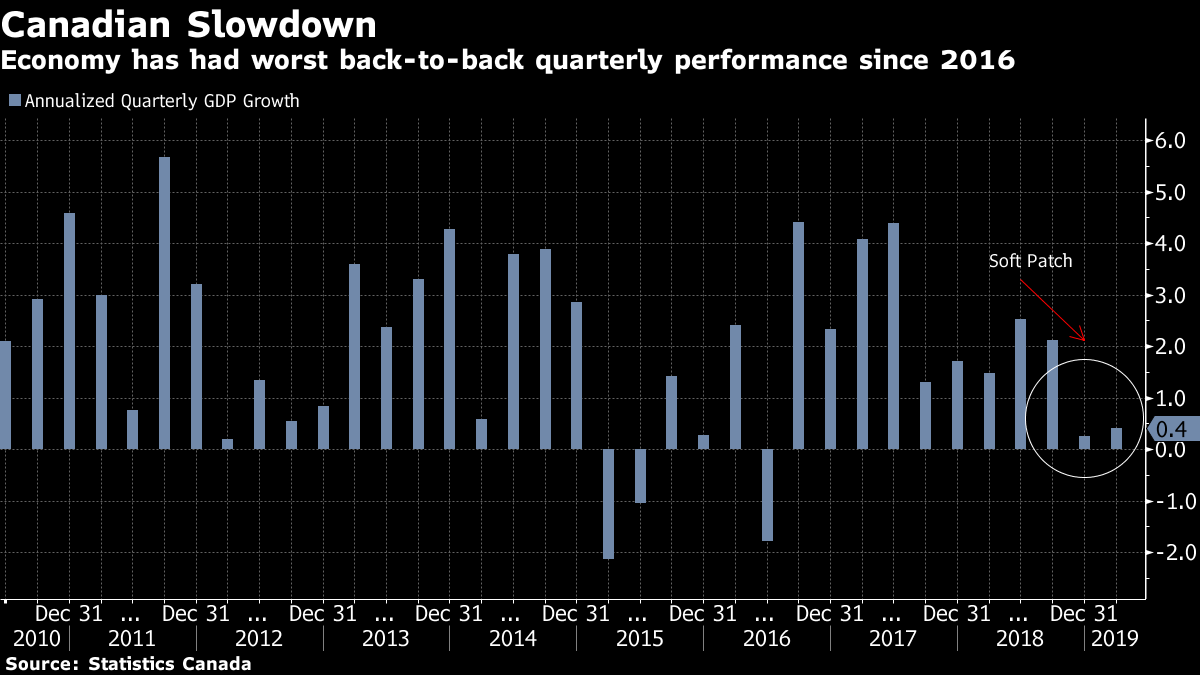
The economy grew by just 0.1 per cent in the first quarter, for an annualized pace of 0.4 per cent, Statistics Canada said Friday from Ottawa. That’s little changed from a 0.1 per cent quarterly (0.3 per cent annualized) reading in the final three months of 2018. Output was dragged lower by the biggest drop in exports in a year and a half.

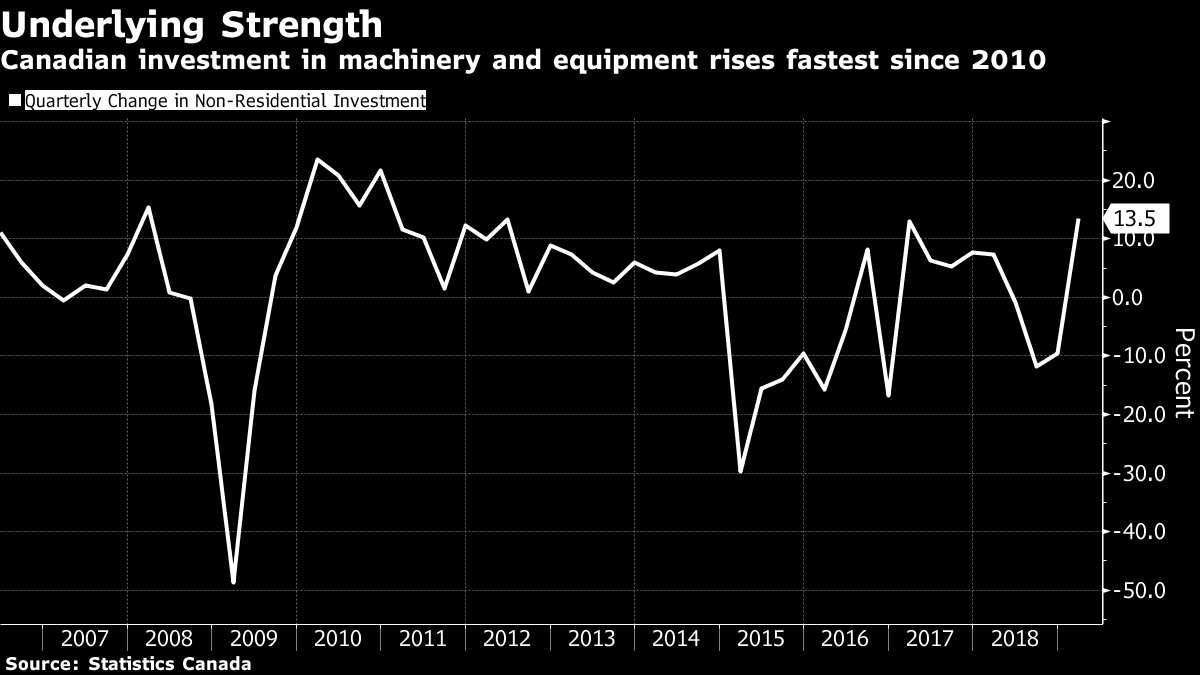
Yet outside of the trade sector the report was strong, with both consumption and business spending making big comebacks. Non-residential investment jumped 13.5 per cent on an annualized basis, the biggest gain since 2010, while spending by households rose at the fastest pace in almost two years. The quarter also ended with a bang, with gross domestic product jumping 0.5 per cent in March, the biggest gain in 10 months.

Embedded Image

The data support the Bank of Canada narrative on underlying strength in the economy despite the recent soft patch and that the slowdown will be temporary, with growth set to accelerate in coming months. The final reading for the first quarter was in line with the central bank’s forecasts, though it came in below economist expectations for annualized growth of 0.7 per cent.

“For Canadian growth, today was a case of out with the bad news, in with the good news,” Avery Shenfeld, chief economist at CIBC World Markets, said in a note to investors.

The Canadian dollar pared loses after the report, but remained down 0.2 per cent to $1.3534 per U.S. dollar at 8:49 a.m. in Toronto trading.

The Bank of Canada forecast growth will accelerate to an annualized 1.3 per cent in the second quarter, and pick up further in the second half of this year, before accelerating back to above 2 per cent growth by 2020.

At the very least, the numbers suggest that heightened uncertainty -- everything from the impact of higher interest rates to potential trade wars and oil-sector woes -- has begun to fade.

There are signs consumers are still spending even amid concerns over bloated debt loads --helped by easing rates on loans, strong job gains, stabilizing housing markets and improving financial markets.

Household spending was up an annualized 3.5 per cent in the quarter, after growing at the slowest pace in almost four years at the end of last year. Business investment was even stronger, after falling for three straight quarters. As a result, domestic demand posted its first gain --3.4 per cent annualized -- for the first time in three quarters.

“When you’re looking at the various components, it’s actually very good results,” Benoit Durocher, senior economist at Desjardins Financial Group in Montreal, said by phone. “You have a rebound in domestic demand which is quite good.”

Canada’s trade sector continues to be a major drag. The decline in the first quarter followed largely flat gains in the previous six months. But even here, trade data reported earlier this month suggested March was much better for exporters -- boding well for the second quarter.

In fact, industry specific data released Friday suggest much of the weakness in the first quarter was confined to energy -- because of curtailed oil production in Alberta -- and construction. The mining and oil and gas sector was down 4.1 per cent in the first quarter, the largest drop since 2016. Construction recorded a 0.5 percent drop in the three-month period. Sixteen of 20 industries saw higher production.

Embedded Image

Other Details

A build-up in inventories was another major contributor to growth, contributing 0.7 percentage points to the change in GDP. The Bank of Canada has cautioned the increase in stockpiles could dampen production in coming months Rising oil prices during the quarter helped generate a much larger gain in real gross national income, which was up 0.9 per cent in the three month period. Housing investment remained soft, dropping 1.6 per cent. One reason for the discrepancy between the gain in domestic demand and GDP is that many of the goods purchased were imported. Import volumes rose 1.9 per cent in the first quarter.


from Business - Latest - Google News http://bit.ly/2XsrAZ6
via IFTTT
May 31, 2019 at 09:03PM

$1.20 raise in B.C. minimum wage takes effect June 1 - CityNews Vancouver

VANCOUVER (NEWS 1130) – Labour groups are welcoming a $1.20 increase to the minimum wage that kicks in on June 1.

The raise will bring B.C.’s $12.65 minimum wage up to $13.85, but not everyone is convinced it goes far enough. The increase will help our province’s lowest paid workers, says Laird Cronk, President of the BC Federation of Labour, but they’ll still be on poverty-level wages.

“It’s still not a living wage. Unfortunately in B.C. the minimum wage is really a poverty wage, but this a trend in the right direction, one of four increases that the Fair Wages Commission has recommended the government over a four year predictable period,” he says. “We need a broader dialogue around how we bridge the gap between minimum wage, which is really a poverty-level wage, and a living wage, where you can meet the necessities of life.”

This is the second of four annual increases that will take place on June 1 of each year, and while he doesn’t think it goes far enough, Cronk says it does help the local economy.

“Folks that have a little bit of an increase in their pocket on this increase and others, they’re not going with offshore investments, they’re not going with tax havens, they’re spending that money in their community so it’s actually good for the economy.”

Ian Tostenson with the BC Restaurant and Food Services Association has concerns about the increase in his industry.

“They don’t make enough profits, restaurants, to sort of absorb that, so you’ve got to either cut costs or you have got increase your prices. And we have seen price increases happen when the last increase came through.”

Tostenson says it could lead to reductions in hiring, with workers expected to do more.

“A restaurant could say to their server instead of you having a section of five tables, we now want you to have a section and manage seven tables. So you could see a slight reduction in hiring or more use of staff in more productive ways.”

He says his members will have tough choices to make.

“We have a restaurant group that has five restaurants and this increase in minimum wage as of June 1 is going to cost their five restaurants about $140,000 on top of the $50,000 they’re already paying with the health tax.”


from Business - Latest - Google News http://bit.ly/2ELgh7e
via IFTTT
May 31, 2019 at 11:17PM

Jumat, 31 Mei 2019

Trump re-opens trade war with Mexico, stocks crumble - CP24 Toronto's Breaking News


Damian J. Troise And Alex Veiga, The Associated Press
Published Friday, May 31, 2019 3:43PM EDT

Stocks tumbled on Wall Street Friday after the U.S. announced plans to expand its trade war to Mexico, its third-biggest trading partner.

The slump all but guarantees the market will end May with its first monthly loss of 2019. The S&P 500 index was on track for its fourth straight weekly decline. The benchmark index has lost about 6.5% this month.

Bond prices rose again, sending yields lower. Oil and gas prices fell sharply.

The new front in the trade war is hitting automakers particularly hard. Many of them import vehicles into the U.S. from Mexico. General Motors and Fiat Chrysler were each down at least 4%.

Technology stocks suffered some of the heaviest losses. They have been hurt the most by escalating rhetoric and tariffs in the U.S. trade war with China. Cisco fell 2.4% and Microsoft slid 1.4%.

Banks also declined as higher bond prices pushed yields lower. Investors have been shifting money into bonds over concerns that economic growth will be crimped by the ongoing trade war. Lower bond yields drag down interest rates, making lending less profitable for banks. Citigroup fell 1.9% and Bank of America lost 1.6%.

Energy companies sank following another broad slide in oil prices. Occidental Petroleum fell 3.8% and Valero Energy dropped 3.4%.

Real estate and utilities fared better than most sectors. They are considered less risky by investors when economic growth is threatened.

Investors have been fleeing to safer holdings all month. The shift to utilities and bonds quickened earlier in May after the U.S. and China broke off negotiations. The U.S. then pushed more tariffs on Chinese goods along with a ban on technology sales. That prompted retaliatory tariffs from China and threats over other key resources.

A smattering of late season earnings reports are also helping to move certain stocks. Williams-Sonoma rose on a solid first quarter financial report while retailer Gap plunged on weak results.

KEEPING SCORE: The S&P 500 index was down 1.2% as of 3:05 p.m. Eastern Time. The Dow Jones Industrial Average fell 308 points, or 1.2%, to 24,861. The Nasdaq slid 1.4% and the Russell 2000 index of smaller companies was 1.3% lower.

Major stock indexes in Europe also fell.

The U.S. stock market's slump in May reversed a four-month run for the S&P 500 that culminated in an all-time high on April 30. The benchmark index is still up about 10% for the year.

ANALYST'S TAKE: The new tariffs on Mexican goods shocked investors who were already nervous about a global trade war crimping economic growth.

“Clearly the markets were blindsided and completely caught off guard,” said Cliff Hodge, director of investments for Cornerstone Wealth.

The major risk, he said, is that continued trade spats could bring on a global recession. Auto companies and agricultural companies will have a harder time passing costs off to consumers. Also, investors are worried about further escalation of global trade spats.

“The fact that the president is willing to use tariffs as a weapon can really cause damage to business confidence,” Hodge said. “You've got to be wondering, who's next?”

TRADE WAR WOES: The new front in the U.S. trade war will have a wide impact on companies making everything from cars to beer and tacos.

General Motors skidded 3.7%, Ford dropped 2.6% and Fiat Chrysler gave up 4.8%. Those companies import vehicles from Mexico to the U.S.

Railroad operators were also getting squeezed. Kansas City Southern fell 4.6%. The company gets almost half its revenue from Mexico each year. Union Pacific shed 1.6%.

Chipotle fell 2.4%. Rising avocado prices could hurt the Mexican restaurant chain. Constellation Brands, which makes Corona and Modelo, dropped 6.1%.

MAYDAY, MAYDAY: May marks the first monthly loss for the market in 2019. That's a sharp shift from stocks' record setting run so far this year. The S&P 500 hit an all-time high on April 30, back when investors had factored in a resolution to Trump's trade wars.

“You had a market that was feeling as though President Trump would want to do a deal so that the economy would not be hurt,” said Tom Martin, senior portfolio manager with Globalt Investments. “And now the behaviour is indicating that he will use (tariffs) to accomplish his goals and seems less concerned about the actual economic impact.”

Since the end of April, investors have fled to safe play holdings like utilities and bonds. Technology stocks, which led gains all year, were among the biggest losers in May. The technology heavy Nasdaq has shed 7.7%, while technology companies within the S&P 500 have lost 8.6%.

Utilities, which have lagged the market, fell only 1.2% in May, making them among the month's best performers. Meanwhile, real estate stocks posted a 1.5% gain, the only winners this month.

STUCK IN A GAP: Clothing and apparel retailer Gap plunged 10.3% after the company gave investors a weak earnings report and slashed its full-year profit forecast.

The disappointing results and estimates come three months after the retailer said it was creating two independent publicly traded companies: low-priced juggernaut Old Navy and a yet-to-be named company that will encompass the iconic Gap brand and Banana Republic, as well as the lesser known names Athleta, Intermix and Hill City.

Overall sales and sales at established stores fell during the quarter. Sales at its namesake Gap stores plunged 10%.

“This quarter was extremely challenging, and we are not at all satisfied with our results,” said Art Peck, president and CEO of Gap in a statement.

CUSHY RESULTS: Williams-Sonoma jumped 12% after the seller of cookware and home furnishings reported surprisingly strong first quarter financial results and raised its profit forecast for the year.

The company also attracted a surge of customers to its stores during the quarter. Sales at established stores rose 3.5%, blowing away Wall Street forecasts of a 1.6% increase.


from Business - Latest - Google News http://bit.ly/2QCFTrN
via IFTTT
June 01, 2019 at 02:43AM

TSX ends worst month of 2019 lower on concerns of economic slowdown, new tariffs - CTV News


Ross Marowits, The Canadian Press
Published Friday, May 31, 2019 12:03AM EDT
Last Updated Friday, May 31, 2019 5:42PM EDT

TORONTO -- Canada's main stock index ended its worst month of the year by falling on growing concerns about an economic slowdown amid U.S. plans to impose tariffs on Mexican imports.

The S&P/TSX composite index closed down 51.75 points on Friday to 16,037.49. That's 1.2 per cent down from a week ago and 3.4 per cent lower in the month of May.

Still, the Toronto market is 12 per cent higher so far in 2019 after a very strong start to the year.

The majority of market watchers would be happy with the year-to-date gain after withstanding December's collapse, says Kevin Headland, senior investment Strategist at Manulife Investments

"Things aren't necessarily bad but they're not as good as perhaps had been hoped and I think that's what the market has reacted to," he said in an interview.

Headland said investors, especially in the United States, reacted very negatively to overnight news from U.S. President Donald Trump that he plans to expand his global trade war by imposing tariffs on all Mexican imports to pressure the country to do more to stop migrants from entering the U.S.

The move also runs the risk of hampering ratification of the revised USMCA trade deal among the U.S., Canada and Mexico, observers have noted.

However, Headland said investor angst goes beyond trade skirmishes with Mexico or China.

"It's not just reacting to another set of tariffs, it's just more indication that there's more pressure on the global economy," he said. "I think it's a read through that things are definitely slowing down."

Data has backed that up. China's manufacturing activity contracted in May while the Canadian economy remained sluggish in the first three months of the year, rising just 0.4 per cent, and giving the weakest back-to-back quarters since 2015.

Investor concerns can be seen in bond yields falling and the yield curve inverting, which heightens concerns about a potential recession.

"Now we're probably seeing the risk of a recession pick up and the recession would likely be in the next 12 to 18 months," he said.

Ongoing weak data could also prompt the Federal Reserve and the Bank of Canada to cut interest rates.

"It's very rare to see rate cuts before recession and perhaps this is a new environment or a less normal environment where perhaps we see rate cuts and we avoid the actual proverbial recession."

Eight of the 11 major sectors of the TSX decreased on Friday, led by health care, energy and financials.

Energy fell 1.14 per cent as the price of crude dropped to its lowest level since February on worries about reduced global demand and higher supplies.

The July crude contract was down US$3.09 at US$53.50 per barrel and the July natural gas contract was down 9.3 cents at US$2.45 per mmBTU.

That's bad for Alberta's oil patch, where Encana Corp. shares lost 4.4 per cent.

The heavyweight financials sector lost more than one per cent with Manulife Financial losing two per cent and Great-West Lifeco Inc. off 1.8 per cent.

Materials led the three sectors that rose, helped by higher metals prices. Barrick Gold shares gained 5.6 per cent.

The August gold contract was up US$18.70 at US$1,311.10 an ounce and the July copper contract was down 1.4 cents at US$2.64 a pound.

The Canadian dollar traded at an average of 73.93 cents US compared with an average of 74.07 cents US on Thursday.

In New York, the Dow Jones industrial average was down 354.84 points at 24,815.04. The S&P 500 index was down 36.80 points at 2,752.06, while the Nasdaq composite was down 114.57 points at 7,453.15.


from Business - Latest - Google News http://bit.ly/2JQTBGW
via IFTTT
June 01, 2019 at 04:42AM

Canada's economy grew at 0.4% pace to start 2019, barely ahead of late 2018 pace - CBC.ca

Canada's economy expanded at an annualized pace of just 0.4 per cent in the first three months of the year, giving the country its weakest back-to-back quarters of growth since 2015.

The real gross domestic product reading for the first quarter followed a revised growth number of just 0.3 per cent in the previous quarter, Statistics Canada said Friday in a new report.

It was the slowest two-quarter stretch of growth since an oil-price plunge caused the economy to shrink over the first half of 2015.

Economists had expected growth at an annualized rate of 0.7 per cent for the first quarter, according to Thomson Reuters Eikon.

The Statistics Canada report said downward pressure on first-quarter growth was driven by weakness in net trade as imports increased 1.9 per cent and export volumes dropped one per cent for their first quarterly decrease since 2017.

Canada also saw a substantial contraction of 9.5 per cent in its exports of farm and fishing products as well as a 2.8 per cent drop in crude-oil shipments.

On the positive side, the agency said overall economic growth was boosted by the highest quarterly level of household spending in two years, following broad-based increases that included strength in auto purchases and audio-visual equipment.

The economy also saw an 8.7 per cent increase in business investments on equipment and machinery — the biggest jolt in 23 years. The surge was fuelled in part by significant investments in aircraft and other transportation equipment, the report said.

Q2 starting off well

Looking ahead, the report's month-to-month reading for March — the final month of the first quarter — suggested the second quarter could be off to a stronger start. March posted a 0.5 per cent increase compared to a 0.2 per cent contraction in February.

The first-quarter reading Friday was slightly higher than the Bank of Canada's prediction of 0.3 per cent.

On Thursday, Carolyn Wilkins, the central bank's senior deputy governor, said the recent economic slowdown was temporary. She said growth has already been accelerating in the second quarter — which the Bank of Canada has predicted will post 1.3 per cent growth.

From there, Wilkins said Canada's economic expansion should pick up its pace throughout the rest of 2019.

Even with the expected domestic improvement, she underlined risks to the outlook. She warned the highly uncertain international trade environment — including the ongoing U.S.-China trade war — poses a threat for Canada.

Wilkins also listed trade disruptions such as Beijing's new restrictions on some Canadian agricultural products. A diplomatic conflict has intensified in recent months, leading China to reject shipments of some key Canadian goods, including canola.

The central bank is also monitoring the possibility of a trade feud between the U.S. and the European Union. U.S. President Donald Trump has threatened to apply tariffs on autos from the EU.


from Business - Latest - Google News http://bit.ly/2QKZMgp
via IFTTT
May 31, 2019 at 08:12PM