Rabu, 05 Juni 2019

Traders bet Bank of Canada will follow Fed with rate cuts this year - Financial Post

The Bank of Canada is likely to join the U.S. Federal Reserve with an interest rate cut this year to deal with the fallout from rising trade tensions, according to trading in the swaps market.

Investors are betting Canadian policymakers will follow an expected U.S. rate cut in September. The chances of a Bank of Canada match at the Oct. 30 meeting jumped above 50 per cent Tuesday, up from about 25 per cent last week, according to data compiled by Bloomberg. The market is implying 20 basis points of easing over the next six months. The odds of a cut soared after U.S. President Donald Trump threatened to impose tariffs on Mexican products to stem illegal immigration, raising concerns about the ratification of the revised North America Free Trade Agreement.

Traders are increasing their bets on a rate cut even as economic data signal the economy is showing signs of pulling out of a first-quarter slowdown. The median consensus of analysts expect that the benchmark rate will remain unchanged this year at 1.75 per cent.

“The data for Canada is unfolding in a manner about as expected, but the medium-term outlook has definitely been impacted by trade/tariff developments of late,” said Mark Chandler, head of fixed income research at Royal Bank of Canada, which sees the central bank on hold through 2020. “Most of the fear surrounds the potential impact on the U.S. factory sector. Analysts have not fully incorporated this into their forecasts, I believe, because of a belief that the tariffs may yet be avoided.”

Federal Reserve Chairman Jerome Powell signaled Tuesday an openness to cut interest rates if necessary, pledging to keep a close watch on fallout from a deepening set of disputes between the U.S. and its largest trading partners. Investors have aggressively increased bets the Fed will cut interest rates this year after Trump widened ongoing trade tensions with the new Mexico threat.

In the U.S., swap traders assign an 89 per cent chance of the Fed cutting rates as soon as September, Bloomberg data show. Investors may get fresh signals on rates this weekend when finance ministers and central bankers from the Group of 20 economies meet in Japan.

“We should get more clarity on both Mexico and China, at the G-20,” said Chandler. If over the coming weeks there is “no improvement, you might see more analysts believing that rate cuts in the U.S. — and maybe Canada — are more likely.”

Bank of Canada Governor Stephen Poloz said as recently as last month he still believes interest rates are poised to continue rising once headwinds to growth dissipate. “The natural tendency is for interest rates to still go up a bit,” Poloz said in an interview on BNN Bloomberg, adding he didn’t yet know the size or the timing of any increases.

Bloomberg.com


from Business - Latest - Google News http://bit.ly/2WJq3AN
via IFTTT
June 05, 2019 at 03:04AM

Another Merger for Chrysler? Here We Go Again - Ward's Auto

The FCA proposal to merge with Groupe Renault has me worried. My worry is purely selfish. I live in southeast Michigan, and I fear this merger is going to hurt the region I live in.

Tens of thousands of employees of the former Chrysler – renamed FCA U.S. in 2014 – live in my backyard. There are 15,000 employees at its world headquarters and technology center in Auburn Hills, alone; there are thousands more in manufacturing and assembly plants in Sterling Heights, Warren, Trenton, and of course, Detroit.

The proposed FCA-Renault merger will be a completely European affair, and there will be no American voice in the ownership of the new structure, even though Chrysler generates most of the profits.

FCA and Renault are in trouble in Europe. Their manufacturing plants operate well below their break-even point and their profit margins are insufficient to keep feeding the voracious capital-expenditure beast. They need to eliminate excess manufacturing capacity, consolidate powertrains and platforms and gain more purchasing scale.

The two companies claim no one will lose their job with this merger, but they can’t make that promise for the long term. And when they start to look for “synergies and efficiencies,” they’re going to be mighty tempted to cut jobs in North America because cutting jobs in Europe will not be tolerated.

Remember, Renault is partly owned by the French government, and even though its ownership will be diluted if the merger goes through, it only has one goal for Renault: Generate more tax revenue and jobs in France. It’s a key reason why Nissan is so uncomfortable with the so-called Renault-Nissan-Mitsubishi “alliance.”

Fiat’s capacity problem in Europe has eased somewhat but only by building fewer Fiats in Italy and making Jeeps there instead. And more Jeep models are on the way. The city of Detroit is extremely lucky that FCA already announced it will build a new plant there to make Jeeps, because with an FCA-Renault merger, there will be enormous pressure to create manufacturing jobs in Europe, not in Detroit.

When Sergio Marchionne wrote his famous 2015 “Confessions of a Capital Junkie” presentation, one of the most promising areas he saw for cutting costs was eliminating all the overlap in powertrains. Every automaker makes engines with similar displacements and horsepower. They make transmissions that are the same size with the same number of gears. Sergio knew he could save billions by teaming up with a partner and eliminating all that overlap.

FCA and Renault will want the same savings, but I worry that will come from eliminating powertrain engineers in the U.S. And I worry that it won’t stop there. Finance, human resources, purchasing, and every other corporate function you can think of will be in danger of being downsized, because again, job cuts will not be tolerated in Europe.

The Dodge and Chrysler brands also could be on the chopping block. None of FCA’s plans ever mentions them. Instead, FCA gushes about the potential for Alfa Romeo and Maserati, even though sales and profits are plunging at Maserati, and Alfa has come nowhere near its promised potential. The only thing that’s going to fix them is more investment, and the Dodge and Chrysler brands that represent iconic Detroit muscle cars and minivans likely could be starved to free up the money.

Poor Chrysler. The famous “merger of equals” with Daimler turned out to be nothing of the sort. Its experience with Cerberus was a disaster. Thankfully, Fiat’s ownership of Chrysler has seen a near-miraculous turnaround. But make no mistake, they both needed each other. Without Chrysler’s incredibly profitable pickups and Jeeps, Fiat would have gone bankrupt.

Look, I have no problem with FCA wanting to merge with another automaker. There’s no choice, it must. And I recognize that cuts will need to be made. I’m just worried that it’s the U.S. side of the operation that will carry the brunt of any cost cutting. And I’m worried from a purely selfish standpoint.

John McElroyJohn McElroy is editorial director of Blue Sky Productions and producer of “Autoline Detroit” for WTVS-Channel 56, Detroit.


from Business - Latest - Google News http://bit.ly/2QH4xau
via IFTTT
June 04, 2019 at 01:18PM

Canfor to permanently close Vavenby sawmill - CBC.ca

US SEC sues Canada's Kik over US$100M ICO, sees Kin as a security - BNNBloomberg.ca

The U.S. Securities and Exchange Commission sued Kik Interactive Inc. for illegally raising US$100 million through a 2017 digital-token sale, in one of its highest profile cases targeting a company for not registering an offering with the regulator.

After losing money for years on its sole product, an online-messaging application, Kik raised more than US$55 million from U.S. investors by selling a digital token called Kin without the proper disclosures, the SEC said in a Tuesday court filing. The agency is seeking unspecified monetary penalties.

“Companies do not face a binary choice between innovation and compliance with the federal securities laws,” said Steven Peikin, co-head of the SEC’s enforcement division.

Kik was among the biggest initial coin offerings in the past two years and has prominent backers. Venture capitalist Fred Wilson defended the Kin digital currency in a blog post, saying it is not a security.

Kin recently launched a crowdfunding site called DefendCrypto.org to raise money to fight back against an SEC investigation into the firm, and the agency’s broader crackdown on ICOs. On the site, Kin says it has raised US$4.8 million to resist SEC actions “that set a dangerous precedent and stifle innovation.”

An attorney for Kik didn’t immediately respond to a request for comment.

The SEC has been sounding the alarm over ICOs for years, arguing that the sales are likely securities that must comply with federal rules. The regulator has warned individual investors of the risks in buying the tokens, cautioning that scammers might be using them to lure investors into frauds.

In late 2016 and early 2017, “Kik faced a crisis,” according to the SEC filing. “Fewer and fewer people were using Kik Messenger. The company expected to run out of cash to fund its operations by the end of 2017, but its revenues were insignificant.”

Then the company decided to do an ICO, in what a board member called “a hail Mary pass,” according to the filing. Its Kin token currently trades at less than a third where it did when the cryptocurrency first began trading, according to CoinMarketCap.com.

Many in the cryptocurrency community believe the case could help clarify when a token will be considered a security and subject to SEC regulations.


from Business - Latest - Google News http://bit.ly/2Wfln1e
via IFTTT
June 05, 2019 at 12:27AM

From Amazon To Walmart, 2020 Candidates Take On Big Corporations By Name - NPR

Democratic presidential candidate Sen. Bernie Sanders speaks during a 2015 rally to push for a raise to the minimum wage to $15 an hour. Andrew Harnik/AP hide caption

toggle caption
Andrew Harnik/AP

Bernie Sanders may not have his usual adoring crowds at his Wednesday campaign stop. That's because he'll be speaking to Walmart shareholders at their annual meeting.

The Vermont senator and 2020 Democratic presidential candidate will present a proposal aimed at giving workers representation on the company's board, echoing a policy he is reportedly working on. (Elizabeth Warren has released a similar policy.)

On Tuesday afternoon, Sanders released a statement criticizing Walmart for issues beyond worker representation on the board.

"It is time for Walmart to pay all of its workers a living wage, give them a seat at the table, stop blocking them from joining a union and allow part-time employees to work full-time jobs," he said.

It's not just Sanders; this is an example of a tactic that has gained traction in the 2020 presidential race, of candidates calling out specific companies in their campaigning and their policies.

Sanders is presenting the resolution on behalf of Cat Davis, a Walmart worker and shareholder, and a leader of the group United for Respect, which aims to protect workers' rights at large corporations.

The proposal would require that the board include hourly associates on its lists of potential new members. Sanders will have three minutes to present the resolution, and it will be put to a vote on Wednesday. The resolution is not expected to pass.

Candidates vs. corporations

Sanders in 2018 already took aim at Walmart with the Stop WALMART Act — "WALMART" here standing for "Welfare for Any Large Monopoly Amassing Revenue from Taxpayers." That bill would have stopped large employers from undertaking stock buybacks unless they take particular steps to boost workers, like paying them at least $15 an hour.

He's introduced another bill with a pointed acronym, the Stop BEZOS Act (That is, "Stop Bad Employers by Zeroing Out Subsidies") — a title aimed at Amazon CEO Jeff Bezos. That bill would tax large employers for the social safety net programs, like food stamps, that their workers use.

Technology firms have also come under scrutiny among candidates, as they are under scrutiny on Capitol Hill. Sen. Elizabeth Warren, D-Mass., in March released a plan to break up big tech companies, with the aim of allowing smaller companies to thrive. In her unveiling, she called out particular companies by name.

"My administration will make big, structural changes to the tech sector to promote more competition — including breaking up Amazon, Facebook, and Google," Warren wrote in a March Medium post. Since then, Sanders and Hawaii Rep. Tulsi Gabbard have voiced support for her plan.

In addition, strikes at the grocery store chain Stop and Shop drew support from candidates including Warren, South Bend Mayor Pete Buttigieg, Minnesota Sen. Amy Klobuchar and former Vice President Joe Biden. Similarly, strikes at McDonald's restaurants have drawn support from multiple candidates.

Rising populism on display

Democratic candidates did take aim at corporations in the 2016 campaign — Bernie Sanders took aim at McDonald's for its wages. Both he and Hillary Clinton did join striking Verizon workers in 2016.

"We were always struggling with, 'How do you make policy tangible?'" said Amanda Renteria, political director for the 2016 Clinton campaign. "And that's a really easy way to do so. People know what Walmart is. People have a conception about it."

But Clinton rarely referenced specific companies negatively on the 2016 campaign trail.

"That really wasn't her style," said Renteria.

It's a tactic that relatively few major candidates have made central to their campaigns in recent years. But the willingness to aggressively call out big companies was arguably long in coming.

"I feel like the political moment we're in is really an outgrowth of really the worker militancy that started in 2012, 2013," said Joseph Geevarghese, executive director of Our Revolution, an advocacy group that grew out of Sanders' 2016 presidential run.

He's talking about walkouts among fast food workers and other low-wage workers that took place in those years (at the time, he was at worker-advocacy group Good Jobs Nation).

Those walkouts themselves had a variety of even older potential causes, he added – long-building inequality; a long, slow recovery from the Great Recession; and the subsequent Occupy Movement, for example.

But whatever the path, the culmination is a political atmosphere where anger is a dominant emotion — and something President Trump has modeled, as well as liberal figures.

"We have been in a populist moment over the last six, seven years," Geevarghese said. "I think Occupy, the strike wave, those are all symbols of that. But I also think Donald Trump is a symbol of the populist wave, at least when it comes to his willingness to go after companies like GM, companies like Carrier."

For her part, Renteria credits Sanders and Warren with having popularized tough anti-corporate rhetoric as a campaign strategy. But she also cautions that it might not work for everyone.

"For somebody like Elizabeth Warren, she has been in this space since the beginning of her career, and so for her it's just validating her brand," Renteria said.

That means calling out Amazon or Walmart seems authentic for candidates like Sanders, Warren and Trump. It might not have for a candidate like Hillary Clinton, and could be a stretch for other Democrats running in 2020.

"I think if other candidates were to take a look at this and go, 'Wow, I can do it too. It makes whatever policy I'm working on more concrete,' that could backfire," Renteria said.

In addition, there's the simple possibility that this kind of rhetoric could create powerful corporate enemies for a candidate at a time when unlimited money is pouring into the coffers of superPACs.

But then, an event like the Walmart shareholders' meeting does allow a candidate to have a media moment that an ordinary policy release might not create. And that's particularly important in a field of about two dozen candidates.

Walmart is one of NPR's financial sponsors.

Let's block ads! (Why?)


https://www.npr.org/2019/06/05/729735727/from-amazon-to-walmart-2020-candidates-take-on-big-corporations-by-name

2019-06-05 10:50:36Z
52780309120907

Markets are urging the Fed to cut interest rates. Will it listen? - Fox Business

Wall Street traders are increasingly betting on the odds of an interest rate cut by the Federal Reserve this year – and on Tuesday, Chairman Jerome Powell hinted policymakers at the U.S. central bank could respond to the recent escalation in the U.S.-China trade war by lowering rates.

Continue Reading Below

U.S. stocks celebrated the news, with the Dow Jones Industrial Average jumping over 500 points.

TickerSecurityLastChange%Chg
I:DJIDOW JONES AVERAGES25332.18+512.40+2.06%
SP500S&P 5002803.27+58.82+2.14%
I:COMPNASDAQ COMPOSITE INDEX7527.116741+194.10+2.65%

Powell, during a listening event in Chicago on Tuesday, said the Fed is closely watching how global trade developments will impact the U.S. economy, noting that policymakers were prepared to act as necessary to sustain near-record expansion.

MORE FROM FOXBUSINESS.COM...

“We do not know how or when these issues will be resolved,” he said. “We are closely monitoring the implications of these developments for the U.S. economic outlook.”

The CME’s FedWatch Tool, which analyzes the probability of rate moves for upcoming Fed meetings, is currently predicting a 55.9 percent chance of a rate cut in July, with 49.7 percent of traders anticipating the benchmark federal funds rate will be moved into the 2 percent to 2.25 percent range. Only 13.6 percent of traders think interest rates will remain at the current range of 2.25 percent to 2.5 percent by September.

And last week, when the bond curve inverted – meaning the yield on the 10-month Treasury bill interest rate fell below the yield on the 10-year-treasury note, a common foreshadowing of an impending recession – the market sent a strong message to the Fed that interest rates were too tight.

“That is a very clear message that the bond market believes interest rates are too high,” Tom Essaye, the founder of Sevens Report Research, told FOX Business. “We haven’t seen that in a decade, probably more. The Fed is ignoring that, and they have their reason, but if it doesn’t change soon, they’re going to have to factor that in. And then the question becomes, have they waited too long? Are we already headed for trouble?”

It’s not only Powell who’s made a dovish pivot in recent weeks.

CLICK HERE TO GET THE FOX BUSINESS APP

James Bullard, the Federal Reserve Bank of St. Louis President, suggested on Monday that the central bank may need to cut rates due to muted inflation, the inverted yield curve and ongoing uncertainty about trade.

U.S. inflation picked up in April after a weak start to the year, but at 1.5 percent, remains well below the Fed’s preferred target of 2 percent, spurring rate cut talks.

Bullard is a voting member of the FOMC committee this year.

“A downward policy rate adjustment may be warranted soon to help re-center inflation and inflation expectations at target and also to provide some insurance in case of a sharper-than-expected slowdown,” he said.

Despite all the fanfare around a looming rate cut, Bank of America CEO Brian Moynihan isn't buying in. “I don’t think they will unless something goes really wrong in the trade, I think the economy is stronger than people think,” Moynihan said during a discussion with FOX Business' Maria Bartiromo at the Economic Club of New York on Tuesday.

Let's block ads! (Why?)


https://www.foxbusiness.com/economy/markets-federal-reserve-cut-interest-rates

2019-06-05 10:08:32Z
52780307955932

Questions loom over Fed efforts to make sure the 'roof isn't leaking' - Yahoo Finance

The Federal Reserve is listening carefully for recommendations on better achieving its dual mandate of maximum employment and price stability, but expectations are tempered for what the Fed may ultimately do at the conclusion of its review process.

At a conference in Chicago, Fed officials heard from academics and other stakeholders with no shortage of ideas on how to best tweak the central bank’s monetary policy strategies. The review covered a lot of ground: from the way the central bank aims at its 2% inflation target, the metrics that it uses when evaluating maximum employment, and the available toolbox of “unconventional” policies during the next crisis.

“When things are strong is when you really need to make sure your roof isn’t leaking,” University of Michigan professor of public policy Susan Collins told Yahoo Finance on Tuesday. “This public conference is partly about that.”

Although it appears that a lot of changes are on the table, some say the Fed may ultimately end up on nothing more than some slight tweaks to its current monetary policy framework.

Average-inflation targeting

In particular focus is the Fed’s approach to inflation, where the central bank has persistently undershot the 2% inflation target that it adopted in 2012. Since then, readings of core personal consumption expenditures (the Fed’s preferred reading of inflation), have only touched or breached 2% once.

Policymakers have proposed variations of dynamic inflation targeting, ranging from a “nominal GDP targeting” strategy that targets spending levels to a temporary price-level targeting that allows the Fed to overshoot inflation when interest rates are near-zero.

Yet the expectation is that the Fed will ultimately land on something less radical: an average-inflation targeting scheme where the Fed would state its intention to aim for inflation above 2% to compensate for periods when inflation is below 2%.

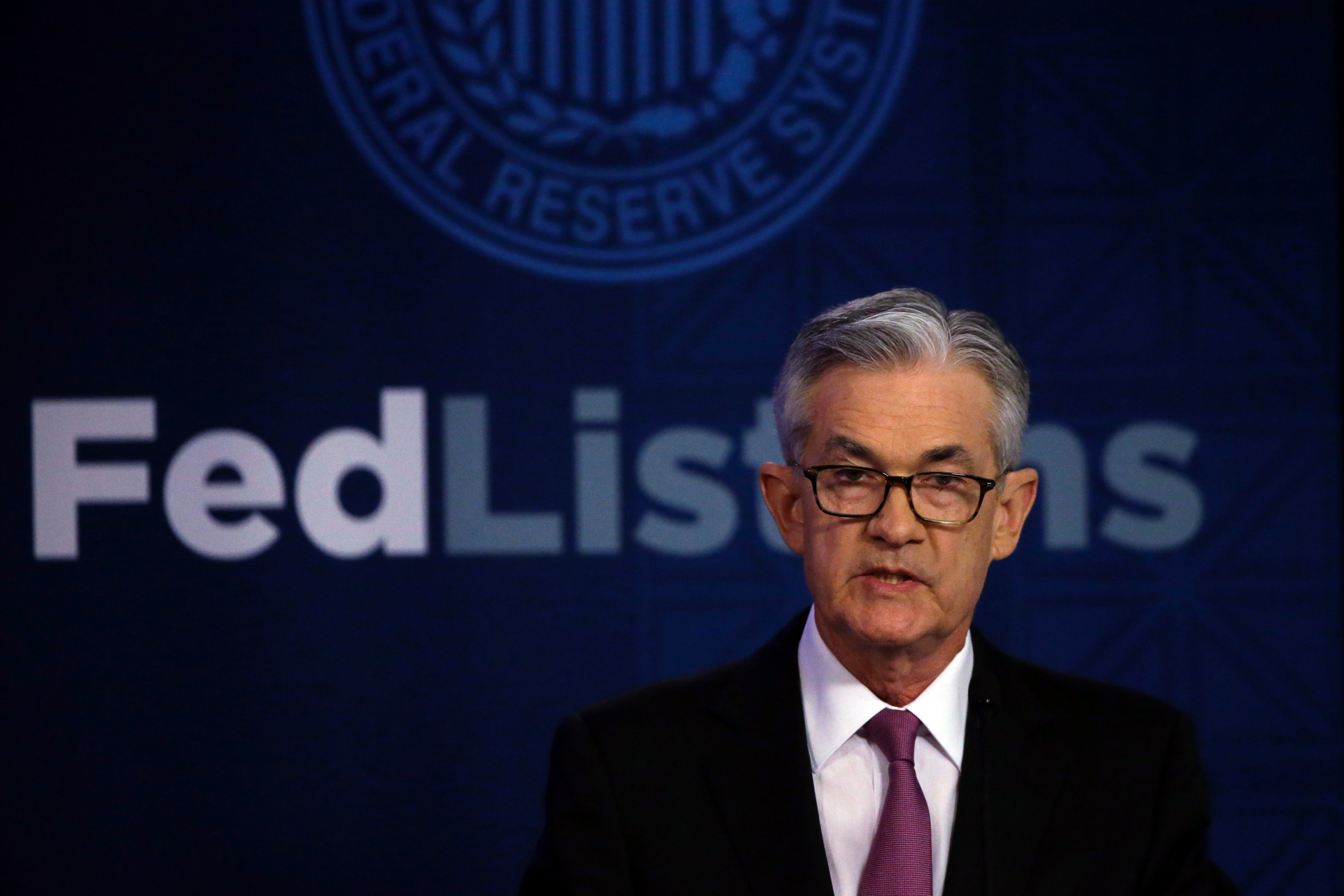
Jerome Powell, Chair, Board of Governors of the Federal Reserve speaks during a conference at the Federal Reserve Bank of Chicago on June 04, 2019 in Chicago, Illinois. The conference was held to discuss monetary policy strategy, tools and communication practices. (Photo by Scott Olson/Getty Images)

“Ultimately, our sense is that this conference will generate a considerable amount of headlines, but the likeliest tangible impact will be a fuller consideration of a shift to average-inflation targeting,” Compass Point’s Isaac Boltansky wrote in a conference preview note on June 3.

For his part, Powell has lowered expectations for the degree of expected change out of this review, saying in March that the process will more likely produce “evolution rather than revolution.”

Deutsche Bank wrote May 30 that they would characterize the review as “refining, rather than reinventing the wheel.” They are even more skeptical of a change in approach to inflation than Boltansky, writing that they do not believe the Fed will make any explicit commitment to make-up for a shortfall of inflation.

Being ‘bolder’ on inflation could be helpful

Collins said that while the Fed is listening to a wide variety of views, a lot of potentially helpful changes have been taken off the table.

One example: raising the 2% inflation target.

Some have criticized the 2% target for being arbitrary, sparking worries that the Fed may have given itself too little room on prices without providing proof for why 2% is the magic number.

“Some of us think that being a little bolder there would be helpful,” Collins told Yahoo Finance. But Collins said the Fed tends to stay away from making dramatic changes outside of crises, when it is forced to do so.

One paper presented at the conference suggested a 3% inflation target, for example. But the Fed has made it clear that it is going to keep its 2% target, and instead tweak its methodology for getting to that target.

The conference hosted a number of other papers, some with more modest suggestions and others with more dramatic proposals for change. For example, a discussion on Fed communications included a recommendation from University of California, Berkeley Professor Jón Steinsson to simply add a link to the Fed’s yearly statement on longer-run goals to its regular policysetting meeting statements to remind market participants that the Fed thinks beyond the short-run. Yet another paper on maximum employment from University of Maryland professors Katharine Abraham and John Haltiwanger challenged the Fed to come up with a whole new way to measuring the labor market beyond the currently available unemployment and unemployment gap statistics.

Modifying the dot plots

In question is also the Fed’s dot plots, which project the policymakers’ estimates for where the federal funds rate will be in the future. Although Powell has criticized the dot plots for being a “source of confusion” to markets at times, discussants at the conference Tuesday appeared to advocate for keeping them but making modifications to the way the Fed shares them.

paper from Brandeis’s Stephen Cecchetti and New York University’s Kermit Schoenholtz recommended that the Fed release a “matrix” that links projections for growth, unemployment, inflation, and interest rates to each FOMC participant.

Some in the room worry that such a disclosure would push the public to place too much emphasis on the Fed chair’s plot points.

Deutsche wrote that the dot plot is “unlikely to be eliminated,” writing that if the central bank does end up near zero interest rates again, it will need the plots again to offer forward guidance to the public.

In the mean time, the Fed is still working its way through its “Fed Listens” tour, which involves conferences across the country.

The Fed has said it will announce the findings of its review in the first half of 2020.

Brian Cheung is a reporter covering the banking industry and the intersection of finance and policy for Yahoo Finance. You can follow him on Twitter @bcheungz.

Read the latest financial and business news from Yahoo Finance

Follow Yahoo Finance on Twitter, Facebook, Instagram, Flipboard, SmartNews,LinkedIn, YouTube, and reddit.

Let's block ads! (Why?)


https://finance.yahoo.com/news/fed-conference-chicago-monetary-policy-framework-092419489.html

2019-06-05 09:24:00Z
52780307955932