Selasa, 02 Juli 2019

Trump says US 'winning' trade war after reviving China talks - BNNBloomberg.ca

President Donald Trump declared the U.S. was "winning" the trade war a day after reaching a temporary truce with Chinese President Xi Jinping.

On a visit to South Korea following the Group of 20 summit in Japan, Trump said at a news conference that the Federal Reserve "has not been of help to us at all" in his trade spat with Beijing.

"Despite that, we’re winning, and we’re winning big because we have created an economy that is second to none," he said.

The White House has yet to reveal details of Trump’s arrangement with Xi, leaving uncertainty about how the two countries will proceed. Trump said after the G-20 meeting that he would hold off indefinitely on tariffs planned for an additional US$300 billion in Chinese imports while allowing U.S. companies to continue to do some business with China’s Huawei Technologies Co., one of the country’s most prominent firms.

‘Catastrophic Mistake’

The move drew criticism back home, where many members of Congress agreed with the administration’s assessment that Huawei is a threat to national security and don’t want the company treated as a bargaining chip. The Commerce Department in May moved to place Huawei on a blacklist that would cut it off from American suppliers.

U.S. officials have alleged the company’s products could be utilized for espionage by Beijing, a claim Huawei denies.

"If President Trump has agreed to reverse recent sanctions against #Huawei he has made a catastrophic mistake," Senator Marco Rubio, a Florida Republican, said in a tweet.

In addition to agreeing to re-start talks, Trump said Xi had also agreed that China would buy large amounts of U.S. agricultural goods. But Chinese official media reports said only that Trump hopes China will import more American goods as part of the trade-war truce.

Trump offered no further visibility into his agreement with Xi during both a scheduled meeting on Sunday with South Korean President Moon Jae-in and a surprise summit with North Korean leader Kim Jong Un at the Demilitarized Zone dividing the Korean Peninsula.

"We are where we are," he said at a news conference with Moon when asked about China. "We’re collecting 25 per cent on US$250 billion, and China is paying for it, as you know, because, as you notice, our inflation hasn’t gone up."

Yuan Devaluation

The president has repeatedly insisted that China bears the cost of the tariffs he’s imposed on its exports to the U.S., rejecting the consensus of economists that the taxes are paid by American companies and consumers in the form of higher prices.

"China has devalued their currency in order to pay for the tariffs," he said. The yuan has declined against the dollar in the last year, helping offset some of the impact of Trump’s tariffs, but Chinese officials have said the devaluation is the result of market forces.

The U.S. Treasury Department under Trump has refrained from accusing China of artificially manipulating its currency.

"And in addition to devaluing, they’ve also pumped a lot of money into their economic model," Trump said. "They’ve been pumping money in. We haven’t. We’ve been retracting. We’ve been raising interest rates and they’ve been lowering interest rates."

Trump frequently complains about the Federal Reserve and its chairman he appointed, Jerome Powell, for raising interest rates in 2018. The central bank indicated after policy meetings earlier this month that it may consider reducing rates later this year if the economy softens.

"We’re not playing on a fair field," Trump said.


from Business - Latest - Google News https://ift.tt/2J3NSfc
via IFTTT
June 30, 2019 at 07:00PM

Chinese stocks are doing something they haven't done in 20 years - CNBC

Investors may be getting a prime chance to play China.

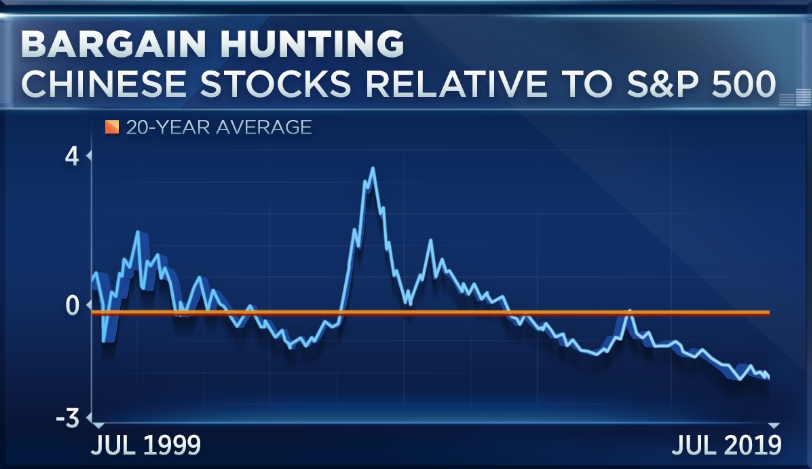
That's at least according to KraneShares investment chief Brendan Ahern, who says that despite Monday's rally in U.S. equities, which took the S&P 500 to a new all-time high after the U.S. and China agreed to a trade truce, Chinese stocks are still looking fairly cheap.

"The truce that was struck over the weekend provides the opportunity for professional investors to come back into Chinese stocks," Ahern said Monday on CNBC's "ETF Edge." "The trade war ... overhang has depressed Chinese equities, and we believe that going forward, the truce provides a great entry point, a great opportunity for investors due to the depressed valuations on both a historical and relative basis."

In fact, on a price-to-book-value basis, Chinese stocks are the cheapest they've been relative to the S&P 500 in 20 years, said Ahern, whose firm operates 16 China-focused ETFs with $2.5 billion assets under management.

Price-to-book-value comparisons stack the underlying company's book value, or the value of all of its hard assets, against its trading price.

But that relatively poor performance is signaling that there could be improvement among Chinese stocks in the near term, Ahern said, adding that he could see them rallying back up to their March highs.

"The overhang of the trade war has kept the Chinese internet and e-commerce companies, the companies that are the transmission for domestic consumption in China, ... down," he said, pointing to KraneShares' CSI China Internet ETF, a popular fund that tracks shares of companies including Tencent and Alibaba.

"We really love KWEB today," he said as the ETF rallied over 2%. "Look at the non-manufacturing [purchasing managers' index] we got overnight. It's still in expansion territory. Retail sales in the month of May was up over 8%. The earnings of the companies we saw from our portfolio, very, very strong. The Chinese consumer is alive and well, we've just had the overhang of the trade war. If that dissipates, I think these names [and] KWEB can go on a run here."

Mary Ann Bartels, Bank of America-Merrill Lynch's head of ETF strategy, said that while she understands Ahern's optimism, her outlook for the U.S.-China trade debacle wasn't as bullish in the near term.

"We've kind of had some data come out of China, some green shoots, just like Brendan mentioned, that are actually positive," she said in the same "ETF Edge" interview. "When you do look at not only China, but emerging markets, they're really at extreme, depressed valuations."

But "we aren't expecting a trade negotiation anytime soon," Bartels said. "We think this is going to be long and drawn out. But for those investors that can take a very long time horizon and withstand volatility, taking a look at the emerging markets, which would include China, might be appropriate."

The iShares China Large-Cap ETF gained over 1% in Monday's trading session, even as U.S. markets lost steam towards the end of the day. KWEB, KraneShares' internet-based Chinese ETF, is now up 20% this year.

Disclaimer


from Business - Latest - Google News https://ift.tt/2NBAl2W
via IFTTT
July 02, 2019 at 05:42PM

OPEC allies agree to extend supply cuts in a bid to support oil prices - CNBC

Secretary General of OPEC, Mohammed Barkindo (R), Russia Energy Minister Alexander Novak (L), Saudi Arabia's Minister of Energy, Industry and Mineral Resources, Khalid Al-Falih (C) hold a joint press conference during the 173rd Ordinary Meeting of the Organisation of Petroleum Exporting Countries (OPEC) in Vienna, Austria on November 30, 2017.

Omar Marques | Anadolu Agency | Getty Images

Russia and nine other non-OPEC producers agreed to a nine-month rollover of supply cuts on Tuesday, ratifying a policy designed to prop up oil prices amid a weakening global economy.

It comes less than 24 hours after energy ministers from the world's most powerful oil-producing nations thrashed out a deal to restrict the amount of crude flowing into the global market.

OPEC reached a deal to extend production cuts until March 2020 on Monday. The Middle East-dominated producer group was able to overcome their differences after five hours of negotiating in Vienna.

International benchmark Brent crude traded at $64.82 Tuesday lunchtime, down around 0.4%, while U.S. West Texas Intermediate (WTI) stood at $58.86, approximately 0.3% lower.

The energy alliance between OPEC and non-OPEC partners, sometimes referred to as OPEC+, has been reducing oil output since 2017.

The policy is designed to prevent prices from sliding amid soaring production from the U.S. — which has become the world's top producer ahead of Russia and Saudi Arabia. The cuts are running at a volume of about 1.2 million barrels per day.

Ahead of the non-OPEC meeting on Tuesday, Saudi Energy Minister Khalid al-Falih had said he was 100% confident of an OPEC+ deal.

The U.S. is not a member of OPEC, nor is it participating in the supply pact. Washington has demanded Riyadh pump more oil to compensate for lower exports from Iran after slapping fresh sanctions on Tehran over its nuclear program. However, the U.S. has also ratcheted up its oil production in recent years.

President Donald Trump is likely to be irritated by an extended period of OPEC-led supply cuts, after repeatedly calling on Saudi Arabia to supply more oil and help reduce prices at the pump.

Brent crude has climbed more than 25% so far this year, after the White House tightened economic sanctions against OPEC members Iran and Venezuela, slashing their exports.

Let's block ads! (Why?)


https://www.cnbc.com/2019/07/02/oil-russia-approves-opec-deal-to-rollover-production-cuts.html

2019-07-02 11:30:28Z
52780323572494

Russia says non-OPEC allies have approved deal to restrict oil production - CNBC

Secretary General of OPEC, Mohammed Barkindo (R), Russia Energy Minister Alexander Novak (L), Saudi Arabia's Minister of Energy, Industry and Mineral Resources, Khalid Al-Falih (C) hold a joint press conference during the 173rd Ordinary Meeting of the Organisation of Petroleum Exporting Countries (OPEC) in Vienna, Austria on November 30, 2017.

Omar Marques | Anadolu Agency | Getty Images

Russian Energy Minister Alexander Novak said non-OPEC producers had agreed to a nine-month rollover of supply cuts, according to multiple media reports Tuesday, ratifying a policy designed to prop up oil prices amid a weakening global economy.

It comes less than 24 hours after energy ministers from the world's most powerful oil-producing nations thrashed out a deal to restrict the amount of crude flowing into the global market.

OPEC reached a deal to extend production cuts until March 2020 on Monday. The Middle East-dominated producer group was able to overcome their differences after five hours of negotiating in Vienna.

International benchmark Brent crude traded at $64.91 Tuesday morning, down around 0.2%, while U.S. West Texas Intermediate (WTI) stood at $58.98, approximately 0.15% lower.

The energy alliance between OPEC and non-OPEC partners, sometimes referred to as OPEC+, has been reducing oil output since 2017.

The policy is designed to prevent prices from sliding amid soaring production from the U.S. — which has become the world's top producer ahead of Russia and Saudi Arabia. The cuts are running at a volume of about 1.2 million barrels per day.

Ahead of the non-OPEC meeting on Tuesday, Saudi Energy Minister Khalid al-Falih had said he was 100% confident of an OPEC+ deal. 

The U.S. is not a member of OPEC, nor is it participating in the supply pact. Washington has demanded Riyadh pump more oil to compensate for lower exports from Iran after slapping fresh sanctions on Tehran over its nuclear program. However, the U.S. has also ratcheted up its oil production in recent years.

President Donald Trump is likely to be irritated by an extended period of OPEC-led supply cuts, after repeatedly calling on Saudi Arabia to supply more oil and help reduce prices at the pump.

Brent crude has climbed more than 25% so far this year, after the White House tightened economic sanctions against OPEC members Iran and Venezuela, slashing their exports.

Let's block ads! (Why?)


https://www.cnbc.com/2019/07/02/oil-russia-approves-opec-deal-to-rollover-production-cuts.html

2019-07-02 10:49:47Z
52780323572494

Li Keqiang, Chinese Premier, Makes a Modest Peace Offering on Trade - The New York Times

DALIAN, China — A top Chinese leader said on Tuesday that his country would cut tariffs and loosen limits on foreign investment, two measures that could ease trade tensions somewhat with the United States.

Speaking in the Chinese port city of Dalian at a meeting of the World Economic Forum, Premier Li Keqiang, China’s No. 2 official, appeared to offer a small olive branch to the Trump administration. He said China would allow foreign financial services companies into its market a year earlier than previously promised and that it would rewrite many rules on foreign investment.

“We will move up the lifting of foreign capital limits in securities, futures and life insurance, from 2021 to 2020,” Mr. Li said, prompting a burst of applause from a crowd that appeared to include many bankers and others in finance. “This shows China’s commitment to opening up.”

By themselves, changes to foreign investment laws are unlikely to satisfy the Trump administration, but they might be a first step toward improving relations.

Trade negotiations between the United States and China collapsed in early May, mainly because Chinese negotiators essentially withdrew previous offers to amend many of the country’s laws. The prospect of rewriting Chinese legislation in response to the demands of a foreign power had stirred a nationalistic backlash within the Chinese leadership and civil service.

President Trump and his Chinese counterpart, Xi Jinping, agreed at a meeting on Saturday during the Group of 20 summit in Osaka, Japan, that they would restart trade talks. But neither side made any mention of returning the negotiations to where they had been in early May, nor did they raise the fraught issue of whether China would rewrite its laws.

China’s legislature approved a new legal code for foreign investment in March, giving the government a face-saving way to justify changes in other laws without appearing to acquiesce to American pressure. Over the weekend, China also slightly trimmed various longstanding restrictions on foreign investment in some industries. But foreign businesses have consistently said that changes on such a small scale would not be enough.

Bigger obstacles stand in the way of a lasting peace on trade. The Trump administration has also focused on persuading China to curtail lavish government subsidies to exporters and to companies that want to rival foreign firms in sectors like commercial aircraft, semiconductors and electric cars.

The Trump administration contends that these policies create unfair, government-backed competitors for American companies and workers. China has resisted putting limits on subsidies, which it regards as having been highly successful in building up its huge industries.

China’s move on foreign financial services would allow international securities firms and insurers to control brokerages and other businesses in China. Currently, foreign firms are allowed only partial stakes. China pledged a year and a half ago to allow foreign firms more leeway.

Mr. Li gave no details about plans to lower tariffs, though China has been reducing them overall in recent months, even as it was hitting the United States with retaliatory tariffs during their trade war.

Tim Stratford, a former American trade official who is now the chairman of the American Chamber of Commerce in China, expressed cautious optimism after Mr. Li’s speech that the Chinese government might make substantive changes. “He’s the head of a very large government and the challenge is to transmit that vision through the whole government,” he said.

But Mr. Stratford noted that China had lost a World Trade Organization legal case in 2012, after not following through on a commitment it made when it joined the W.T.O. in 2001 to open its market to foreign credit cards. China’s civil service is still working on regulations to let them in.

Mr. Li also made a carefully hedged promise that China would maintain the overall stability of its currency, the renminbi, and would not seek to devalue it so as to gain a competitive advantage in trade.

If the renminbi’s value declines against the dollar, that would make Chinese exports cheaper in terms of dollars and more competitive overseas, while making imports of foreign goods more expensive and less competitive within China. The United States Treasury has been putting pressure on China for many years not to devalue its currency, fearing the effects on trade competition as well as disruption of financial stability in China and some of its Asian neighbors.

But on Sunday, President Trump unexpectedly praised a modest decline in the value of the renminbi last year. He noted that the weakening of the renminbi then had offset some of the costs of his tariffs on Chinese goods for American consumers.

Let's block ads! (Why?)


https://www.nytimes.com/2019/07/02/business/china-li-keqiang-economy-trade.html

2019-07-02 10:08:49Z
CAIiEC0WbWeOd58Y64p1mOYST2wqFwgEKg8IACoHCAowjuuKAzCWrzww9oAY

China's second-in-command: We're building an even playing field for foreign firms - CNBC

Chinese Premier Li Keqiang addresses a press conference on Nov. 28, 2017.

Attila Kisbenedek | AFP | Getty Images

DALIAN — Chinese Premier Li Keqiang on Tuesday pledged to an assembly of global business leaders and government representatives that Beijing will push to create an equal playing field in the country for all companies.

As American and Chinese negotiators begin a renewed push at a trade deal, that rhetoric appeared to address many of the U.S. complaints about unfair treatment for foreign firms that lie at the heart of the dispute. Still, the extent to which China's leadership will act on its promises of economic freedoms remains the important question.

"Right now we need to let state-owned enterprises, privately owned enterprises and foreign-invested companies, as long as they are registered in China, to be recognized as Chinese companies, all treated equally," Li said in his address at the World Economic Forum in Dalian, China.

Li gave the example of how China's plans for nearly 2 trillion yuan ($300 billion) in tax and fee cuts this year should be applied to all three categories of businesses, according to a CNBC translation of his Mandarin-language remarks.

American and other foreign companies have long complained that the Chinese government gives preferential treatment to home-grown businesses, especially conglomerates owned by the state. Despite claims of "reform and opening up" over the last four decades, Beijing has often required foreign companies to form joint ventures with Chinese entities — and allegedly coerced them to share valuable technology — in order to operate in the country. China's privately run businesses, which contribute to the majority of jobs and growth in China, have also complained of unequal access to financing compared with state-run enterprises.

Li did not comment or respond directly to a question on the U.S.-China trade tensions on Tuesday.

His remarks came on the heels of U.S. President Donald Trump's and Chinese President Xi Jinping's agreement this past weekend to proceed with trade talks. Negotiations had taken a turn for the worse in early May, but at their meeting on the sidelines of the G-20 meeting in Osaka, Japan, the two leaders said they would resume looking for a way forward.

"The business community wants a productive relationship with China," Charles Freeman, senior vice president for Asia at the U.S. Chamber of Commerce, said in a phone interview with CNBC on Monday. "We think that (a) good commercial relationship is fundamental to the health of the relationship. Overall, (regarding Saturday's temporary truce), it's a bit of a feel good, it's a little lack of detail. But we like the tenor."

Trade tensions between the world's two largest economies have lasted for more than a year. Both countries have levied tariffs on billions of dollars' worth of goods from the other. The U.S. has also put tech firm Huawei on a blacklist that effectively prevents American companies from selling to the Chinese telecommunications giant. Trump said Saturday he would consider allowing sales to the company, and said the U.S. would hold off on tariffs on Chinese goods.

In his remarks on Tuesday, Li laid out a list of ways in which he claimed China is opening or plans to open its economy to more foreign participation. Those included:

  • Lifting restrictions on foreign ownership of securities, futures and life insurance firms by 2020, a year earlier than previously planned.
  • Opening the manufacturing sector to greater foreign investment, including easing foreign equity restrictions in the auto industry.
  • Gradually reducing the industries that are off-limits to foreign investment.

Li added during a Tuesday afternoon session with business executives and reporters that foreign-invested companies registered in China can also benefit from government measures to support local innovation. If the businesses find they are unable to take advantage of those policies, Li said the companies can file complaints.

During his Tuesday morning address, the Chinese leader did not emphasize economic challenges as much as he had to a domestic audience during the annual gathering of the National People's Congress in March. In front of the World Economic Forum, Li maintained that the country is on track to reach its target of between 6% and 6.5% in economic growth for the year. That would still fall below last year's 6.6% rate, which was itself the slowest growth since 1990.

On the economic policy front, Li said China will not engage in competitive devaluation of its currency, or flood its economy with extreme stimulus despite pressure on growth. Both of those potential actions had been a concern of markets and would have indicated significant fears of an economic slide among Beijing's decision makers.

Let's block ads! (Why?)


https://www.cnbc.com/2019/07/02/li-keqiang-china-will-become-an-even-playing-field-for-foreign-firms.html

2019-07-02 05:39:31Z
52780324793818

Senin, 01 Juli 2019

Iran oil minister: 'OPEC might die' - CNN

Iran on Monday threw its weight behind an apparent agreement in Vienna by OPEC to extend production cuts for another six to nine months. But Iranian oil minister Bijan Zanganeh warned the unilateral way that decision was reached is "threatening the existence of OPEC."
America's oil boom will break more records this year. OPEC is stuck in retreat
"OPEC might die," Zanganeh told reporters on Monday, according to the Financial Times.
When asked about the comments by CNN's John Defterios, Zanganeh said later on Monday, "It's important for me to protect the existence of OPEC."
Iran appeared to take issue with the fact that Russia -- which isn't an OPEC member -- announced to the world over the weekend what OPEC was about to do. Russian President Vladimir Putin, speaking at the G20 meeting in Japan after meeting with Saudi Crown Prince Mohammed bin Salman, didn't even wait for OPEC's members to formally meet in Vienna.
Jason Bordoff, a Columbia University professor and former energy adviser to President Barack Obama, wasn't surprised by Iran's reaction: "When the president of Russia announces an OPEC decision before an OPEC meeting even starts, that may rub OPEC members the wrong way," he said. "That risks alienating OPEC members."

A shaky alliance

The comments from Iran shine a spotlight on the fault lines within OPEC and its allies.
"Iran's statements reflect a growing political division between the member states, if not OPEC decision makers themselves," said Clayton Allen, senior vice president of trade, policy and geopolitics at Height Capital Markets.
As the world's largest oil exporter, Saudi Arabia is the de facto leader of OPEC. But the cartel includes 13 other members, including Saudi arch rival Iran. Since late 2016, OPEC has teamed up with Russia and other non-OPEC members to try to stabilize the oil market by holding back production.
The global economy just dodged another bullet. But the US-China trade truce won't fix it
That alliance successfully mopped up some of the glut in oil stockpiles that caused oil prices to crash. However, these major oil producers continue to be challenged by skyrocketing American shale oil output, the US-China trade war and signs that demand for oil is deteriorating.
"Iran is pushing back on this notion that OPEC is now being governed by a small minority of its members," said Allen.

Saudi Arabia downplays tensions

When CNN asked about these tensions, Saudi Arabia Energy Minister Khalid Al-Falih on Monday stressed that OPEC members are pragmatic, choosing to focus squarely on supply and demand.
"We have had wars. We have had conflicts, differences between different countries. We keep them outside the room," Falih said.
To Falih's point, dissent within OPEC has to some extent been going on since the group formed in September 1960.
Saudi Arabia and Iran have long been rivals in the Middle East. Iran and Iraq were at war for nearly a decade beginning in 1980. And in 1990, Iraq invaded fellow OPEC member Kuwait -- an incursion that would start the first Gulf War.
Chevron has been in Venezuela for nearly 100 years. It could finally be forced to leave
"Just like any cartel, the members have been bitching at themselves since OPEC was started," Allen said.
Factions in modern OPEC have been amplified by US sanctions on Iran and Venezuela, which have sidelined hundreds of thousands of barrels of crude.
It's unclear whether Iran's concerns about Russia and Saudi Arabia dominating OPEC's decision making will spread to other members of the cartel.

Shale revolution challenges OPEC

The answer could emerge as OPEC faces tougher calls in the future about production. Even Iran's oil minister conceded on Monday that this week's decision was a relatively easy one.
OPEC and its allies had little choice but to keep production cuts in place as they try to support prices pressured by the trade war and recession fears. Cutting output would have been difficult given worries that a military conflict in the Middle East could derail supply.
Saudi Arabia's alliance with Russia reflects OPEC's shrinking market share. Spiking shale output in the United States means OPEC manages a smaller piece of the pie than it used to.
Not only has America surpassed Saudi Arabia and Russia to become the world's largest oil producer, but Texas alone will soon pump more than any OPEC member besides Saudi Arabia.
"OPEC is clearly challenged by the stunning surge of US oil production," said Columbia's Bordoff.

Let's block ads! (Why?)


https://www.cnn.com/2019/07/01/business/iran-opec-saudi-arabia-russia/index.html

2019-07-01 16:51:00Z
CBMiUGh0dHBzOi8vd3d3LmNubi5jb20vMjAxOS8wNy8wMS9idXNpbmVzcy9pcmFuLW9wZWMtc2F1ZGktYXJhYmlhLXJ1c3NpYS9pbmRleC5odG1s0gFUaHR0cHM6Ly9hbXAuY25uLmNvbS9jbm4vMjAxOS8wNy8wMS9idXNpbmVzcy9pcmFuLW9wZWMtc2F1ZGktYXJhYmlhLXJ1c3NpYS9pbmRleC5odG1s