Forever 21, the low-price fast-fashion chain, is ceasing all operations in Canada.The Los Angeles-based company announced Sunday that it has filed for bankruptcy in both the U.S. and Canada.The “wind-down” of the Canadian arm is part of plans to restructure and refocus the business. The retailer currently employs approximately 2,000 people at its 44 locations across Canada.READ MORE: Popular fashion retailer Forever 21 files for Chapter 11 bankruptcy Story continues below“Forever 21 has made the difficult decision to discontinue further financial and operational support for Forever 21 Canada as we reposition the brand and global business to adapt to the current retail environment,” the company said in a statement to Global News.Here’s what Canadian shoppers need to know about the closures.When will stores close?Forever 21 Canada has locations in Alberta, British Columbia, Manitoba, Ontario, Quebec and Nova Scotia.A spokesperson told Global News that all 44 stores will close before the end of the year.READ MORE: Calgary’s only Forever 21 location closes its doorsThe Canadian subsidiary, under creditor protection, plans to “conduct a responsible, controlled and orderly wind-down of the Canadian business.”A specific timeline of closures was not provided. It’s not clear whether some stores will close sooner than others.What about online shopping and gift cards?Canadian customers will still be able to shop online once stores close, though it will be from a U.S. website.“Canadian customers can continue to shop our curated assortment of merchandise on our U.S. website,” said the spokesperson.READ MORE: Forever 21 accused of ‘triggering’ plus-sized customers after including diet bars in online ordersAs for gift cards, customers will have until the end of Oct. 15, 2019 to use existing cards at Canadian locations.No further gift cards will be sold from Canada as of Sept. 30.There is “potential” that Canadian customers could use existing, unused gift cards at remaining stores in the States, the spokesperson said, but that has not yet been determined.“More information will be provided shortly,” she said.When will liquidation sales start?So far, a firm date hasn’t been set on when liquidation sales will start.“It will begin imminently,” a spokesperson said Monday morning.When it does begin, all sales will be final.“However, Forever 21 Canada will honour its existing return and exchange policy up to, and including, Oct. 15, 2019 for all goods purchased on or before Oct. 7, 2019.”WATCH:Ariana Grande sues Forever 21 for $10 million
from Business - Latest - Google News https://ift.tt/2mkxChn
via IFTTT
September 30, 2019 at 11:43PM
TORONTO - Canada Post is racking up close to $1 million annually in parking tickets as drivers struggle to navigate increasingly congested city streets, data show.
The information, obtained by The Canadian Press through freedom of information requests, indicates the bulk of the citations are in and around Toronto.
“To meet the needs of Canadians, our employees have to routinely park their vehicles,” said Canada Post spokesman Jon Hamilton. “With the concentration of addresses in urban downtown cores and a rising demand for pickups and deliveries, this can cause challenges, not just for Canada Post but for all delivery companies.”
Data show the Crown corporation has paid out almost $7.5 million in parking fines over the past decade. The worst year was in 2016 with $943,293 paid, slightly more than last year's $914,831, and almost quadruple the $289,908 recorded in 2009.
Under the federal Canada Post Act, the corporation has, with some exceptions, the “sole and exclusive privilege of collecting, transmitting and delivering letters to the addressee thereof within Canada.” The corporation has a fleet of almost 13,000 vehicles that delivered close to eight billion pieces of mail last year.
Eric Holmes, a spokesman for the City of Toronto, said mailbox placements are approved with the “general preference” they not be placed along high-volume streets.
“Illegally parking, stopping, or standing a vehicle is dangerous for pedestrians, cyclists and other motorists and creates congestion,” Holmes said. “Enforcement of parking violations is one way the City of Toronto helps deter this behaviour.”
Hamilton said the corporation was an “active participant” in partnerships with Toronto, Montreal and Vancouver that aim to ease congestion, especially in downtown cores and along major access routes.
Canada Post spars with media group over the flyer business
A group representing some of the nation's largest print and digital news media organizations alleges Canada Post is abusing its position and cornering the flyer delivery business. BNN Bloomberg spoke with Ian Lee, associate professor at Carleton University's Sprott School of Business.
“We also review our operations to make changes, such as adjusting pickup and delivery times, where possible,” Hamilton said. “It's a bigger discussion than simply designating more delivery zones.”
Overall, the fines are barely a rounding error for Canada Post, which lost $270 million last year on revenue of $6.6 billion dollars - three-quarters of the corporation's total revenues. The company initially refused a June 2016 request for the ticket data, citing “commercial sensitivity.”
It relented in June after belated intervention from the information commissioner and released the total value of tickets by region paid from 2009 until mid-2016. Asked for updated figures, the country's largest retail network insisted on receiving a new formal access-to-information request before providing them.
All regions of Canada show ticketing of branded Canada Post vehicles, but most citations are in major urban centres, where thousands of mail addresses can be concentrated in a few blocks. Despite the daunting logistics of pickup and delivery, a Toronto traffic police spokesman was blunt:
“This is an easy one,” Sgt. Brett Moore said. “There is no preferential treatment for Canada Post.”
In general, Canada Post's drivers are on the hook for traffic violations. However, company policy makes allowance for parking tickets - with an excuse - except in designated accessibility spots.
Emilie Tobin, with the Canadian Union of Postal Workers, said the idea of parking exemptions for Canada Post vehicles is a complex topic given that the company is federally regulated but drivers have to follow varying provincial and municipal bylaws.
“In some areas, it is difficult to find a legal parking space, so our members do have to park illegally and some do incur parking tickets,” Tobin said. “It's not an ideal system and postal workers would prefer that routes could be structured in a way that allowed for legal parking 100 per cent of the time.”
from Business - Latest - Google News https://ift.tt/2oC6vip
via IFTTT
September 30, 2019 at 05:44PM
The oil tanker 'Devon' prepares to transfer crude oil from Kharg Island oil terminal to India in the Persian Gulf, Iran, on March 23, 2018.
Ali Mohammadi | Bloomberg | Getty Images
Oil slipped on Monday as China's economic outlook remained weak even as manufacturing data improved, with the continuing trade war with the United States weighing on demand growth for the world's largest crude importer.
Brent crude futures were down $1.08, or 1.7%, at $60.83 a barrel. U.S. West Texas Intermediate (WTI) crude futures fell by $1.13, or 2%, to $54.78.
China's official Purchasing Managers' Index (PMI) rose to 49.8 in September, slightly better than expected and advancing from 49.5 in August.
However, it remained below the 50-point mark that separates expansion from contraction on a monthly basis, data from the National Bureau of Statistics showed.
China warned on Monday of instability in international markets from any "decoupling" of China and the United States, after sources said that U.S. President Donald Trump's administration was considering delisting Chinese companies from U.S. stock exchanges.
Meanwhile, top oil exporter Saudi Arabia has restored capacity to 11.3 million barrels per day after an attack on its processing facilities this month, sources told Reuters last week, though Saudi Aramco has yet to confirm it's operations have been restored fully.
While Saudi Arabia is maintaining exports by using crude from inventories and spare production capacity, it remains unclear how much of its output has actually been restored.
Saudi Arabia's Crown Prince Mohammed bin Salman, often referred to as MBS, warned in an interview broadcast on Sunday that oil prices could spike to "unimaginably high numbers" if the world does not come together to deter Iran, but said he would prefer a political solution to a military one.
"The remarks by MBS help to alleviate immediate concerns around escalations in the Middle East, leaving the market to revert its focus to the economy," BNP Paribas global oil strategist Harry Tchilinguirian told the Reuters Global Oil Forum, noting the risk posed by the U.S.-China trade dispute.
Money managers cut their net long U.S. crude futures and options positions in the week to Sept. 24, the U.S. Commodity Futures Trading Commission (CFTC) said on Friday.
"Clearly, speculators have taken comfort from Saudi comments and the speed at which they plan to bring supply back to the market," ING bank said in a note.
"However, we still believe that the market is underpricing the geopolitical risk in the region."
Oil prices are likely to remain steady this year, a Reuters survey showed on Monday, with supply shocks such as the attack on Saudi Arabia countering flagging demand.
Analysts forecast that Brent crude would average $65.19 a barrel in 2019 and WTI $57.96.
from Business - Latest - Google News https://ift.tt/2meINbm
via IFTTT
September 30, 2019 at 04:52PM
The Trump administration has issued a partial -- and qualified -- denial to the revelation that it is discussing imposing limits on U.S. investments in Chinese companies and financial markets as China vowed to continue opening its markets to foreign investment.
Bloomberg News on Friday reported that Larry Kudlow, the head of President Donald Trump’s National Economic Council, was leading deliberations inside the White House over what some hawks have labeled a potential “financial decoupling” of the world’s two largest economies.
The options discussed have included forcing a delisting of Chinese companies from U.S. exchanges, imposing limits on investments in Chinese markets by U.S. government pension funds and putting caps on the value of Chinese companies included in indexes managed by U.S. firms, according to people familiar with and involved in the discussions.
In a statement emailed to Bloomberg over the weekend, a spokeswoman for U.S. Treasury Secretary Steven Mnuchin said there were no current plans to stop Chinese companies from listing on U.S. exchanges.
“The administration is not contemplating blocking Chinese companies from listing shares on U.S. stock exchanges at this time,” Treasury spokeswoman Monica Crowley said. Crowley did not address any of the other options reported and declined to offer any further details of the discussions.
The response came after Friday’s initial Bloomberg report, which was later matched by other news organizations including the Financial Times and New York Times, unnerved markets in the U.S. and led to a slump in U.S.-listed Chinese firms. The S&P 500 Index closed down about 0.5 per cent on Friday with the U.S. shares of companies like Alibaba Group Holding and Baidu Inc. tumbling. China’s stock market declined ahead of a week-long National Day holiday.
New Talks
The Trump administration is also getting ready to host Chinese Vice Premier Liu He and other senior officials for trade talks expected Oct. 10-11, just days before another threatened increase in U.S. tariffs on Chinese imports is due to take effect.
While both sides are eager to secure at least a short-term truce in what is now an 18-month-old trade war that has started to drag on the global economy, national security hawks inside the Trump administration continue to push for the conflict to be broadened.
The desire by some inside the White house for new controls on the flow of capital to China reflects the multi-dimensional economic war some Trump advisers are eager to wage against a rising economic rival. Beyond the tariffs on some US$360 billion in imports from China imposed since last year, the Trump administration is pursuing strict new controls on exports of technology and has taken a skeptical approach to Chinese-backed investments in the U.S.
People close to the White House deliberations say they remain preliminary and that no final course of action has been decided on. They also insist the focus is on protecting U.S. investors from ending up unwittingly with stakes in Chinese companies that do not have the same auditing standards as U.S. listed firms.
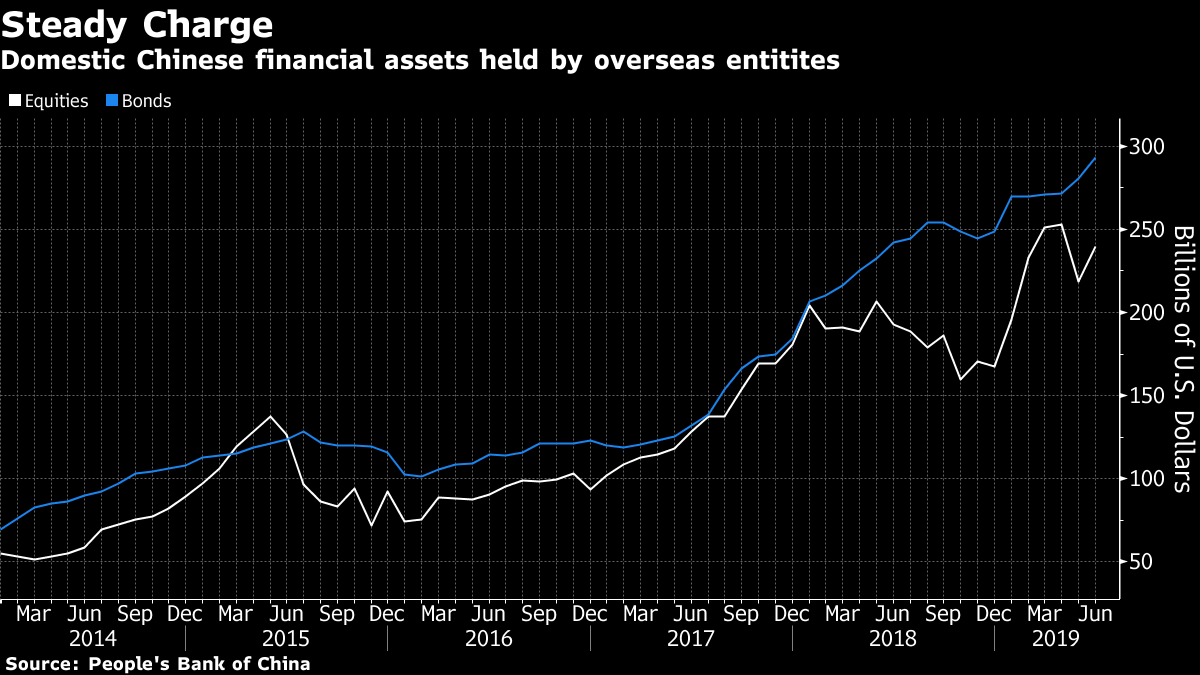
One factor in that happening, they say, is the increasing presence of Chinese institutions on indexes such as MSCI’s benchmark emerging markets index and a Bloomberg Barclays bond index. Both are used by many institutional investors to decide the composition of their funds.
The growing Chinese presence on international indexes reflects China’s economic rise and Beijing’s decision to continue opening up its financial markets to outside investors. Earlier this month, China lifted long-standing quantitative limits on foreign investment in mainland markets.
China on Sunday declared that the government would continue to open up its financial markets and encourage foreign investment.
“We will take further steps to promote high quality two-way financial opening, encourage foreign financial institutions and funds to invest in the domestic financial market to boost the competitiveness and dynamism of the domestic financial system,” read a summary from the eighth meeting of the Financial Stability and Development Committee posted on its website.
Speaking Monday at a briefing in Beijing, China foreign ministry spokesman Geng Shuang said “maximum pressure and forced decoupling will surely harm the interests of our enterprises and people, cause instability in financial markets, as well as threaten international trade and global economic growth.”
--With assistance from Jun Luo, Lucille Liu and Kiuyan Wong.
from Business - Latest - Google News https://ift.tt/2nctWyq
via IFTTT
September 30, 2019 at 09:57AM
Co-Founder and former CEO of WeWork Adam Neumann, seen here on May 15, 2017 in New York City, was hailed as a real estate visionary.
Noam Galai/Getty Images
It didn’t take long for Adam Neumann to lose his aura of invincibility. It disappeared in a matter of a few weeks.
As a co-founder of We Co., the parent company of WeWork, Mr. Neumann had been hailed as a real estate visionary. The company secures office space under long-term leases, renovates it and then divides it up to sublease it with shorter terms and premium prices.
Backed by private capital, the company earlier this year had a private-market valuation of US$47-billion. Then came its filing for a public listing, which exposed the size of its losses (US$1.9-billion in 2018 and another US$905-million in the first six months of this year) and the discovery of some questionable transactions. For example, investors learned that We paid millions of dollars to a company controlled by Mr. Neumann for the “We” trademark, a deal the company later said it would unwind.
Story continues below advertisement
As the company’s public face, Mr. Neumann bore the brunt of the backlash. After its initial public offering was ultimately postponed a few weeks later, he was booted as chief executive.
In the aftermath, it has been easy to paint Mr. Neumann as a problematic founder who spooked investors. But there’s been a sudden shift in market sentiment that’s bigger than him, or even WeWork. Quite simply, many investors have new expectations.
For years, ambitious companies coming to market were rewarded for growth at all costs. But now, institutional money managers have started to demand positive cash flow and a visible path to profits – and these businesses struggle to show it.
“We have been through one of the glory periods for companies to remain private and get funding and do things without making money for a long period of time," Tim Armour, CEO of American asset-management giant Capital Group, said at an investor conference two weeks ago. “I question whether that will continue.”
The issue is that many companies are talked about as startups, even though they have been in business for many years.
“If you’ve got a company with no revenue, investors can dream whatever revenue number they want,” John Ewing, chief investment officer at Ewing Morris & Co., said in an interview. That let venture-capital backers speculate about valuations. Eventually, though, "the dreamers move on.”
As the original backers exit in search of funding the next big thing, public-market investors start to value the companies using different metrics. “You hit an air pocket when you transition," Mr. Ewing said.
Story continues below advertisement
Story continues below advertisement
Public investors weren’t so skeptical only a few months ago. Ride-hailing giant Uber Technologies Inc. piled up operating losses totalling US$10.1-billion from 2016 to 2018, but was still able to go public in May at an US$82-billion valuation. Rival ride-hailing company Lyft Inc. also went public despite losses, as did workplace messaging company Slack Technologies Inc.
At the time, the expectation was that once these companies and others like them had sizable market shares, they would start to raise prices. No one seems to know whether that will work any more.
“Uber may never prove their business model,” said Kim Shannon, president of Sionna Investment Managers and a value investor who has long been skeptical of the growth-at-all-costs model.
Since going public in May, Uber’s shares have dropped 33 per cent. Lyft’s have tumbled 43 per cent since its March IPO.
It isn’t solely a Silicon Valley phenomenon. In Canada, cannabis producers are enduring similar struggles.
At its peak, Canopy Growth Corp., the largest of the Canadian players, was worth $23-billion. It even attracted a $5-billion investment from alcohol giant Constellation Brands Inc. last summer.
Story continues below advertisement
But just like the Silicon Valley startups, Canopy has hit the air pocket.
In July, Canopy founder Bruce Linton was ousted as CEO. A month later, the company disclosed that it will not be profitable for three to five years. On a conference call, executives said Canopy had been so focused on being the early market leader that it cut corners, and now has to go back and retrofit greenhouses and fix problems across its supply chain. The company’s shares have plummeted 53 per cent from their 2019 high.
This type of shift in investor sentiment has happened many times before. The dot-com bubble is often cited as the prime example, but since the start of the century investors have also gotten into frenzies over sectors such as telecommunications and clean technology, only to abandon them.
This time around, the frenzy is defined by the extent to which investors idolized company founders − something Ms. Shannon called the market’s “collective mania." For cannabis, it was Mr. Linton. For ride-hailing, it was Uber’s Travis Kalanick. For WeWork, it was Mr. Neumann. All three are now gone.
To their credit, these men leave behind legitimate businesses with respectable revenues – unlike many companies from the dot-com boom. The question, however, is whether investors will stick around for the transition to profitability.
Because unlike private capital, Mr. Ewing said, "public investors have a lot of alternatives for where to invest.”
from Business - Latest - Google News https://ift.tt/2nEBwlr
via IFTTT
September 30, 2019 at 05:22AM
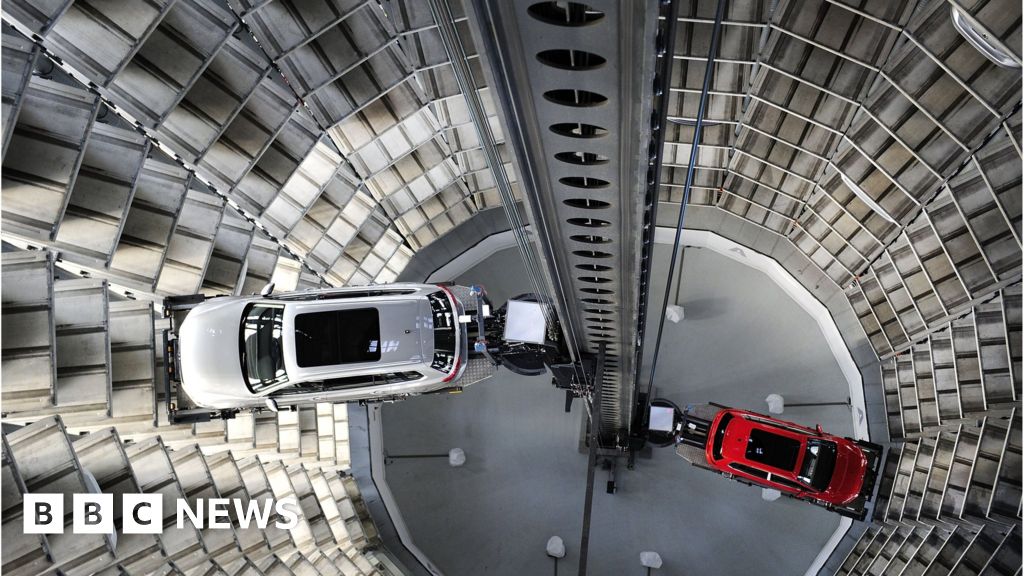
Germany's first mass lawsuit begins as 450,000 owners of diesel Volkswagen cars take on the company.
They argue they are owed compensation for being sold cars based on misleading emissions data.
The scandal has already cost VW €30bn (£26.6bn).
It has faced class action claims in the US and Australia, but this is the first time Germans could pursue group claims since the law was changed last year.
This trial will settle points of law and the claimants will later be able to file follow-up claims for compensation if they are successful.
The trial, at Braunschweig Higher Regional Court, about 20 miles from VW's Wolfsburg head office, is likely to last years, however.
Part of VW's settlements so far include a deal to buy back 500,000 cars in the US, where it has agreed to pay more than $25bn (£20bn).
In Australia the company will pay 127 million Australian dollars (£70m) to compensate owners, paying them A$1,400 apiece.
Last week it emerged that three current and former Volkswagen executives were charged with market manipulation in connection with the diesel emissions scandal.
Chief executive Herbert Diess, chairman Hans Dieter Pötsch and ex-boss Martin Winterkorn, did not inform investors early enough about the financial fallout, German prosecutors allege.
In 2015, the firm admitted using illegal software to cheat on emissions tests. VW said it was confident those allegations would prove groundless.
This may be a landmark lawsuit - and in terms of the sheer number of claimants, it's certainly attention grabbing. But it may not be the biggest concern for Volkswagen right now.
Unless there is a settlement, the legal process is likely to take take years - VW expects it to take at least four. Even if they win, car owners will have to go back to court to get compensation.
Meanwhile, VW's chairman and chief executive are both fighting criminal charges for alleged market manipulation linked to the diesel scandal.
Volkswagen itself is facing the possibility of hefty fines from the EU, after being accused of colluding with other manufacturers to delay the introduction of emissions control technology.
It's safe to say its lawyers are already keeping pretty busy at the moment. And in the meantime, the company is trying to turn itself into a leader in the market for electric cars.
Against that background, the group lawsuit may seem for the moment like just another irritation.
TORONTO — Canada Post is racking up close to $1 million annually in parking tickets as drivers struggle to navigate increasingly congested city streets, data show.
The information, obtained by The Canadian Press through freedom of information requests, indicates the bulk of the citations are in and around Toronto.
“To meet the needs of Canadians, our employees have to routinely park their vehicles,” said Canada Post spokesman Jon Hamilton. “With the concentration of addresses in urban downtown cores and a rising demand for pickups and deliveries, this can cause challenges, not just for Canada Post but for all delivery companies.”
Data show the Crown corporation has paid out almost $7.5 million in parking fines over the past decade. The worst year was in 2016 with $943,293 paid, slightly more than last year’s $914,831, and almost quadruple the $289,908 recorded in 2009.
Under the federal Canada Post Act, the corporation has, with some exceptions, the “sole and exclusive privilege of collecting, transmitting and delivering letters to the addressee thereof within Canada.” The corporation has a fleet of almost 13,000 vehicles that delivered close to eight billion pieces of mail last year.
Eric Holmes, a spokesman for the City of Toronto, said mailbox placements are approved with the “general preference” they not be placed along high-volume streets.
“Illegally parking, stopping, or standing a vehicle is dangerous for pedestrians, cyclists and other motorists and creates congestion,” Holmes said. “Enforcement of parking violations is one way the City of Toronto helps deter this behaviour.”
Hamilton said the corporation was an “active participant” in partnerships with Toronto, Montreal and Vancouver that aim to ease congestion, especially in downtown cores and along major access routes.
“We also review our operations to make changes, such as adjusting pickup and delivery times, where possible,” Hamilton said. “It’s a bigger discussion than simply designating more delivery zones.”
Overall, the fines are barely a rounding error for Canada Post, which lost $270 million last year on revenue of $6.6 billion dollars — three-quarters of the corporation’s total revenues. The company initially refused a June 2016 request for the ticket data, citing “commercial sensitivity.”
It relented in June after belated intervention from the information commissioner and released the total value of tickets by region paid from 2009 until mid-2016. Asked for updated figures, the country’s largest retail network insisted on receiving a new formal access-to-information request before providing them.
All regions of Canada show ticketing of branded Canada Post vehicles, but most citations are in major urban centres, where thousands of mail addresses can be concentrated in a few blocks. Despite the daunting logistics of pickup and delivery, a Toronto traffic police spokesman was blunt:
“This is an easy one,” Sgt. Brett Moore said. “There is no preferential treatment for Canada Post.”
In general, Canada Post’s drivers are on the hook for traffic violations. However, company policy makes allowance for parking tickets — with an excuse — except in designated accessibility spots.
Emilie Tobin, with the Canadian Union of Postal Workers, said the idea of parking exemptions for Canada Post vehicles is a complex topic given that the company is federally regulated but drivers have to follow varying provincial and municipal bylaws.
“In some areas, it is difficult to find a legal parking space, so our members do have to park illegally and some do incur parking tickets,” Tobin said. “It’s not an ideal system and postal workers would prefer that routes could be structured in a way that allowed for legal parking 100 per cent of the time.”
from Business - Latest - Google News https://ift.tt/2m9QTSD
via IFTTT
September 30, 2019 at 03:56AM


/arc-anglerfish-tgam-prod-tgam.s3.amazonaws.com/public/LR2KDR7EHVGEPFAUB5HDUGI6HA.jpg)