Canada’s labour market slipped after two straight months of strength, with both employment and the jobless rate little changed, indicating the nation’s recent pace of job growth may be cooling.
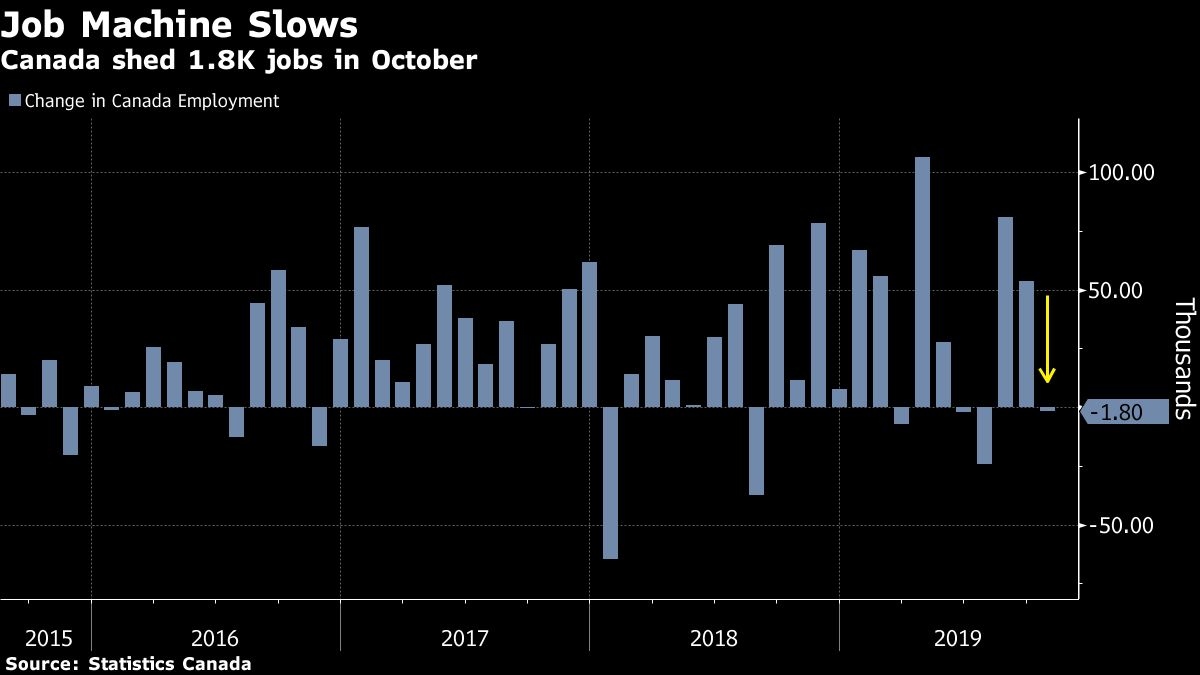
The country lost 1,800 jobs in October, Statistics Canada said Friday in Ottawa, versus economist expectations for a 15,000 uptick in employment. October marks the first month of job losses since July and comes after Canada added almost 135,000 jobs in the prior two months. Full-time positions fell by 16,100, while part-time increased 14,300. The unemployment rate held steady at 5.5 per cent, matching the median forecast, and wage gains accelerated.
The Canadian dollar dropped on the report, falling 0.4 per cent to $1.3224 per U.S. dollar at 8:46 a.m. in Toronto trading. Yields on Canadian two-year bonds were down three basis points to 1.60 per cent.
Key Insights
The flat reading for employment in October doesn’t shift the view of a labor market that remains a bright spot for the Canadian economy despite concerns that trade tensions are slowing growth.
The question now is whether the month’s drop in employment is a blip or if it’s a sign of future weakness. The latter could pressure the Bank of Canada into cutting interest rates, something they opened the door to in October’s meeting
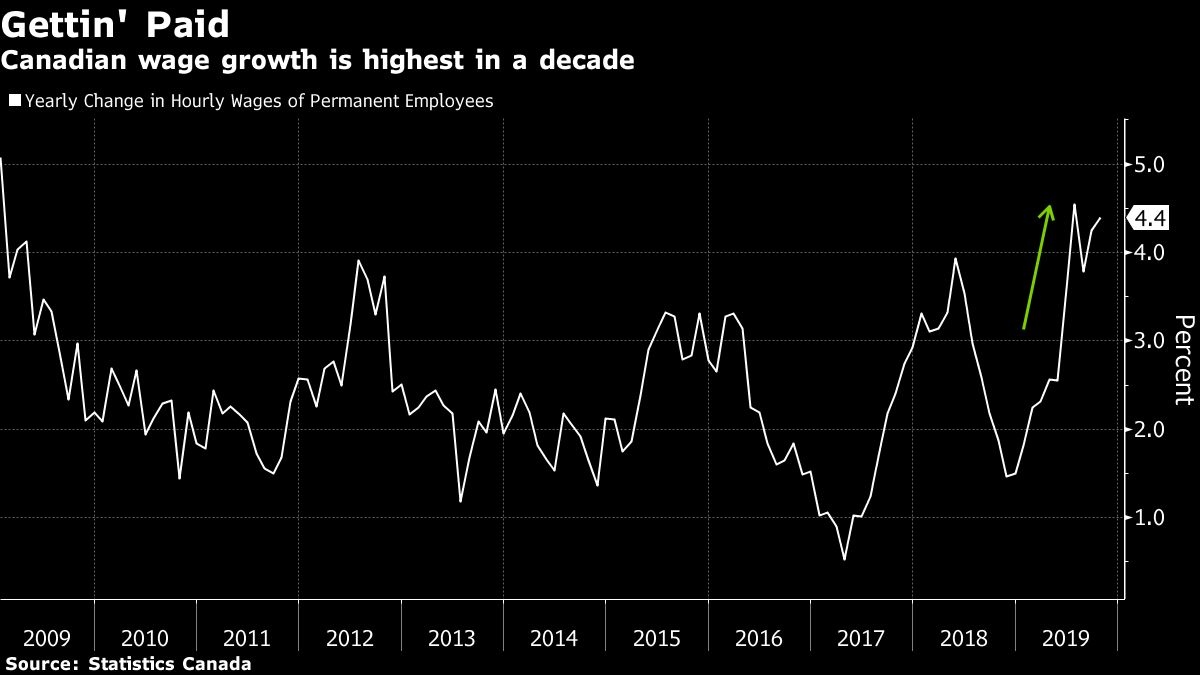
Wage gains quickened to 4.4 per cent on the year, a sign that tightness in the labor market is boosting pay. Hours worked advanced 1.3 per cent from a year earlier, matching last month’s pace.
“It’s hard to be too upset over one soft print,” said Rob Both, a macro strategist at Toronto-Dominion Bank. “It doesn’t change anything for the Bank of Canada.”
Get More
Private sector employment was virtually unchanged, while self-employment plunged by 27,800. Public sector employment helped offset most of the losses, adding 28,700 jobs. Election-related hiring contributed to the gains in the public sector.
Even with the slight drop in October, job gains so far this year have been robust. The country has added almost 391,000 jobs, the most in the first 10 months of a year since 2002.
The construction and manufacturing sectors dragged on employment, losing a total of 44,000 jobs while public administration and finance, insurance and real estate sectors rose notably
--With assistance from Erik Hertzberg.
from Business - Latest - Google News https://ift.tt/2NqSXjM
via IFTTT
November 08, 2019 at 08:44PM
(Kitco News) - Gold and silver prices are lower and dropped to three-month lows in early U.S. trading Friday. The safe-haven metals have been hammered this week by rallying world stock markets that saw the U.S. indexes score record highs Thursday. December gold futures were last down $6.70 an ounce at 1,459.70. December Comex silver prices were last down $0.245 at $16.765 an ounce.
Serious near-term technical damage has been inflicted in both gold and silver markets this week, as both have seen bearish downside “breakouts” from sideways trading ranges on the daily bar charts. More price pressure is likely in the near term, with gold likely to find strong support at $1,400.00 that would stop the bleeding. For silver, prices could continue to erode to the $15.50 level before bottoming out.
Asian and European stock indexes were mixed to mostly weaker overnight. U.S. stock indexes are pointed toward narrowly mixed openings when the New York day session begins.
Traders and investors on this day are not quite so confident the U.S. and China are close to signing a partial trade deal. Now reports are saying there is heavy resistance among some inside the Trump administration to acquiesce to China by rolling back trade tariffs on Chinese imports to the U.S. One Trump trade official late Thursday said there is still no agreement in place and the ultimate decision lies with the mercurial President Trump. Much of this week had seen global equity markets in rally mode on notions of a soon-completed “Phase 1” of the U.S.-China trade agreement.
In overnight news, China’s October exports fell 0.9% year-on-year, which was better than the 3.1% drop expected. China’s imports were down 6.4% in October, year-on-year, while a drop of 8.6% was forecast.
A feature in the marketplace this week besides record highs in the U.S. stock indexes is rising U.S. bond yields, which hit a three-month high on Thursday.
The key “outside markets” today see the U.S. dollar index up and at a three-week high. Nymex crude oil prices are lower and trading around $56.15 a barrel.
U.S. economic data due for release Friday includes monthly wholesale trade and the University of Michigan consumer sentiment survey.
Technically, the gold bears now have the overall near-term technical advantage. Prices are in a two-month-old downtrend on the daily bar chart and have seen a bearish downside “breakout” from the recent sideways trading range, to suggest still some more price pressure in the near term. Bulls’ next upside price objective is to produce a close in December futures above solid resistance at $1,500.00. Bears' next near-term downside price breakout objective is pushing December futures prices below solid technical support at $1,400.00. First resistance is seen at the overnight high of $1,473.90 and then at $1,480.00. First support is seen at the overnight low of $1,457.00 and then at $1,450.00. Wyckoff's Market Rating: 4.5
December silver futures bears also have the overall near-term technical advantage. Prices are in a two-month-old downtrend on the daily bar chart and have seen a bearish downside “breakout” from the recent trading range, to suggest still some more price pressure in the near term. Silver bulls' next upside price breakout objective is closing prices above solid technical resistance at $18.00 an ounce. The next downside price breakout objective for the bears is closing prices below solid support at $16.00. First resistance is seen at the overnight high of $17.095 and then at $17.25. Next support is seen at the overnight low of $16.66 and then at $16.50. Wyckoff's Market Rating: 4.0.
from Business - Latest - Google News https://ift.tt/2NQrV4t
via IFTTT
November 08, 2019 at 08:22PM
Barrick is the operator and 75% owner of the Turquoise Ridge mine in Nevada, pictured. Newmont owns the remainder. (Image courtesy of Barrick Gold.)
Canada’s Barrick Gold (TSX:ABX)(NYSE:GOLD), the world’s second largest producer of the yellow metal, saw its profit for the three months to September almost tripled as a result of higher output and prices.
The Toronto-based miner also bumped its payout to investors for the period by 25% to $0.05 per share, as adjusted profit rose to $264 million, or 15 cents per share. That compares to $89 million, or 8 cents per share, a year earlier.
In terms of output, Barrick churned out 1.31 million ounces in the third quarter from 1.15 million ounces in the three months to June 30.
The gold giant, however, expects production numbers to stay put through 2024, reaching between 5.15 and 5.6 million ounces of gold a year — in line with what it expects to produce this year.
The world’s second largest gold miner sees output reaching 5.15 to 5.6 million ounces a year between 2020 and 2024
The company also predicted all-in sustaining costs (AISC) to be between $850 and $950 an ounce over the next five years, an improvement from the $984 per ounce reported in the previous quarter.
Barrick has been looking to boost its reserves to address falling production. In July, the miner took a step in that direction by agreeing to combine its assets in the US state of Nevada with those of Newmont Goldcorp, the world’s No. 1 gold producer.
A final settlement, which meant the creation of a new company — Twiga Minerals — was reached in October. Barrick has said it plans to sell about $1.5 billion in assets by the end of 2020. At the same time, it’s looking to buy more top-tier gold projects, in Canada and elsewhere, and invest in copper assets.
from Business - Latest - Google News https://ift.tt/32moasL
via IFTTT
November 06, 2019 at 09:59PM
For example, while you probably know you can get free two-day shipping as a Prime member, did you know you can also get packages sooner, or schedule a delivery date that's more convenient for you?
Black Friday and Cyber Monday have become two of the biggest shopping days of the year, with retailers fighting for your dollar through sales and perks. Amazon's enormous catalog, loyal subscriber base and massive shipping empire put it in a position to be extra aggressive in getting your business. Here are all the ways the Prime membership you already have can help you shop this Nov. 29 and Dec. 2.
Schedule a convenient shipping date during checkout with Amazon Day.
James Martin/CNET
Schedule a convenient shipping date for your package
Everyone knows about Amazon's free two-day shipping, but another option is to choose a delivery date during checkout. It's called Amazon Day and it's helpful if there's a specific day you know someone will be at home to answer for packages -- especially if it's something pricey that you don't want to risk sitting outside unattended.
If you order multiple items on different days, you can have them delivered on the same day as long as they're eligible for this offer.
If you have an Amazon Echo of any kind, you can use it to track your orders.
Just say "Alexa, where's my package?" and yuor Echo will let you know where it is and when it'll arrive. Once your order has been delivered, the Echo's ring light will pulse yellow.
Use any Amazon Echo to track your packages.
Sarah Tew/CNET
Shop Early Access deals before non-Prime members
If something you've been eyeing says "Prime Early Access," as a Prime member, you can shop that sale 30 minutes before non-Prime members. However, you'll have to compete with other members who are also interested in the product before it sells out.
Now playing:Watch this:
How to win Black Friday and Cyber Monday in 2019
2:25
Use Prime Now to get what you ordered in a couple of hours
If there's a product you want same-day, you can see if it's available in Prime Now. Amazon will deliver from morning until evening, so you won't have to worry about receiving your order at 3 a.m.
This way of shopping is nifty for when you really need to go to the grocery, but can't risk losing out on that new item, like a fresh Echo device that might go on sale. Prime Now isn't available in all locations, so enter your ZIP code at primenow.amazon.com to see if you're eligible.
Share your Prime perks with family
If you've got another adult living in your household, like a significant other or friend, you can share your Prime membership with them. You'll still be able to keep your personal accounts separate, which is helpful if you're shopping for the holidays, but you'll both have access to all the same Prime benefits.
You can also share your account with up to four teens and up to four children in your household. While they'll have their own logins, you can still manage their profiles.
Amazon employees can leave a package inside your house with Amazon Key.
Tyler Lizenby/CNET
Amazon can leave your package inside your house
When you know you're not going to be home for a while and you've got a shipment on the way, it's much safer to have an Amazon employee leave your items inside your house to avoid theft.
If you have the Amazon Key Home Kit, you can request to have your expensive packages left in your home, and even your vehicle or garage, for free. The kit itself costs $290 and comes with a cloud cam ($80 at Amazon) and a smart lock, so you'll be in charge of letting the delivery person in and can watch as it's happening.
WeWork employees were swept up by cofounder and then-CEO Adam Neumann's wild ambitions and enthralled by his startup's cool culture and lavish perks, according to the New Yorker.
"In retrospect, there's no way this could have worked," a WeWork software engineer told the magazine. "People were high. It seems insane now, but at the time it made so much sense."
WeWork flew 8,000 employees to London for a company retreat where Lorde performed and Deepak Chopra led a meditation, and Neumann floated the idea of a WeWork on water called WeSail, the New Yorker reported.
WeWork employees were swept up by cofounder and then-CEO Adam Neumann's wild ambitions and enthralled by his company's cool culture and lavish perks, but grew concerned as red flags mounted, according to the New Yorker, which interviewed several WeWork staff.
"In retrospect, there's no way this could have worked," a WeWork software engineer told the magazine. "People were high. It seems insane now, but at the time it made so much sense."
The shared-workspace startup plowed money into growing its business without setting realistic targets.
"It was chaos," a WeWork architectural designer told the New Yorker. Trying to organize the large teams "was like herding cats," she said, and WeWork's sales staff "were always promising insane things like 'We'll get it done by October!' And it's July."
WeWork also splashed its cash on flying 8,000 employees to a company retreat in London last summer, where Lorde performed and Deepak Chopra led a meditation, the New Yorker reported. The event was a warning sign for some employees.
"OK, this is $2,500 a head just for the flights," a WeWork designer told the magazine. "From a business perspective, there were some red flags there."
WeWork staff, increasingly worried about their employer's scattershot approach and reckless spending, hoped there were adults pulling the strings.
"There was always this assumption that, behind Adam, there was someone intelligent — a group of people — who were watching and making the practical, financial decisions," a WeWork development worker told the magazine. "That someone was taking care of it."
However, that idea was dashed at another WeWork gathering in Los Angeles in January — figure skater Adam Rippon and actor Jaden Smith made appearances — where Neumann floated the idea of a WeWork on water called WeSail, and creating a WeBank.
"That was when it hit me," the development worker told the New Yorker. "There wasn't anyone else running the company. It was just Adam and his wife."
‘If the largest lender in this country can get comfortable with this, then everybody should,’ We Co. founder Adam Neumann said.
Photo:
Noam Galai/Getty Images
Banks jockeying for a role in WeWork’s public debut wooed founder
Adam Neumann
with sky-high valuations that would make him a billionaire many times over. Their loans to the company told a different story.
When
Wells Fargo
WFC 1.33%
& Co. signed on to a $6 billion loan earlier this year, Mr. Neumann said: “If the largest lender in this country can get comfortable with this, then everybody should.”
SHARE YOUR THOUGHTS
Who do you think is to blame for WeWork’s struggles? Join the conversation below.
Yet Wells Fargo, the fourth-largest U.S. bank, only started lending to WeWork after an executive at the bank promised to keep an eye on Mr. Neumann, according to people familiar with the matter.
Banks harbored significant doubts about We Co., as the WeWork parent is known, even as they pitched its stock to investors, according to interviews and documents reviewed by The Wall Street Journal. Running out of cash, the company was rescued last month by Japanese conglomerate
SoftBank Group Corp.in a deal that bounced Mr. Neumann.
WeWork’s unraveling has hit hardest the wallets and reputations of SoftBank and other venture-capital investors who enabled Mr. Neumann and his company’s rise. But with its money and credibility, Wall Street also fed the company’s breakneck growth and its image as a superhot technology company.
WeWork’s model—leasing office space, outfitting it with touches like free beer and fruit-infused water, then subleasing it—required a constant supply of credit. Landlords demanded bank letters that guaranteed several months of rent upfront. These letters could be recycled as the short-term pledges expired.
JPMorgan was one of the biggest lenders to WeWork and to Mr. Neumann, who counted CEO James Dimon and asset-management chief
Mary Erdoes,
whose division had lent to Mr. Neumann, among his confidants.
In 2015, JPMorgan led a group of banks extending a $650 million loan to WeWork. Two years later, the company went back for another $500 million, and Wells Fargo joined the group.
Wells Fargo bankers acknowledged internally that WeWork’s business model was unproven but agreed to lend $100 million if the company set aside cash as collateral, according to people familiar with the matter and a memo reviewed by the Journal.
WeWork would be a profitable client in Silicon Valley, where Wells Fargo doesn’t have a strong presence, they argued in the memo. It also could land the bank a role in WeWork’s IPO and future stock sales, which the bankers estimated could bring in $12 million in fees, according to the internal memo about whether to approve the loan.
An internal committee initially rejected the loan, raising concerns about the company’s prospects and Mr. Neumann’s style, the people said. Roy March, the head of Wells Fargo’s Eastdil real-estate unit, assured executives he was close to Mr. Neumann and would personally mentor him, the people familiar with the situation said.
Perry Pelos,
a top Wells Fargo executive, ultimately signed off after several appeals, the people said. Wells Fargo sold most of Eastdil this year.
This summer, as WeWork prepared to go public, Mr. Neumann told friends a new round of bank financing would “blow the market away,” according to a person familiar with the matter. He had been meeting with Mr. Dimon and Goldman CEO
David Solomon,
people familiar with the conversations said.
Bankers at JPMorgan and Goldman, meanwhile, were vying for roles in the company’s IPO. They had told Mr. Neumann it could be worth as much as $60 billion (JPMorgan) and $90 billion (Goldman), according to people familiar with the matter. Lining up a loan would help them win the assignment.
JPMorgan proposed a $6 billion loan that required WeWork to raise $3 billion in the stock market by the year’s end. The package included a $2 billion line of credit it could use to continue to sign deals for new space.
Here’s a look at WeWork’s business model. Photo: David 'Dee' Delgado/Bloomberg
Goldman proposed $3.65 billion in loans, secured by income from WeWork’s buildings, people familiar with the matter said. The deal would allow WeWork to borrow more if it hit certain milestones—up to $10 billion over time—and didn’t require the company to go public, some of the people said. WeWork executives wanted more money upfront, they said.
JPMorgan won.
The bank pushed other lenders to commit at least $750 million apiece toward the $6 billion total, dangling a role in the IPO, according to people familiar with the negotiations. Some bankers worried JPMorgan’s initial terms were too lenient and demanded WeWork set aside more cash to back the loan, the people said.
Eventually, the $2 billion line was 100% collateralized, meaning WeWork would have to pledge a dollar of cash for each dollar it borrowed, the people said. Goldman, Wells Fargo and six other big banks agreed to participate.
The lenders would split about $250 million in fees upfront, according to people familiar with the deal, a high sum for a low-risk arrangement. A day after it was finalized, WeWork said it had chosen JPMorgan and Goldman to lead its IPO. The other banks got junior roles.
The IPO ran into trouble almost immediately after documents were filed in August. Investors balked at WeWork’s growing losses and unusual financial arrangements between the company and Mr. Neumann. Bankers offered shares at a lower price; investors still didn’t bite.
The company pushed Mr. Neumann out as CEO and called off the IPO in September, which killed the loan deal. WeWork, suddenly dangerously low on cash, found the banks unwilling to reup.
It turned back to JPMorgan, seeking a $5 billion lifeline, people familiar with the matter said.
This time, the bank refused to lend its own money without gauging demand from investors, people familiar with the matter said. It eventually offered the full $5 billion itself.
WeWork took SoftBank’s money instead.
Mr. Dimon defended his bank’s dealings with WeWork in a television interview this week.
“We helped WeWork get to a proper conclusion,” Mr. Dimon said. “Now it has a chance to succeed.”
U.S. stock index futures edged higher on Friday morning following Thursday's record close for the Dow Jones Industrial Average.
Around 6 a.m. ET, Dow futures indicated a positive open of more than 30 points. Futures on the S&P and Nasdaq were both little changed.
Stocks rose to record highs on Thursday after the world's two largest economies reportedly agreed to remove existing trade tariffs, sparking a huge rotation into equities and out of bonds.
Investors are closely monitoring news on the China-U.S. trade front after a spokesperson for the Chinese commerce ministry said that both sides had agreed to cancel existing tariffs in phases.
Furthermore, data released Friday morning showed that Chinese exports and imports declined less than expected in the month of October, according to Reuters.

![Live 24 hours gold chart [Kitco Inc.]](https://www.kitco.com/images/live/gold.gif?0.2924175530478188)
![Live 24 hours silver chart [ Kitco Inc. ]](https://www.kitco.com/images/live/silver.gif)