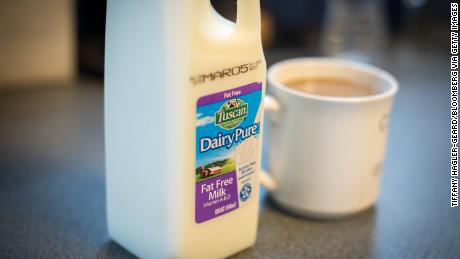
The 94-year-old company has struggled in recent years because Americans are drinking less cows milk. 2019 has been particularly brutal: the company's sales tumbled 7% in the first half of the year, and profit fell 14%. Dean Foods(DF) stock has lost 80% this year
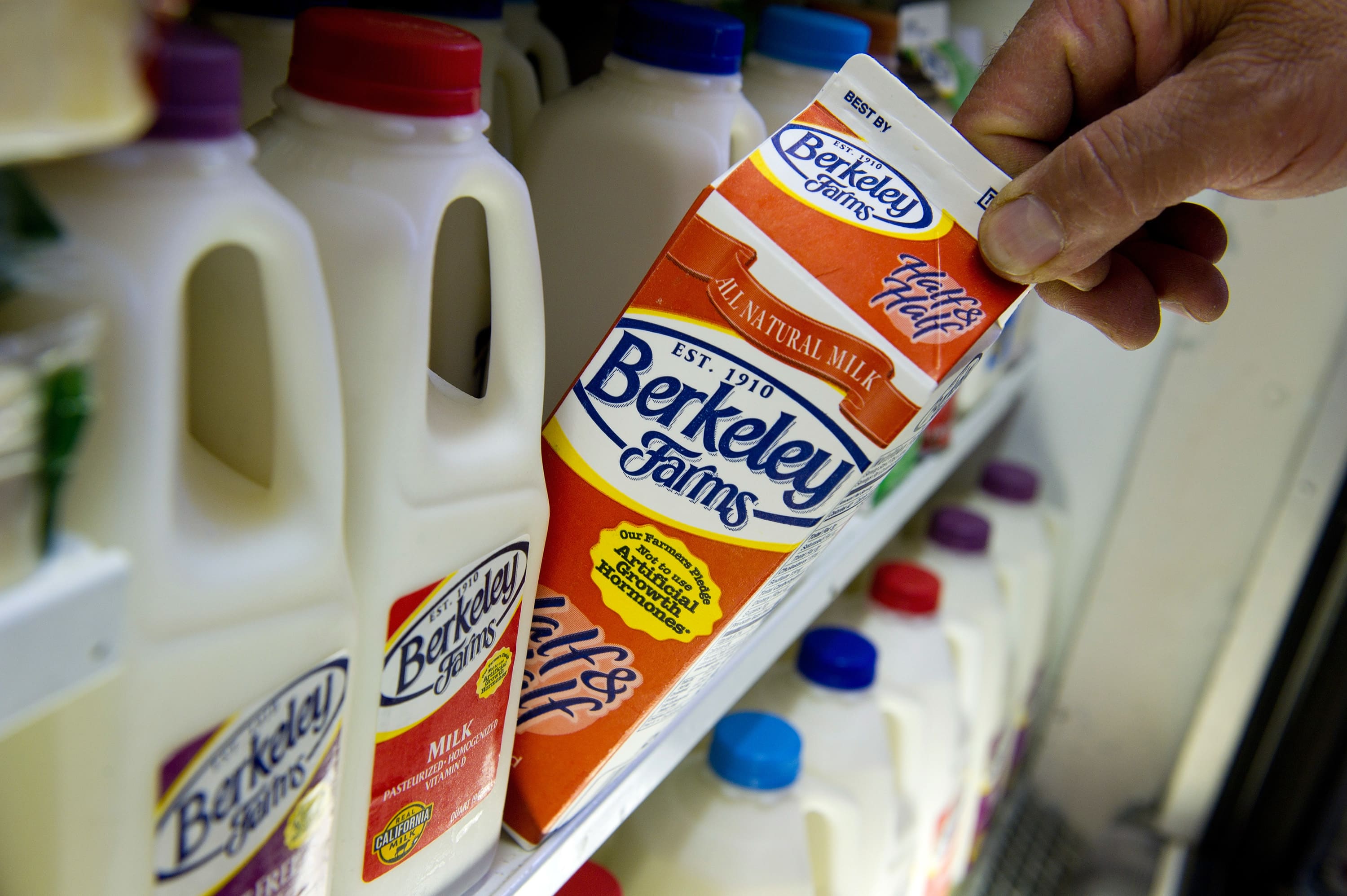
The company, which makes some of the country's most recognizable milk and dairy products, including Dairy Pure, Organic Valley and Land O'Lakes, has blamed its struggles on the "accelerated decline in the conventional white milk category."
The company is saddled with debt and has been unable to fund all of its workers' pensions. So on Tuesday, Dean Foods filed for Chapter 11 bankruptcy protection to keep the business operating, reorganize its debt and help fund the pensions while it looks to sell the company.
Dean Foods said in a statement that it is working with the Dairy Farmers of America cooperative on a potential deal, in which the cooperative would buy almost all of the company.
As part of the bankruptcy process, the company secured $850 million in financing from its existing lenders, including Rabobank(RSWLDD), to keep the company running.
Once a staple of the American refrigerator, milk has slowly fallen out of favor with consumers as they seek less-sugary or plant-based alternatives.
The global market for milk alternatives is expected to top $18 billion this year, up 3.5% from 2018, according to Euromonitor. That's still a fraction of the traditional milk market which will come in at just under $120 billion globally this year.
Sales for cow's milk has been declining for the past four years. Sales for the past 52 weeks, ending on October 26, was around $12 billion, according to data Nielsen provided to CNN Business. That's a decline from $15 billion during a similar time period in 2015. All types of cow's milk, such as 1%, 2%, skim and fat-free milk sales have all declined.
In contrast, and while still much smaller, sales of oat milk has jumped 636% to $53 million over the past year.
That's not the only problem Dean Foods has faced. Walmart(WMT), which was one of Dean Food's biggest customers, dropped them last year after building its own dairy plant.
Closed Redwood U.S. Hemp-Based Products Platform and Cronos Fermentation Facility Acquisitions Announced the launch PEACE+™, A New Hemp-Derived U.S. BrandAdvanced Operational Readiness of Cronos Israel with Completed Construction of Manufacturing FacilityTORONTO, Nov. 12, 2019 (GLOBE NEWSWIRE) -- Cronos Group Inc. (NASDAQ: CRON) (TSX: CRON) (“Cronos Group” or the “Company”), today announced financial results and business highlights for the three- and nine-months ending September 30, 2019.“As demonstrated by our progress in the third quarter, we are making great strides to advance the development and diversity of our portfolio and to expand our manufacturing capabilities,” said Mike Gorenstein, CEO of Cronos Group. “We are confident that our platform strategy and focus on consumer driven innovation will continue to differentiate Cronos Group and drive growth and value creation over the long-term.”Financial Results Third Quarter 2019
from Business - Latest - Google News https://ift.tt/2O55Z5O
via IFTTT
November 12, 2019 at 07:00PM
Dean Foods on Tuesday announced that it has filed for Chapter 11 bankruptcy protection.
The Dallas-based milk processor said that it plans to use the Chapter 11 proceedings to keep running the business, and address debt and unfunded debt obligations as it seeks to sell the company. Dean Foods has secured commitments for $850 million in debtor-in-possession financing, a type of funding for companies in financial distress.
Customers are expected to receive their dairy products without any interruptions.
Dean Foods also said that it is engaged in "advanced discussions" with Dairy Farmers of America about selling "substantially" all of its assets. Even if both parties agree to the sale, the transaction would be subject to receiving higher or better offers while the company is in bankruptcy.
In September, Dean Foods said that it had concluded a strategic review and decided against a sale. CEO Eric Beringause joined the company three months ago after serving as chief executive of dairy producer Gehl Foods.
Dean Foods' business has struggled as more consumers turn to nondairy milk or buy private label products. Americans' per capita consumption of fluid milk has fallen 26% in the last two decades, according to data from the U.S. Department of Agriculture.
Walmart began processing its own milk in 2017. Walmart's decision sparked upheaval, leading Dean Foods to cancel more than 100 milk contracts with dairy farmers across eight states. Compounding the company's problems, grocery chain Food Lion cut ties with the milk producer in 2018.
In seven of its last eight quarters, Dean Foods has reported a net loss.
Dean Foods Co.
DF, +2.29%
has voluntarily filed for Chapter 11 bankruptcy protection on Tuesday, with the dairy company saying it was working toward an "orderly" sale of the company. The company, which brands include DairyPure, Land O Lakes and Lehigh Valley Dairy Farms, said it has secured commitments for $850 million in debtor-in-possession (DIP) financing to support its operations during the process. The company said it has been in advanced discussions with the Dairy Farmers of America Inc. regarding the potential sales of substantially all of its assets. "The actions we are announcing today are designed to enable us to continue serving our customers and operating as normal as we work toward the sale of our business," said Chief Executive Eric Beringause. "Despite our best efforts to make our business more agile and cost-efficient, we continue to be impacted by a challenging operating environment marked by continuing declines in consumer milk consumption." The stock, which was halted for news, had closed Monday at 80 cents. It had plunged 79% year to date, while the S&P 500
SPX, -0.20%
has climbed 23%.
LONDON (Reuters) - World shares inched higher on Tuesday as investors awaited a speech by President Donald Trump on U.S. trade policy and on news he was likely to delay a decision on European auto tariffs.
Bond markets also seemed increasingly confident a recession will be avoided as EU officials said Trump was expected to announce this week that he was delaying the tariff decision on EU cars and parts for another six months.
The news boosted expectations about Trump's speech later in the day and for some resolution to his administration's long-running trade war with China.
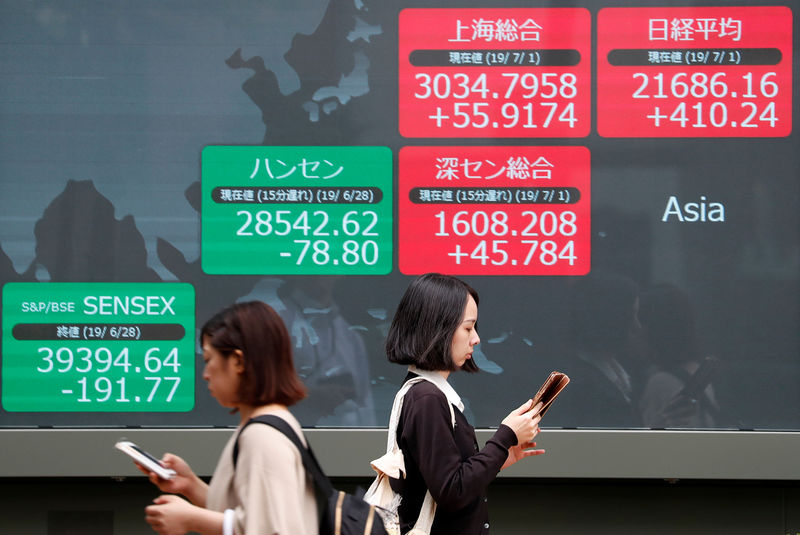
The pan-European shuffled 0.2% higher, back towards 4-year highs helped by upbeat chipmaker shares. MSCI's broadest index of Asia-Pacific shares outside Japan had climbed 0.5%, following a sharp 1.2% pullback on Monday.
Japan's , which dithered either side of flat most of the day, ended 0.8% higher. But Shanghai blue chips eased 0.2% after bank lending growth undershot analysts' estimates, while Australian shares were down, too.
A positive signal on U.S.-China trade would likely satisfy traders even without specific details, said Rob Marshall-Lee investment leader for Emerging Market and Asian Equities at Newton Investment Management.
"I think that there will be some kind of deal that comes of all of this," Marshall-Lee said, adding that whatever emerges both Washington and Beijing will want to claim it as a win domestically.
Trump wrongfooted markets over the weekend when he said there had been incorrect reporting about U.S. willingness to lift tariffs on China.
Investors were also anxious about the situation in Hong Kong after a violent escalation of protests had knocked 3% off the and nearly 2% off Asia-exposed banks HSBC and StanChart in recent days.
Hong Kong's embattled leader Carrie Lam on Tuesday said protesters who are trying to "paralyze" the city were extremely selfish and hoped all universities and schools would urge students not to participate in violence.
Lam was speaking a day after police shot a protester and a man was set on fire in some of the most dramatic scenes to grip the city during the more than five months of civil unrest. The Hang Seng managed to claw back 0.5%.
BORIS GETS BREXIT BOOST
Bond markets were also stirring again.
A partial holiday in the United States had closed the Treasury market on Monday but there was an early milestone on Tuesday with the gap between short-term 3-month and longer-term 10-year yields hitting the widest level of the year so far.
That widening, or steepening of the 'curve' as it is also known, adds to signs that faith in the global economy in gaining again after fears it was heading into recession.
Treasury yields on 10-year notes were fractionally higher at 1.9350% having dropping away from last week's three-month top of 1.97%. European yields were also a touch higher.
Wall Street futures for the inched up 0.1%. Monday's partial holiday had made for a quiet session after the record highs of last week. The ended up 0.04%, while the S&P 500 lost 0.20% and the Nasdaq 0.13%.
In currency markets, the main mover was sterling which gave back ground after surging on Monday after the Brexit Party said it would not contest previously Conservative held seats in the last UK election.
It had jumped to a 6-month high versus the euro and as much as 1% on the dollar but shed around 0.3% to 0.86 per euro and $1.2823 when Brexit Party leader Nigel Farage then said on Tuesday he would not give any more ground.
Against a basket of currencies, the dollar steadied at 98.224. The euro hovered around $1.1030 just away from a three-week low of $1.1015, while the dollar faded to 109.26 yen.
Gold looked to be heading for a third day of declines, touching its lowest since early August at $1,447.89 per ounce. It was last trading at $1,453.01.
gained 28 cents to $57.14 a barrel, while futures added 35 cents to $62.53.
Huawei and other Chinese tech companies will be subject to tough restrictions from the United States irrespective of any future trade deal, an economist told CNBC Tuesday.
The two largest economies in the world have been at odds over their trade links for about 18 months. Their tit-for-tat tariff dispute escalated in May, when the U.S. took steps to ban Huawei from selling its technology in the U.S. market.
"Even with a phase one trade deal or even a complete trade deal, our conviction is that tougher restrictions from the U.S. on technology will continue," Tao Wang, chief China economist at UBS, told CNBC's Joumanna Bercetche.
Speaking at the UBS European Conference, Wang said that the U.S. decision to ban Huawei was a "catalyst to show that actually the dispute on the trade front has spread to other areas, like technology."
In May, President Donald Trump signed an executive order declaring that the U.S. telecoms sector was experiencing a "national emergency." "Foreign adversaries are increasingly creating and exploiting vulnerabilities in information and communications technology and services," Trump said in the order.
According to Wang, the national security argument makes it more difficult for the U.S. to change its position on Chinese tech.
"Once you mention that, I think it's very difficult for any politician to say 'I don't care about national security.' It is going to be difficult to actually reverse," she said.
Last month, Trump said that the U.S. and China have put together a "very substantial phase one deal" and that "phase two will start almost immediately" after the first part is signed. According to the U.S. president, the first part of the deal is about "60%" of the full agreement. For now, there is no scheduled date nor place for the first signing between China and the U.S.
China could grow 5.7% in 2020
According to UBS, China is set to grow at a pace of 5.7% in 2020, after the U.S. administration decided in October not to implement more tariff increases on Chinese goods. The bank's forecast assumes there won't be an escalation in trade tensions between Beijing and Washington.
At the same time, UBS has also noted that the several increases in tariffs throughout 2019 have impacted investment into the Chinese corporate and manufacturing sectors. Property starts and investment are also likely to weaken modestly in 2020 as a result of trade uncertainty, it said.
Wang told CNBC that overall the Chinese growth rate in 2020 will depend on the trade war. She said that if the latest round of potential duties were removed, alongside the September tariffs, "China has a pretty decent chance of getting to 6% (GDP in 2020)."
LIANYUNGANG, CHINA - NOVEMBER 09: Cars sit parked before shipping aboard at a port on November 9, 2019 in Lianyungang, Jiangsu Province of China.
(Reuters) - The latest bargaining chip in U.S.-China negotiations to cool a 16-month-old trade war is whether President Donald Trump would roll back tariffs on hundreds of billions of dollars’ worth of Chinese imports, and how soon.
FILE PHOTO: A 100 yuan banknote (R) is placed next to a $100 banknote in this picture illustration taken in Beijing November 7, 2010. REUTERS/Petar Kujundzic/File Photo
The Trump administration began imposing the tariffs in July 2018 on industrial components and technology goods from China. After Beijing retaliated with higher duties on U.S. farm goods, Trump struck back with more tariffs - many already enacted, some still threatened - under which the vast majority of Chinese imports could be affected by the end of 2019.
As U.S. and Chinese negotiators close in on a “phase one” trade deal, expectations are rising that at least some of these tariffs will be removed.
China’s Commerce Ministry and a U.S. official said on Nov. 7 that a deal would include tariff rollbacks, but Trump undercut the idea after pushback from China hawks in his administration, saying he has not decided to do so.
Following is a look at current and planned U.S. tariffs on Chinese goods, listed in reverse chronological order. Trade experts say the most recent tariffs would be the likeliest to be removed.
The United States is scheduled to levy 15% tariffs on about $156 billion of Chinese products on Dec. 15, including cellphones, laptop computers, toys and clothing - known as “List 4B.”
People briefed on the trade talks say the United States has effectively agreed not to proceed with this round of tariffs as part of the phase one trade deal. A U.S. official has said the fate of these tariffs would be considered as part of the final negotiation over the deal’s text.
CANCELED OCT. 15 RATE INCREASE
After an early October round of talks led to a White House handshake on the interim deal with Chinese Vice Premier Liu He, Trump decided not to proceed with an Oct. 15 increase on tariffs on about $250 billion worth of Chinese goods to 30% from the 25% rate already imposed.
If talks to complete the text for the phase one trade deal collapse, Trump could move to reimpose this increase. Affected goods range widely from industrial components and semiconductors to furniture and building materials.
The United States imposed a 15% tariff on about $125 billion of goods on Sept. 1, 2019, including flat-panel television sets, flash memory devices, smart speakers, Bluetooth headphones, bed linens, multifunction printers and many types of footwear.
Trump imposed these tariffs, and set the Dec. 15 duties in motion, after a late-July round of negotiations failed to result in a major increase of Chinese purchases of U.S. farm goods. The phase one trade deal now being discussed would roughly double such purchases from pre-trade-war levels over a period of time, according to U.S. Treasury Secretary Steven Mnuchin.
People familiar with the discussions say that China has asked for these Sept. 1 tariffs to be removed as part of the deal and the request is being considered.
MAY 10 TARIFF RATE INCREASE
On May 10, 2019, Trump increased tariffs on $200 billion worth of Chinese goods to 25% from 10% after China pulled back from a proposed deal that U.S. officials said was nearly completed.
The higher tariffs applied to nearly 6,000 products that were originally taxed in September 2018, from computer modems and routers to vacuum cleaners, lighting fixtures and furniture.
The U.S. trade representative’s office issued exclusions on hundreds of these products in September 2019, including some computer circuit boards, laminated wood flooring and dog collars.
SEPT. 24, 2018, $200 BILLION TARIFF ACTION: "LIST 3" here
Trump imposed tariffs on a $200 billion list of Chinese imports on Sept. 24, 2018, after Beijing retaliated against an initial U.S. volley of tariffs with its own duties on American farm products and manufactured goods.
This list of product tariffs, and the two previous lists below, may be the least likely to be rolled back, trade experts and people familiar with the talks say, adding that keeping some tariffs in place would maintain leverage over China for future negotiations. Trump has said he will not do a complete rollback of tariffs on Chinese goods.
AUG/SEPT 2018 TARIFFS, $50 BILLION "LIST 1" here "LIST 2" here
The first U.S. tariffs on Chinese imports imposed in the summer of 2018 covered $50 billion of Chinese goods considered core to U.S. “Section 301” allegations that China systematically steals and forces the transfer of American intellectual property to Chinese firms.
These initial lists were composed primarily of Chinese-made industrial components, machinery, semiconductors and other non-consumer goods aimed at inflicting pain on Chinese exporters while minimizing the impact on U.S. manufacturers.
The “List 1” tariffs on an initial $34 billion in Chinese goods were imposed on July 6, 2018, while a second list of $16 billion “List 2” tariffs went into effect on Aug. 23, 2018.
Reporting by David Lawder and Heather Timmons in Washington; Editing by Matthew Lewis and Leslie Adler