Senin, 10 Februari 2020

Xerox raises its takeover offer for HP - Financial Times

Xerox has made a new offer of about $35bn, including debt, to buy personal computer maker HP, as it seeks to win over the support of its rival’s shareholders in a move that could escalate hostilities between the two companies.

The latest sweetened offer of $24 per share — $18.40 in cash and 0.149 Xerox shares for each HP — represents a 41 per cent premium to HP’s unaffected 30-day stock price.

The Connecticut-based company will take its offer directly to shareholders after HP’s board twice rejected a previous $22-a-share bid, saying it undervalued the company. Xerox will start its public takeover bid in March by offering to buy shares directly from investors. 

Shares in HP were up 2.7 per cent to $22.32 in early trading while Xerox shares advanced 1.1 per cent to $37.61.

Xerox said it had met a number of HP investors as it has been actively trying to convince them of the merits of a combination, but did not name the shareholders to which it had spoken.

“The tender offer announced today will enable these stockholders to accept Xerox’s compelling offer despite HP’s consistent refusal to pursue the opportunity,” Xerox said in a statement on Monday. 

Activist investor Carl Icahn, who owns stakes in both companies and ranks as one of HP’s largest shareholders, has lobbied in favour of a deal.

HP has raised concerns about how its smaller rival Xerox will fund the deal, as well as questioning the business rationale. 

Xerox’s market value is less than a third of HP’s, but Xerox claims that the combination could potentially unlock as much as $2bn in annual cost savings.

HP is particularly concerned about the decline in Xerox revenues and believes that a decision last year by Xerox to end its joint venture with Fujifilm left a sizeable strategic hole in Xerox’s portfolio. 

Xerox raised $2.3bn from the Fujifilm sale that it can use in its pursuit of HP as well as $24bn in financing for the deal from Citigroup, Mizuho Financial Group and Bank of America.

In recent weeks Xerox has acquired a small stake in HP and has subsequently tried to replace its entire board — a common tactic in the arsenal of activist investors but an unusually aggressive move for a company trying to accomplish a merger. 

HP labelled the nominations “a self-serving tactic” by Xerox in its hopes to expedite a deal. 

The Xerox nominees include Betsy Atkins, the chief executive of venture capital firm Baja Corporation; Kim Fennebresque, who was previously a top banker at Lazard and UBS; Matthew Hart, an American Airlines board member; Jacob Katz, the former chairman of tax advisory group Grant Thornton; and Fred Hochberg, who served as the president of the US Export-Import Bank during the Obama administration.

Let's block ads! (Why?)


https://news.google.com/__i/rss/rd/articles/CBMiP2h0dHBzOi8vd3d3LmZ0LmNvbS9jb250ZW50LzA3ZmRmNGY4LTRjMGMtMTFlYS05NWEwLTQzZDE4ZWM3MTVmNdIBP2h0dHBzOi8vYW1wLmZ0LmNvbS9jb250ZW50LzA3ZmRmNGY4LTRjMGMtMTFlYS05NWEwLTQzZDE4ZWM3MTVmNQ?oc=5

2020-02-10 15:18:00Z
52780601810251

Africa May be Spared from Coronavirus – No Thanks to its Leaders - CCN.com

  • Africa isn’t ready for a massive coronavirus outbreak, but its largest airline is still running flights from hard-hit China.
  • African healthcare systems and leadership are not developed enough for modern challenges.
  • The continent’s hot and humid weather may protect it from the coronavirus more than its governments ever could.

As the deadly Wuhan coronavirus spreads around the world, one continent is suspiciously absent from the statistics: Africa. It, along with South America, has recorded zero cases of the new disease despite its increasingly intimate links with China.

Ethiopian Airlines, Africa’s largest airline, is still running flights from China. As much as 1,500 passengers arrive from China each day – many of whom go on to travel to other African countries for business and tourism. Could Ethiopian airlines be importing the coronavirus into a continent that can’t handle such a deadly disease?

For Africa’s leaders, this would be a nightmare scenario. But thankfully, the continent’s tropical weather may do a better job fighting the coronavirus than its governments ever could.

Africa is Still Reeling from the Ebola Outbreak

Africa is no stranger to infectious disease. The continent is still reeling from the Ebola outbreak from 2014-16, which went on to infect 28,600 people, killing a staggering 11,325. The outbreak was only brought to heel by a massive international response.

Ebola was so deadly because of the unique conditions in Africa that make controlling a deadly epidemic difficult. Africa is home to many of the poorest countries in the world. These nations do not have healthcare systems that are strong enough to handle a massive epidemic.

According to Oyewale Tomori, a fellow of the Nigerian Academy of Science, Nigeria isn’t ready to handle the coronavirus.

Tomori questions his government’s readiness, stating the following to Bloomberg:

If it (the coronavirus) comes, what next do you do? Do you have the isolation wards where you can keep the people? Do you have proper systems of monitoring? Do you have laboratory diagnostics for it? In each of these areas, I don’t think we are measuring up to par, and that is my worry.

Oyewale may be right.

Despite being Africa’s largest economy, Nigeria’s electrification rate is among the lowest in the world. Despite producing 1.7 million barrels of oil per day, it’s plagued with power cuts and blackouts – issues that make running a modern healthcare system impossible. The situation is so bad that the nation’s president, Muhammadu Buhari, frequently travels to other countries for basic healthcare services.

There is no way Nigeria would be able to handle a coronavirus outbreak. If the disease spread there, the death toll would be devastating.

Ethiopian Airlines Continues China Flights

Despite Africa’s woeful unpreparedness for coronavirus pandemic, its biggest airline, Ethiopian Airlines, continues to run flights from China. This includes a flight to Chongquing – a municipality that borders the hard-hit Hubei province. This decision has drawn the ire of many African leaders.

Kenyan President Uhuru Kenyatta has urged Ethiopian airlines to cancel flights to China. He states the following:

Our worry as a country is not that China cannot manage the disease. Our biggest worry is diseases coming into areas with weaker health systems like ours.

Kenyatta’s comments are richly ironic considering that his government recently spent $1.5 billion on an arguably unnecessary Chinese-built railroad. Perhaps Kenyatta should be worried about his own priorities instead of whining about the “weak healthcare system” his government should have fixed decades go.

Is Africa too Hot for the Coronavirus?

Thankfully, the world doesn’t have to rely on people like Kenyatta or Buhari to prevent the spread of coronavirus into Africa and the rest of the world. The weather may do a better job than they ever could. According to research, respiratory illnesses like the coronavirus have a hard time spreading in hot and humid weather.

Channel News Asia states the following:

Studies showed that the “regular” coronavirus (which is one of the causes of the common cold) can survive on surfaces 30 times longer in places with a temperature of 6 degrees Celsius compared to those where the temperature is 20 degrees Celsius and humidity levels are high.

Warm temperatures may also prevent the coronavirus from spreading to places like India, and may also lead to the end of the outbreak in China when warmer weather returns.

Coronavirus May Spare Africa – No Thanks to its Leaders

Africa may have lucked out this time. The continent’s warm and humid climate makes it harder to spread the winter-loving coronavirus. Healthcare infrastructure left over from the Ebola outbreak will help authorities contain any cases that do arise. But the coronavirus should serve as a wake-up call to Africa’s leaders.

It is 2020 and there is no excuse for an entire continent to be largely unprepared for modern challenges. People like Muhammadi Buhari and Uhuru Kenyatta put the whole world in danger by not developing their healthcare systems to modern standards. While this is easier said than done for developing nations, hopefully they can address the problems before the next outbreak hits.

Disclaimer: The opinions expressed in this article do not necessarily reflect the views of CCN.com.

This article was edited by Sam Bourgi.

Last modified: February 10, 2020 2:11 PM UTC

Let's block ads! (Why?)


https://news.google.com/__i/rss/rd/articles/CBMiU2h0dHBzOi8vd3d3LmNjbi5jb20vYWZyaWNhLW1heS1iZS1zcGFyZWQtZnJvbS1jb3JvbmF2aXJ1cy1uby10aGFua3MtdG8taXRzLWxlYWRlcnMv0gFTaHR0cHM6Ly93d3cuY2NuLmNvbS9hZnJpY2EtbWF5LWJlLXNwYXJlZC1mcm9tLWNvcm9uYXZpcnVzLW5vLXRoYW5rcy10by1pdHMtbGVhZGVycy8?oc=5

2020-02-10 14:09:00Z
52780597906268

Xerox sweetens its bid for HP Inc. to about $34 billion - CNBC

Xerox boosted its offer to acquire HP Inc. to $24 a share, or about $34 billion, the company announced Monday.

The new offer would be for $18.40 per share in cash and 0.149 Xerox shares per share of HP. Shares of HP climbed as much as 4.6% in pre-market trading on the news.

Last November, Xerox offered HP $22 per share in its takeover bid for the company. HP's board of directors unanimously rejected the proposal, arguing the offer undervalued HP and wasn't in the best interest of shareholders. In response, Xerox CEO John Visentin told HP's directors that if they didn't reconsider his acquisition bid, he would approach HP's shareholders directly.

Xerox said Monday's announcement that it has met with HP's shareholders several times to discuss the potential "synergies" that could come from a deal. Xerox said the sweetened bid would enable HP's shareholders to "accept Xerox's compelling offer despite HP's consistent refusal to pursue the opportunity."

"The value created by the synergies realized in a combination of Xerox and HP is incremental to any value that HP can create by revising its strategic plan or dramatically changing its capital allocation policy to incorporate additional share repurchases," Xerox said in the release. "Xerox's offer provides HP stockholders with both significant, immediate cash value, and meaningful upside via equity ownership in the combined company."

Representatives from HP weren't immediately available for comment.

Let's block ads! (Why?)


https://news.google.com/__i/rss/rd/articles/CBMiZGh0dHBzOi8vd3d3LmNuYmMuY29tLzIwMjAvMDIvMTAveGVyb3gtc3dlZXRlbnMtaXRzLWJpZC1mb3ItaHAtaW5jLXRvLTI0LWEtc2hhcmUtZnJvbS0yMi1hLXNoYXJlLmh0bWzSAWhodHRwczovL3d3dy5jbmJjLmNvbS9hbXAvMjAyMC8wMi8xMC94ZXJveC1zd2VldGVucy1pdHMtYmlkLWZvci1ocC1pbmMtdG8tMjQtYS1zaGFyZS1mcm9tLTIyLWEtc2hhcmUuaHRtbA?oc=5

2020-02-10 13:01:00Z
CAIiEMSb4dVykXarc7i8HXNHJDQqGQgEKhAIACoHCAow2Nb3CjDivdcCMJ_d7gU

Apple stock falls; a delay in production resuming at Foxconn would be 'shock to the system,' analyst says - MarketWatch

Shares of Apple Inc. AAPL, -1.36% fell 0.9% in premarket trading Monday, to extend the pullback from last week's record close, amid concerns over the impact of suppliers closing facilities in China because of the coronavirus outbreak. Wedbush analyst Dan Ives said media reports saying production at key supplier Foxconn, which was scheduled to resume production on Monday, have been delayed "will be a shock to the system and disrupt the supply chain further for Apple on both its core iPhone franchise and AirPods unit production, which is already facing a short supply heading into this week." Foxconn stated on its website: "We are also working with the local governments to facilitate the necessary preparations for our employees to safely return to work. The operation schedules for our facilities in China follow the recommendations of the local governments, and we have not received any requests from our customers on the need to resume production earlier." Ives reiterated his outperform rating on Apple and his $400 stock price target. The stock has rallied 9.0% year to date while the Dow Jones Industrial Average DJIA, -0.94% has gained 2.0%.

Let's block ads! (Why?)


https://news.google.com/__i/rss/rd/articles/CBMikgFodHRwczovL3d3dy5tYXJrZXR3YXRjaC5jb20vc3RvcnkvYXBwbGUtc3RvY2stZmFsbHMtYS1kZWxheS1pbi1wcm9kdWN0aW9uLXJlc3VtaW5nLWF0LWZveGNvbm4td291bGQtYmUtc2hvY2stdG8tdGhlLXN5c3RlbS1hbmFseXN0LXNheXMtMjAyMC0wMi0xMNIBT2h0dHBzOi8vd3d3Lm1hcmtldHdhdGNoLmNvbS9hbXAvc3RvcnkvZ3VpZC85QzBCREYzNy1BNkRBLTRENEYtQjdGRS1DN0NGMzRDODkxQjI?oc=5

2020-02-10 12:35:00Z
52780596016559

Coronavirus, Tesla, Victoria's Secret, Allergan and 'Parasite' - 5 Things You Must Know Monday - TheStreet

Coronavirus, Tesla, Victoria's Secret, Allergan and 'Parasite' - 5 Things You Must Know Monday

Stock futures are mixed as the number of new cases of the coronavirus rises in China; factories and businesses in China struggle to get running following an extended break; Tesla's factory in Shanghai resumes production.
Author:
Updated:
Original:

Here are five things you must know for Monday, Feb. 10:

1. -- Stock Futures Mixed as Coronavirus Deaths Surpass SARS

Stock futures were mixed Monday and markets in Asia fell as the number of new cases of the coronavirus rose in China and factories and businesses there struggled to start production following a Lunar New Year break that was extended to help stem the spread of the outbreak.

Contracts tied to the Dow Jones Industrial Average fell 10 points, S&P 500 futures were up 0.75 1.75 points and Nasdaq futures rose 9.50 points.

Stocks closed lower Friday following four days of gains after the U.S. economy added more jobs than expected in January but worries about the spread of coronavirus lingered.

The virus has killed about 910 people and infected close to 41,000. The coronavirus has now killed more people than the SARS epidemic in 2002-2003.

China has pledged about $10 billion to combat the pandemic, which has forced businesses to close, shuttered factories and severed transportation links as citizens attempt to avoid contracting the respiratory illness.

With analysts forecasting a sharp slowdown in China's economy during the first quarter, and prolonged weakness until the virus is either contained or a feasible vaccine is found, markets in Asia have struggled to find ground, with stocks trading weaker again Monday following Wall Street's post jobs report selloff on Friday. 

2. -- Allergan, EdgeWell and Restaurant Brands Report Earnings

Earnings reports are expected Monday from Allergen (AGN) - Get Report, RingCentral (RNG) - Get Report, XPO Logistics (XPO) - Get Report, Edgewell Personal Care (EPC) - Get Report, Restaurant Brands International (QSR) - Get Report and Diamond Offshore Drilling (DO) - Get Report.

Highlights later in the week are reports from Lyft (LYFT) - Get Report, Under Armour (UAA) - Get Report, Cisco Systems (CSCO) - Get Report, CVS Health (CVS) - Get Report, Alibaba (BABA) - Get Report, Nvidia (NVDA) - Get Report, PepsiCo (PEP) - Get Report and Roku (ROKU) - Get Report.

Cisco, CVS, Nvidia and PepsiCo are holdings in Jim Cramer's Action Alerts PLUS member club. Want to be alerted before Jim Cramer buys or sells the stocks? Learn more now.

The economic calendar in the U.S. on Monday is bare. Later in the week will see the release of the Consumer Price Index and Retail Sales for January, and Federal Reserve Chairman Jerome Powell holds two days of testimony before Congress.

3. -- Tesla's Plant in Shanghai Resumes Production

Tesla's (TSLA) - Get Report plant in Shanghai resumed production Monday, following a government-ordered break to help combat the coronavirus.

Tesla had said the closure of the $2 billion Shanghai gigafactory would delay Model 3 deliveries in the world's largest car market, and also extend the ramp-up of production of its benchmark sedan, which it hopes will hit 150,000 a year when the newly opened facility is running at peak capacity.

"In view of the practical difficulties key manufacturing firms including Tesla have faced in resuming production, we will coordinate to make all efforts to help companies resume production as soon as possible," a spokesman for the Shanghai municipal government said, Reuters reported.

Tesla shares were rising 5.22% in premarket trading Monday to $787.15. The stock rose to all-time high of $968.98 last Tuesday, but then shed more than 22% after analysts warned of high valuations and the potential hit to production targets from the coronavirus outbreak.

4. -- L Brands Is Close to Selling Victoria's Secret

L Brands (LB) - Get Report is close to selling its Victoria’s Secret brand to private-equity firm Sycamore Partners in a deal that could be announced as soon this week, CNBC reported, citing people familiar with the matter.

CNBC said it couldn't immediately be determined what leadership role L Brands CEO Les Wexner would have in such a deal. Wexner is L Brands company's biggest shareholder, with a roughly 17% stake, but he has come under pressure because of his ties to the late sex criminal Jeffrey Epstein and for the poor performance of Victoria’s Secret, CNBC noted.

The Wall Street Journal reported in January that L Brands was considering selling the Victoria's Secret brand, as well as Wexner stepping down as CEO.

5. -- 'Parasite' Wins Best Picture

“Parasite” won best picture at the Academy Awards on Sunday evening, the first foreign language film to win the ceremony’s top honor.

Joaquin Phoenix earned his first Oscar for his starring role in "Joker," while Renee Zellwegger won the best actress award for her portrayal of Judy Garland in "Judy."

Parasite won four Oscars, including for director Bong Joon Ho, international feature film and original screenplay. 

Netflix's (NFLX) - Get Report "The Irishman," which came into the Oscars with 10 nominations, failed to win a single award.

Let's block ads! (Why?)


https://news.google.com/__i/rss/rd/articles/CBMiXmh0dHBzOi8vd3d3LnRoZXN0cmVldC5jb20vbWFya2V0cy81LXRoaW5ncy15b3UtbXVzdC1rbm93LWJlZm9yZS10aGUtbWFya2V0LW9wZW5zLW1vbmRheS0wMjEwMjDSAWNodHRwczovL3d3dy50aGVzdHJlZXQuY29tLy5hbXAvbWFya2V0cy81LXRoaW5ncy15b3UtbXVzdC1rbm93LWJlZm9yZS10aGUtbWFya2V0LW9wZW5zLW1vbmRheS0wMjEwMjA?oc=5

2020-02-10 10:17:20Z
CAIiEM6VjxXehjDVeA-hyaLtlTkqFQgEKg0IACoGCAow8_0FMPBXMNniAg

Asian markets slip amid warnings that China virus remains a threat - MarketWatch

Asian stock markets slid Monday after China reported an uptick in new cases of its virus outbreak and analysts warned optimism the disease is under control might be premature.

Market benchmarks in Tokyo, Shanghai and Hong Kong retreated. Australia was unchanged.

A decline last week in the number of new Chinese virus cases reported daily fed investor optimism the disease and its economic impact might fade. But economists and industry analysts warn the outbreak still is weighing on retailing, tourism, electronics, shipping and other fields.

Markets took the decline in daily new cases “as an early indication of containment,” said Vishnu Varathan of Mizuho Bank in a report.

“But this may well prove to be premature relief,” said Varathan. “And so, the “Coro-NO-virus” relief is at best shallow, if not essentially no relief, at this point.”

Tokyo’s Nikkei 225 NIK, -0.60%   and Hong Kong’s Hang Seng HSI, -0.59%   each shed 0.6%, though the Shanghai Composite Index SHCOMP, +0.51%   rebounded and rose 0.5%.

In South Korea, the Kospi 180721, -0.49%   declined 0.5% while Sydney’s S&P/ASX 200 XJO, -0.14% closed down 0.1%. Markets in New Zealand NZ50GR, -0.50%  , Taiwan Y9999, -0.33%   and Southeast Asia also retreated. Indonesian stocks slid 1%.

China reported 3,062 new virus cases in the 24 hours through midnight Sunday. That’s up 15% from Saturday’s tally in a reminder of enduring uncertainty about the disease, which has prompted authorities to cut most access to the central city of Wuhan and impose travel and other restrictions on others.

China’s central bank promised additional lending to cushion companies against the blow of intensive controls that closed shops, factories and other businesses nationwide. The government promised tax cuts and subsidies to farmers, makers of medical supplies and other companies.

Authorities are using targeted loans and government spending to fight the virus’s effects instead of a broad-based stimulus, said Iris Pang of ING in a report.

“It seems that policymakers do not want to confuse emergency policies with standard easing policies,” said Pang. “We may not see broad-based economic policy actions in the near term.”

On Wall Street, stocks snapped a four-day winning streak and fell Friday but closed out the U.S. market’s best week in eight months.

Stronger corporate earnings and hopes global central banks can support markets had helped to diffuse fears about the Chinese virus. But analysts said investors took profits Friday amid lingering uncertainty about the virus’s global impact.

The benchmark S&P 500 index SPX, -0.54%   retreated 0.5% to 3,327.71 and the Dow Jones Industrial Average DJIA, -0.94%   lost 0.9% to 29,102.51. The Nasdaq composite COMP, -0.54%   slid 0.5% to 9,520.51.

Benchmark U.S. crude CLH20, -0.46%   lost 22 cents to $50.09 per barrel in electronic trading on the New York mercantile Exchange. The contract fell 63 cents on Friday to settle at $50.32. Brent crude BRNJ20, -0.42%  , used to price international oils, gave up 14 cents to $54.31 per barrel in London. It slid 46 cents the previous session to close at $54.47 per barrel.

The dollar USDJPY, +0.05%   gained to 109.76 yen from Friday’s 109.87 yen.

Let's block ads! (Why?)


https://news.google.com/__i/rss/rd/articles/CBMib2h0dHBzOi8vd3d3Lm1hcmtldHdhdGNoLmNvbS9zdG9yeS9hc2lhbi1tYXJrZXRzLXNsaXAtYW1pZC13YXJuaW5ncy10aGF0LWNoaW5hLXZpcnVzLXJlbWFpbnMtYS10aHJlYXQtMjAyMC0wMi0wOdIBT2h0dHBzOi8vd3d3Lm1hcmtldHdhdGNoLmNvbS9hbXAvc3RvcnkvZ3VpZC9BRjFDMjg1MC00QkMwLTExRUEtODYyMC1COTIzRTExRkI1NzU?oc=5

2020-02-10 09:26:00Z
CAIiEKnt3jNBRXZZsyCcGgIoyKkqGAgEKg8IACoHCAowjujJATDXzBUwiJS0AQ

China's return to work lifts local stocks while rest of Asia trails - Investing.com

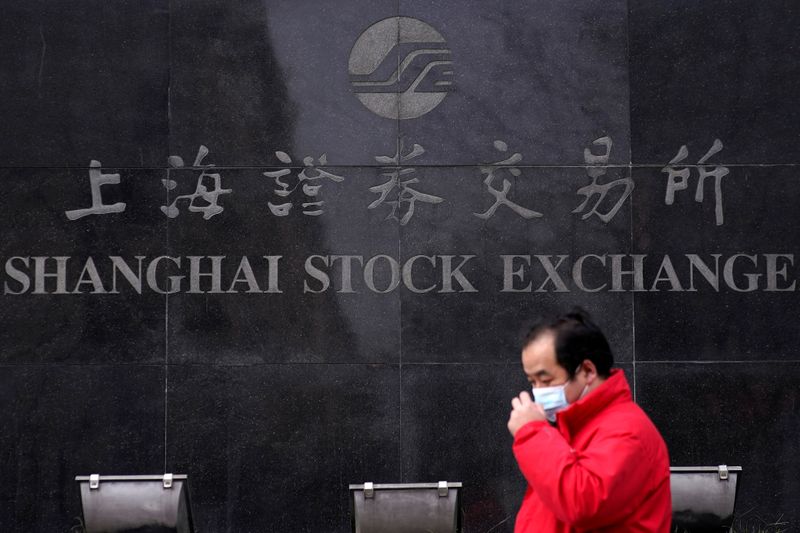
© Reuters. A man wearing a mask walk at the Shanghai Stock Exchange building at the Pudong financial district in Shanghai © Reuters. A man wearing a mask walk at the Shanghai Stock Exchange building at the Pudong financial district in Shanghai

By Swati Pandey

SYDNEY (Reuters) - Asian shares fell on Monday as the death toll from a coronavirus outbreak exceeded the SARS epidemic of two decades ago, though Chinese shares gained as authorities lifted some work and travel restrictions, helping businesses to resume operations.

In early European trades, the pan-region , German and futures all slipped 0.1% while U.S. stock futures were more upbeat with e-minis for adding 0.2%.

More than 900 people have so far died mainly in China's central Hubei province as of Sunday with most of the new deaths in the provincial capital of Wuhan, the epicenter of the outbreak.

To contain the spread, China's government had ordered lockdowns, canceled flights and shut schools in many cities. But on Monday, workers began trickling back to offices and factories though a large number of workplaces remain closed and many white-collar workers will continue to work from home.

MSCI's broadest index of Asia-Pacific shares outside Japan reversed some of its early losses but was still down 0.4%. Japan's was off 0.6%, South Korea's was 0.5% weaker while Australia's benchmark index eased a shade.

China's indexes were the only ones in the black in Asia with the blue-chip index adding 0.5% and Shanghai's SSE (LON:) Composite up 0.3%.

"Markets have turned around a bit reflecting the news that Chinese businesses were returning to work," said James McGlew, analyst at stockbroker Argonaut.

"Overall, I think, there is still a concern out there that the impact from the coronavirus hasn't been fully quantified," he added.

"Today's (easing of restrictions) seems to be more of a symbolic gesture rather than the government actually being on top of the situation with this virus."

The outbreak has killed more people than the SARS epidemic did globally in 2002/2003. The virus has also spread to at least 27 countries and territories, infecting more than 330 people overseas.

Over the weekend, an American hospitalized in the central city of Wuhan became the first confirmed non-Chinese victim of the virus. A Japanese man who also died there was another suspected victim.

Monday's losses in Asia extended from Wall Street on Friday where the fell 0.9%, the S&P 500 declined 0.5% while the Nasdaq lost 0.5%.

"Expect markets to be sensitive to virus headlines. In this environment, we favor defensive positioning," ANZ economists wrote in a note.

China's central bank has taken a raft of measures to support the economy, including reducing interest rates and flushing the market with liquidity. From Monday, it will provide special funds for banks to re-lend to businesses working to combat the virus.

Despite the measures, analysts expect the world economy to take a hit from an expected slowdown in China.

"For now, our best guess is that the economic disruption related to the coronavirus will cost the world economy over $280 billion in the first quarter of this year," Capital Economics said in a note on Friday.

"If we're right, then this will mean that global (economic output) will not grow in q/q terms for the first time since 2009."

The virus has overshadowed other market news with better-than-expected U.S. jobs data on Friday failing to lift sentiment.

Non-farm payrolls increased by 225,000 jobs in January, with employment at construction sites increasing by the most in a year amid milder-than-normal temperatures, the Labor Department said.

Euro zone bond yields fell after German industrial output tumbled in December to notch its biggest fall since January 2009, fanning concerns about the bloc's biggest economy.

The euro staged a half-hearted bounce from four-month lows to be last at $1.0949.

The dollar reversed losses against the yen to be up 0.1% at 109.79.

The Australian dollar, considered a liquid proxy for China plays, also jumped 0.4% to $0.66975 after briefly hitting an 11-year low of $0.6679. It fell 0.2% last week to clock its sixth consecutive weekly loss.

That left the flat at 98.651.

In commodities, futures eased 3 cents to $54.44 a barrel while futures was flat $50.3 a barrel.

Since Jan. 17, oil prices have fallen by 14% while is down around 10%.

U.S. inched up slightly to $1,574 an ounce.

Let's block ads! (Why?)


https://news.google.com/__i/rss/rd/articles/CBMigQFodHRwczovL3d3dy5pbnZlc3RpbmcuY29tL25ld3Mvc3RvY2stbWFya2V0LW5ld3MvYXNpYW4tbWFya2V0cy1zdGVtLWxvc3Nlcy1hcy1jaGluYS1yZXR1cm5zLXRvLXdvcmstYnV0LXNlbnRpbWVudC1qaXR0ZXJ5LTIwODAxNzLSAQA?oc=5

2020-02-10 07:46:00Z
CBMigQFodHRwczovL3d3dy5pbnZlc3RpbmcuY29tL25ld3Mvc3RvY2stbWFya2V0LW5ld3MvYXNpYW4tbWFya2V0cy1zdGVtLWxvc3Nlcy1hcy1jaGluYS1yZXR1cm5zLXRvLXdvcmstYnV0LXNlbnRpbWVudC1qaXR0ZXJ5LTIwODAxNzLSAQA