The numbers: The nation’s businesses created 125,000 private-sector jobs in October, payroll processor ADP said Thursday.
Economists polled by Econoday had forecast a gain of 125,000.
The September total for jobs added was revised down from an initial 135,000 to 93,000, ADP said.
What happened: Large businesses, meaning those with about 500 employees or more, added 44,000 jobs. Mid-sized enterprises (50-499 employees) added 64,000 positions, while small employers, or those with one to 49 workers, tacked on 17,000 jobs.
Goods-producing sectors such as manufacturing, construction and mining were a weak spot, with 13,000 jobs lost. Service-providing sectors showed strength, with 41,000 jobs added in education and health services, and 32,000 jobs tacked on in trade, transportation and utilities.
What they’re saying: Mark Zandi, chief economist of Moody’s Analytics, said in a news release that job growth “has throttled way back over the past year.”
“The job slowdown is most pronounced at manufacturers and small companies,” Zandi added. “If hiring weakens any further, unemployment will begin to rise.”
“While job growth continues to soften, there are certain segments of the labor market that remain strong,” said Ahu Yildirmaz, co-head of the ADP Research Institute, in the release. “The health-care industry and mid-sized companies had solid gains.”
Big picture: The American economy has been slowing, and economists have predicted that job creation will continue to lose steam due to a trade war with China that has damaged the global economy and boomeranged on the U.S.
Wednesday’s ADP report comes ahead of the more closely watched release on nonfarm payrolls from the federal government on Friday.
Market reaction: Futures for the Dow Jones Industrial Average
YMZ19, -0.19%
were little changed on Wednesday, as traders waited for a Federal Reserve decision.
Call me crazy, but in a market already saturated by streaming services — and not to mention upcoming options from the likes of Disney and Apple — I’m more than a bit intrigued by HBO Max. Aside from the confusing matrix of names (HBO Max, HBO GO, HBO Now), the reality is that HBO Max really looks to be a compelling offering. With a rumored price point in the $15 range, HBO Max will not only offer up everything currently available on HBO, but additional content from Warner Bros., New Line, DC Entertainment, TNT, TBS, the Cartoon Network, and much more.
What’s interesting about the impending launch of HBO Max is that AT&T seems completely unfazed by what is undeniably a crowded field of competitors. During an earnings conference call earlier this week, AT&T CEO Randall Stephenson seemed to downplay rivals by insisting that HBO Max is so unique as to clearly stand apart from other streaming services.
“This is a product that’s going to be very different from anything else that you’ve seen in the market so far,” Stephenson boasted. “This is not Netflix. This is not Disney. This is HBO Max.”
While it’s certainly easy to poke fun at Stephenson’s remarks, there’s no denying that HBO Max will have an absolute treasure trove of content, including the exclusive rights to Friends and The Fresh Prince of Bel-Air.
While it remains to be seen how consumers take to HBO Max — and pricing will certainly be a huge factor — it’s clear that AT&T has extremely high hopes for its burgeoning streaming service. Recently, AT&T COO John Stankey relayed that the company is aiming to have upwards of 80 million subscribers by 2021, an ambitious goal to say the least.
Image Source: HBO
from Business - Latest - Google News https://ift.tt/32ZcWLZ
via IFTTT
October 30, 2019 at 09:05AM
A push to create a national Silver Alert system that would attempt to help locate elderly individuals suffering from diseases like Alzheimer's and dementia has so far been met with a cool response from jurisdictions across the country.
Even the Alzheimer's Society of Canada has expressed a lack of enthusiasm for a system — similar to Amber Alerts for missing children — that could send out information to the public through smartphones, email, radio and TV networks.
"We aren't endorsing them because there isn't robust evidence that they actually work," said Mary Schulz, director of education of the Alzheimer Society of Canada.
But Schulz also noted that alert fatigue might be an issue in terms of "how much people will actually pay attention if they're being bombarded with Silver and Amber and who knows what … other kinds of alerts."
"We need really robust academic research to be done on these kinds of alerts before, I think, we would invest," she said.
According to the Alzheimer Society of Canada, an estimated 564,000 Canadians are living with dementia. By 2031, this figure is expected to rise to 937,000 — an increase of 66 per cent.
Sam Noh has advocated for a Silver Alert program since his father disappeared after going for a walk in Coquitlam, B.C., in September 2013. (Tina Lovgreen/CBC)
Sam Noh, an advocate of Silver Alerts, spoke to CBC News recently about implementing such a system. His father disappeared in Coquitlam, B.C., in 2013 and never returned. Noh said he heard people had seen his dad in the first day he went missing, but didn't know how to report it.
"The chance of survival decreases after 24 hours. If we had the Silver Alert program, we could quickly spread that information about the disappearance," Noh told CBC British Columbia's All Points West.
Sophia Aggelonitis, a former Ontario provincial cabinet minister who was responsible for the seniors portfolio, founded Silver Alert Canada and has been pushing for a nationwide program.
"Despite information about prevention strategies and the use of locating devices, seniors still go missing," said Aggelonitis, whose own grandmother once wandered away. "A Silver Alert would be an addition to ongoing strategies."
How such a system would work, and whether it would be similar to the Amber Alert system, would be up to the regions and dependent on the situation, she said.
"If a senior walks away, takes their car or is likely to travel by bus etc., each situation would determine the right type of alert to be issued," said Aggelonitis. "I believe the best authorities to determine the type alert protocol would be the police."
Many U.S. states use system
Many states in the U.S. employ such a system, each with its own criteria as when to issue such alerts. In California, for example, an alert will only be issued if a missing person is 65 or older, developmentally disabled or cognitively impaired, and the law enforcement agency has determined that the person has gone missing under "unexplained or suspicious circumstances."
States will use various means of informing the public that a person is missing, including "be on the lookout" broadcasts to other law enforcement, through the media, as well as dynamic-message signs next to highways.
To combat the issue of alert fatigue, some, like Noh, have lobbied for a localized or geo-targeted approach to Silver Alerts. In places like Florida, for example, the local law enforcement agency will activate a local or regional Silver Alert and determine the areas for activation.
Sophia Aggelonitis, a former Ontario cabinet minister, founded Silver Alert Canada and has been pushing for a nationwide program. (Sophia Aggelonitis/Twitter)
But Silver Alerts have yet to become popular in Canada.
In 2017, Alberta and Manitoba amended their Missing Persons Act to allow for Silver Alerts. The amendments allow police to activate alerts in certain circumstances involving vulnerable people with cognitive impairments and to provide the public with information about a missing individual.
Winnipeg Police Service Sgt. Rick McDougall said in the past year, their force has issued two such alerts and both were successful in helping locate the missing individuals.
In one case, an older gentleman had driven to a local shopping mall and then went missing. His vehicle was recovered but he was nowhere to be found and police later learned he was suffering from a cognitive impairment.
"We issued media releases, as well as social media releases, immediately under the Silver Alert. And actually as a result of that, [he was] located … quite some distance away from where [he] went missing."
Very different than Amber Alerts
McDougall stressed that the system is very different than Amber Alerts in that it disseminates information about a missing person to the public through the media and social media — and not through texts and alarms via mobile phones. Nor does it automatically interrupt public broadcasts. However, he notes, the media can choose to broadcast the information if they deem it appropriate.
Although Alberta now allows for Silver Alerts, the Calgary Police Service has so far not used them. A spokesperson with the force said their missing persons unit classifies elderly missing persons as high risk, especially those who have a history of Alzheimer's or dementia, and that their cases are prioritized in regards to resources and response.
In Ontario, the provincial government explored the idea in 2011 but later shelved the proposal. In a statement to CBC News, the Ontario Ministry for Seniors and Accessibility said if someone with dementia goes missing, police treat it as an emergency, and if an alert is required, "the police will issue one similar to what was previously known as a 'Silver Advisory.'"
Yet support for a nationwide system has failed to gain traction, says Aggelonitis.
Her organization launched an online petition for a Silver Alert system that was presented to the House of Commons last February. Months later, then-Public Safety Minister Ralph Goodale responded, saying that the federal government was instead developing a national dementia strategy.
Goodale also noted that officials who oversee the National Public Alerting System policy, which details the types of emergency alerts that can be sent through the system, had not been approached by any province or territory to amend their policy and utilize the system for Silver Alerts.
Amber Alerts in Canada now sound an alarm on people's mobile devices. Based on the systems in place in some provinces and U.S. states, that's unlikely to happen under a Silver Alert system. (Kate Bueckert/CBC)
Schulz, from the Alzheimer Society of Canada, said that instead of alerts, more focus should be placed on educating families and caregivers to be more proactive in ways to prevent their loved ones from going missing.
People also need to be more aware or look for signs that someone may be in trouble, she said, such as seeming to be out of place or perhaps being inappropriately dressed on a cold day.
"That societal issue is one that is really growing in momentum, where we are starting to appreciate that if there is someone who's walking around in a housecoat in –25 degree weather, that there should be somebody that we can call," said Schulz.
The Alzheimer Society has a partnership with MedicAlert, she said, which makes it rather simple if you encounter someone who seems in distress: Simply call the number on the bracelet.
"These kinds of strategies — we need to make it easy for people to be helpful," said Schulz.
Aggelonitis agrees that providing information about wandering-prevention strategies and locating devices is paramount, especially when someone is newly diagnosed.
"However, I also believe that these initiatives, in combination with a Silver Alert public notification system, will help find seniors … and isn't that what we all want?"
from Business - Latest - Google News https://ift.tt/34fiEcJ
via IFTTT
October 30, 2019 at 03:00PM
U.S. President Donald Trump looks on as Jerome Powell, his nominee to become chairman of the U.S. Federal Reserve, walks to the podium at the White House on Nov. 2, 2017.
Carlos Barria/Reuters
President Donald Trump launched a fresh attack on the U.S. Federal Reserve on Tuesday as policymakers opened a two-day meeting that was expected to end with a decision to lower interest rates.
“The Fed doesn’t have a clue! We have unlimited potential, only held back by the Federal Reserve,” Trump said on Twitter.
Trump, in a departure from his White House predecessors who refrained from commenting on Fed policy, has made a habit of criticizing the U.S. central bank for decisions he argues kept borrowing costs too high for too long.
from Business - Latest - Google News https://ift.tt/2ozUIBO
via IFTTT
October 29, 2019 at 10:36PM
Saudi Aramco told bankers working on its initial public offering that it earned $68 billion in the first nine months of 2019, Bloomberg reported Tuesday.
The disclosed earnings establish Aramco as the world's most profitable company ahead of its record IPO.
The nine-month figure is likely dragged down by September drone attacks on Aramco facilities. The state-owned firm was forced to rely on oil reserves as it repaired damaged infrastructure.
Saudi Aramco told bankers associated with its upcoming initial public offering that it earned $68 billion in the first nine months of 2019, Bloomberg reported Tuesday.
The massive stockpile establishes the state-owned firm as the world's most profitable company.
The news arrives as the oil producer prepares the largest IPO in history. Aramco is looking to float 1% to 2% of its shares on Saudi Arabia's Tadawul market before offering the remainder of a 5% stake to international investors.
The public offering process will officially kick off Sunday and trading is slated to begin December 11, according to state TV channel Al Arabiya. Saudi Aramco has not confirmed those dates.
Saudi Crown Prince Mohammed bin Salman previously called for the company to be valued at $2 trillion, but analysts and investors have balked at the lofty valuation. If the 5% stake is offered at a $2 trillion valuation, the public offering could bring in as much as $100 billion, four times the largest IPO to date.
Aramco disclosed its nine-month earnings to analysts working on the offering, and comparative figures from prior periods or future projections aren't yet public. The oil company previously disclosed income of $111 billion for all of 2018.
The disclosed earnings are likely lower than the company's projections, as they cover the period when oil production was crippled by September drone attacks. The strikes led the price of oil to spike as much as 20%, and Aramco was forced to rely on reserves as it repaired damaged infrastructure.
Production will return to "maximum sustained capacity" by the end of November, CEO Amin Nasser told CNBC earlier in October.
Apple is currently the world's most profitable public company, reporting $59.35 billion in net income for 2018.
Now read more markets coverage from Markets Insider and Business Insider:
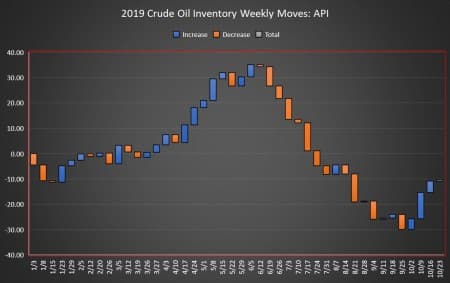
The American Petroleum Institute (API) has estimated a small crude oil inventory build of 592,000 barrels for the week ending October 24—close to analyst expectations of a 729,000-barrel build.
Last week saw a large build in crude oil inventories of 4.45 million barrels, according to API data. The EIA’s estimates, however, disagreed, reporting a draw of 1.7-million-barrel build for that week.
After today’s inventory move, the net draw for the year is now dwindling at 10.23 million barrels for the 44-week reporting period so far, using API data.
Oil prices were trading down on Tuesday prior to the data release, confused with conflicting reports that Saudi Arabia—the kingpin of OPEC—is willing to cut deeper at the December OPEC meeting, while Russia continues to suggest indirectly that it might not be interested in doing more. On top of that, and potentially more worrisome, is the demand growth prospects for oil that most analysts are predicting.
At 11:08am EDT, WTI was trading down $0.60 (-1.08%) at $55.21 per barrel—up $1 week over week. Brent was trading down $0.32 (-0.52%) at $60.93, up roughly $1.50 per barrel week on week.
The API this week reported a build of 1.599 million barrels of gasoline for week ending October 24. Analysts predicted a draw in gasoline inventories of 2.333 million barrels for the week.
Distillate inventories grew by 1.998 million barrels for the week, while inventories at Cushing fell by 846,000 million barrels.
US crude oil production as estimated by the Energy Information Administration showed that production for the week ending October 18 stayed at 12.6 million bpd for the third week in a row—the highest production level that the United States has seen.
At 4:45pm EDT, WTI was trading at $55.47, while Brent was trading at $61.12.
Julianne Geiger for Oilprice.com
More Top Reads From Oilprice.com:
from Business - Latest - Google News https://ift.tt/2NmwdjV
via IFTTT
October 30, 2019 at 02:56AM
Yum Brands – Yum earned an adjusted 80 cents per share for its latest quarter, 14 cents a share shy of consensus forecasts. Revenue also came in below estimates, hurt by a weaker-than-expected performance at its Pizza Hut and KFC units.
Anixter International – The software company agreed to be acquired by private-equity firm Clayton, Dubilier & Rice for $81 per share in cash. The total value of the deal is $3.8 billion including assumed debt, with the transaction expected to close by the end of 2020's first quarter.
Molson Coors – The beer brewer fell a penny a share short of estimates, with quarterly profit of $1.48 per share. Revenue also came in short of forecasts and Molson Coors announced a restructuring that will slash up to 500 jobs.
Garmin – The GPS and fitness device maker earned $1.19 per share for its latest quarter, well above the 95 cents a share consensus estimate. Revenue also topped forecasts. Garmin saw better-than-expected results in all its units, as well as higher-than-expected profit margins.
Tupperware – Tupperware earned an adjusted 43 cents per share, well short of the 62 cents a share consensus estimate. The housewares maker's revenue also came in short of forecasts. The company said it was experiencing challenging trends in markets like the U.S., China, Canada, and Brazil. Tupperware also cut its full-year earnings outlook.
Johnson & Johnson – J&J said its testing found no asbestos in its Johnson's Baby Powder. That testing included a single bottle that the Food and Drug Administration had said contained trace amounts of asbestos, prompting J&J to recall a lot of 33,000 bottles earlier this month.
Fiat Chrysler – Fiat Chrysler said it was in talks about a possible merger with Peugeot maker PSA that could create a combined company worth about $50 billion. Fiat Chrysler had abandoned talks earlier this year to merge with France's Renault.
Amgen – Amgen reported quarterly profit of $3.66 per share, 13 cents a share above estimates. The biotech company's revenue also beat forecasts and Amgen raised its full-year guidance amid strong sales of its biosimilar drugs.
Electronic Arts – Electronic Arts reported quarterly profit of 96 cents per share, 10 cents a share above estimates. The video game maker's revenue also topped estimates. Electronic Arts saw stronger digital sales, including game downloads and in-game purchases.
Mattel – Mattel came in 10 cents a share above estimates, with quarterly profit of 26 cents per share. The toy maker's revenue was slightly above Wall Street forecasts. Mattel also said it is restating some past earnings following an internal investigation into accounting issues, and the company's chief financial officer is resigning.
Mondelez International – Mondelez reported quarterly profit of 64 cents per share, 4 cents a share above estimates. Revenue was slightly above forecasts. The snack maker raised its full-year outlook, as sales volume increases across its major markets.
FireEye – FireEye raised its annual revenue guidance, after doubling estimates by reporting quarterly profit of 2 cents per share. The cybersecurity company's revenue also beat forecasts as it sold more cloud subscriptions.
Advanced Micro Devices – AMD reported adjusted earnings of 18 cents per share, in line with Street forecasts. Revenue was very slightly below estimates, although the chipmaker reported better-than-expected results for its data center business.
Yum China – Yum China beat analyst estimates by 3 cents A share, with quarterly profit of 58 cents per share. The restaurant operator's revenue was below forecasts, however, as were comparable-restaurant sales at KFC, Pizza Hut, and Taco Bell.
Sony – Sony reported its best-ever second-quarter profit, driven by strong sales of its image sensors. Sales helped offset a drop in earnings from Sony's gaming division.
Edison International – Edison's Southern California Edison unit said its equipment will likely be found to have been associated with a 2018 California wildfire that damaged more than 1,000 homes in Los Angeles and Ventura counties.


/arc-anglerfish-tgam-prod-tgam.s3.amazonaws.com/public/MDVTG4KWEFF7POPJFAVEYBUDOQ.JPG)