Kamis, 31 Oktober 2019

Varcoe: Encana's founding CEO laments company's 'disturbing' southward shift - Calgary Herald

Gwyn Morgan, the founding CEO of Encana, says the company's '"centre of gravity" has been shifting for years. Peter J. Thompson / PST

It should not come as a shock that Encana Corp. is uprooting its corporate flag and moving its headquarters to the United States.

It certainly didn’t catch Gwyn Morgan off guard.

The founding CEO of the major Calgary-based petroleum producer, who retired in 2005, noted Encana’s “centre of gravity” has been shifting for years.

When the company placed more focus on U.S. growth, or when current CEO Doug Suttles began working out of the company’s offices in Denver, or Encana said it was adopting a “headquarter-less model,” or made a US$7.7-billion purchase of Texas-based Newfield Exploration a year ago, the signs all pointed in the same direction.

Southbound.

However, for a city, province and industry struggling from a prolonged downturn, the news still stings.

“It’s sort of the step that all of us hoped wouldn’t happen, especially the employees and the guy who founded the company. But it is disturbing and not surprising,” Morgan said Thursday in an interview.

“But there is a sense of loss anyway because it’s hard to come from being a proud Canadian-headquartered company, with a mission, to be sort of a branch office.”

Encana announced early Thursday it was changing its name to Ovintiv Inc., and intends to establish its corporate domicile in the United States, pending approval by stock exchanges, courts, as well as shareholders, next year.

The company said the shift should help it attract larger pools of investment. Encana pointed out its main American competitors have 20 per cent more index and passive ownership than it does being a Canadian-based firm.

Suttles insists the change won’t affect jobs or capital allocation in Canada, although it’s hard to see how this isn’t another step in a slow-motion shuffle southward.

“We don’t want people to see this as some negative reflection on Canada,” he told BNN Bloomberg television.

How else should people read it?

Yes, the company still has a big presence in the Bow building and excellent assets in the Montney and Duvernay formations.

It still has 40 per cent of its workforce, about 1,100 people, in Canada. This is nothing to sneeze at.

“Make no mistake, we have a long and proud history in Canada, and our assets here are world-class,” Suttles told analysts on a conference call. “How we operate the business and run the business will not change.”

However, the decision to change its name and shift its corporate base to the U.S. speaks volumes about where its future lies, underscoring the challenges facing the country’s energy sector as investment, equipment and people head elsewhere.

A number of other internationally-based companies have retreated from the country after oil prices tanked and the industry began a painful restructuring.

“This is a tragedy for Canada,” said Alex Pourbaix, CEO of Cenovus Energy, the Calgary-based oilsands producer that was spun out of Encana in 2009.

“There’s a more fundamental issue going on, and that is over the past five or six years, we have generally seen an exodus of investment, both by international companies and, frankly, by Canadian companies.”

While local jobs may not be lost, Morgan said it is significant when the top decision-makers aren’t in the country.

A native of Carstairs, Morgan recalls when he first started in the industry in the 1970s, there were few large Calgary-headquartered operators. Most of the key decisions were made elsewhere.

Encana was created following the blockbuster announcement in January 2002 that Alberta Energy Co. and PanCanadian Energy Corp. would merge in a $27-billion union. The company’s name even fused the words “energy” with Canada to promote its brand.

By the time Morgan retired last decade, Encana was the largest company in Canada by market capitalization, ahead of the country’s big banks.

“It was a fulfilment of what I called my lifelong ambition to create a great Canadian-headquartered company that wouldn’t go, that would never be taken over, and move to somewhere else,” he added.

“But I never expected that the company would end up, if I can put it this way, exporting itself to the U.S.”

Now, some people will say Thursday’s decision isn’t significant, the company isn’t relocating jobs, it’s still drilling and producing large volumes in the Western Canadian Sedimentary Basin, and the country remains part of its future.

Let’s hope time proves them right.

However, Morgan isn’t convinced the changes are minor, noting a head office means more than just a place to call home. It means having corporate positions centralized in the city, spending money in the local economy, remaining active in local sponsorships and charitable work, and having a sharper focus on its home turf.

“There’s just a big difference overall when the decisions are being made somewhere else about the business sector in your country,” he said.

You also don’t have to look very far to see the constant challenges the Canadian oilpatch faces.

On the same day as Encana unveiled its new name and is moving its base to the U.S., the Alberta government announced it’s modifying its oil curtailment program, allowing companies with extra crude-by-rail capacity to produce more than their provincial quotas.

This should allow some growth to return to the sector. Yet, it wouldn’t be necessary to tinker with quotas if we had sufficient pipeline capacity in the first place.

Meanwhile, the Petroleum Services Association of Canada released a new forecast that only 4,500 oil and gas wells will be drilled in the country next year, a 10 per cent drop from this year’s already-low levels.

Changes to curtailment, less drilling and a high-profile company shifting its corporate base into the U.S. aren’t the problem, they’re the symptoms.

An inability to build pipelines, changing investment patterns, weak commodity prices, the push toward decarbonization and federal regulatory obstacles all signal that growth prospects are limited in Canada, at least for the time being.

And this is what the Encana announcement represents, a steady retreat, a drumbeat of negative news, and a longing for the times when industry was focused on building world-class operators within Canada, not watching them head south.

Chris Varcoe is a Calgary Herald columnist.

cvarcoe@postmedia.com


from Business - Latest - Google News https://ift.tt/2PAyBWY
via IFTTT
November 01, 2019 at 07:02AM

SeaBus service first to be affected by transit strike: Union - Vancouver Sun

Talks between the union and Coast Mountain Bus Company broke off Thursday afternoon with no deal reached.

When Metro Vancouver transit workers go on strike Friday, the first thing commuters will notice is that SeaBus service will likely be cut back by one boat for the afternoon rush.

Contract talks between Coast Mountain Bus Company (CMBC) and Unifor, the union that represents about 5,000 bus operators, maintenance workers and SeaBus employees broke off Thursday.

Earlier in the week, the union announced that if a tentative deal wasn’t reached by 8 a.m. on Friday, strike action would begin with a ban on uniforms by transit operators, and the company’s technicians and skilled-trades workers refusing to work overtime.

“The greatest impact will be at SeaBus,” said Mike Smith, president of Unifor Local 2200, which represents bus maintenance staff and SeaBus workers. “Probably right off the bat we’ll probably be down a boat. They do not have the people to run the boats.”

SeaBus provides service between Downtown Vancouver and the North Shore, and this summer TransLink added a third vessel, which had been used as a spare, into the rotation to provide more service during peak periods. Smith said the morning rush hour will look the same, but by the afternoon that third boat will be gone because every boat must have an engineer on board, and engineers work OT every day because there is a shortage of skilled workers.

“There is no contingency plan for that either,” Smith said.

The SeaBus likely will be affected first by the transit strike. Arlen Redekop / PNG

That means the SeaBus will be back to 15-minute intervals instead of 10 minutes, and people will be waiting to get on a crowded boat.

“There’s a lot more people riding that boat than there ever has been,” Smith said. “They’re going to get home — it’ll just be a lot longer.”

Smith said the overtime ban for maintenance workers won’t be noticed right away, but it will gradually increase pressure on the system. Mechanics work “sporadic overtime” to catch up on overdue work, like fixing buses that have broken down or conducting mandated vehicle inspections that have backed up, and without OT there will be fewer buses available.

“The buses will be slower impact — not smaller but slower,” Smith said. “The longer this goes on, the less buses will be on the road because it will back up; the maintenance will back up.”

TransLink spokesperson Jillian Drews said it’s not possible to tell customers which routes and runs will be cancelled.

“Reduced maintenance will shrink the fleet size. It’s fair to say there will be service reduction,” said Drews in an email.

Unifor national president Jerry Dias said the goal is a fair contract that ensures members are working under safe and reasonable conditions.

“To minimize the disruption to the public while still ramping up pressure on the employer, we have chosen a measured level of strike action in the first phase,” he said in a statement.

Gavin McGarrigle, Unifor’s western regional director, said Wednesday the union is asking for measures that would reduce overcrowding, service increases and more reasonable break times for its members. Passengers are packing onto buses “like sardines” or can’t board buses because they’re too crowded, while the tense environments mean drivers are more likely to be subjected to violent outbursts like one recorded on video this week of a passenger kicking a door, then spitting on a driver, he said.

Drivers complain that they often don’t get breaks from driving because increasing traffic congestion makes it hard to stay on schedule.

Coast Mountain said Thursday that it’s “negotiating in good faith” and has made fair and reasonable offers. In a prepared statement the company said if the union proceeds with job action, it will only punish transit users in Metro Vancouver.

“Without maintenance overtime, we will see bus and SeaBus service cancellations affecting customers,” said CMBC president Michael McDaniel.

He said the company has been bargaining with the union since Aug. 1 but the union has refused to participate in third-party mediation.

“CMBC is now back at the table and our current offer includes significantly better wages and benefits, and addresses working conditions,” said McDaniel. “This package would be greater than most other public sector settlements in B.C. I urge the union to hold off on job action until a deal is done.”

The company said many services will not be affected by the strike, including SkyTrain, West Coast Express, HandyDart, the West Vancouver Blue Bus and other contracted services.

If it comes to a full shutdown, like the one that happened in 2001, experts say the labour dispute could have significant consequences for an urban area that relies heavily on transit.

“If we do have a serious disruption that lasts an extended period, it’s going to set back the progress that has happened to shift people to more sustainable urban mobility options here in Vancouver,” said Anthony Perl, professor of urban studies and political science at Simon Fraser University.

Public transit plays an increasingly important role in the regional transportation network as the population grows and the space for new roads and infrastructure doesn’t, he said.

Ridership reached an all-time high in 2018. The number of boardings increased more than seven per cent across the system, representing the largest ever annual increase in transit use.

Buses are the most widely used transit service in the region, with an average of 20 million boardings per month, or 262 million boardings last year. Almost two-thirds of all transit journeys are by bus, and almost three-quarters of transit journeys include a bus connection. Bus ridership grew by eight per cent last year.

Mayor Mike Little of the District of North Vancouver said he and other regional mayors have been pushing for increased transit funding: “People are becoming more comfortable with relying upon the service but it’s really, really stressed.”

• Transit users are being advised to sign up for transit alerts at translink.ca and to follow @TransLink on Twitter.

— With files from David Carrigg and The Canadian Press

jensaltman@postmedia.com

ticrawford@postmedia.com

CLICK HERE to report a typo.

Is there more to this story? We’d like to hear from you about this or any other stories you think we should know about. Email vantips@postmedia.com.


from Business - Latest - Google News https://ift.tt/2Wt2l9w
via IFTTT
November 01, 2019 at 07:33AM

Keystone pipeline shut after spilling over 1 million litres of oil in North Dakota - CBC.ca

An estimated 1.4 million litres of oil have spilled from TC Energy Corp.'s Keystone crude pipeline in North Dakota, state authorities said on Thursday, a major leak at a time of increased regulatory scrutiny of oil pipeline expansions.

The cause of the rupture has not yet been disclosed. But the initial estimate makes it one of the biggest onshore crude spills in the past decade and the largest for Keystone, according to U.S. Pipeline Hazardous Materials and Safety Administration (PHMSA) data.

Pipeline operator Calgary-based TC Energy has been seeking to expand its pipelines linking Western Canadian oil fields to U.S. refineries with its proposed Keystone XL project. The $6 billion US ($7.8 billion Cdn) project has faced regulatory and environmental hurdles despite backing by U.S. President Donald Trump.

A nearly 10-year legal fight between TC Energy, formerly called TransCanada, and environmental activists has delayed development of the line that would run from Alberta to the U.S. Gulf Coast. A Nebraska court in August affirmed an alternative route through the state, raising hopes the project might proceed and provide badly needed transport for Alberta's crude.

On Wednesday, TC Energy said its 93.8 million litre-per-day (lpd) Keystone pipeline system to the United States was shut after a drop in pressure was detected. It said there were no injuries and it was investigating the cause of the breach near Edinburg, N.D.

The company has not said when pipeline operations would restart, but told shippers that service to U.S. Midwest refiners would remain shut during the outage. The line could remain shut for at least a week, according to market sources on Thursday.

TC Energy has begun using backhoes and vacuum trucks to recover the spilled oil, said Brent Nelson, an emergency response manager for Walsh County who visited the site.

"At this time I would estimate 50 to 75 persons onsite working between two shifts.... They are focusing on oil recovery at this time and will then move to making repairs," he said.

The exact amount of oil released will not be available until recovery has been completed, TC Energy said in a statement on Thursday.

In 2017, a Keystone crude pipeline leak in rural South Dakota spilled nearly 1.04 million litres, PHMSA data showed. Earlier this year, Keystone was partially shut after leaking 6,800 litres of crude in Missouri.

The latest release also affected a wetland area, a statement from the North Dakota Department of Environmental Quality said.

"It [Keystone] went in during the 1990s. They've had a few spills ... more than you would hope to have on a line that's still fairly new," said Carl Weimer, executive director of the Pipeline Safety Trust in Bellingham, Wash., a non-profit promoting pipeline safety.

Keystone has leaked substantially more oil, and more often, in the U.S. than the company indicated to regulators in risk assessments before operations began in 2010, according to a Reuters review in 2017.

Marketlink pipeline disrupted 

The Keystone outage also disrupted flows on the Marketlink pipeline, which has a capacity to flow 119 million lpd and is connected to Keystone, roiling oil prices at the delivery point for U.S. crude futures. 

On Wednesday, TC Energy said on its website that the Marketlink system was not affected by the Keystone outage, which was shut from Hardisty, Alta., to Cushing, Ohio and to Wood River-Patoka, Ill.

By Thursday, sources said the rates on the Marketlink were reduced, with one source saying the line was operating at about 30 million lpd.

However, market intelligence firm Genscape said on Thursday afternoon that Marketlink shut from reduced rates at approximately 47 million lpd earlier in the day.

"[This incident] underscores the structural issue plaguing the Canadian oil industry," said Michael Tran, managing director of global energy strategy at RBC Capital Markets.

"While it is too soon to draw comparisons to last year's historic pricing disconnect, the stranded barrels may raise similar fears if the outage proves longer than historical precedents," Tran said.

TC Energy said in a statement it would focus on cleaning up the spill and preparing to make Keystone pipeline repairs.


from Business - Latest - Google News https://ift.tt/320EAXr
via IFTTT
November 01, 2019 at 05:47AM

BC Ferries passengers handed travel bans after spate of abusive incidents - CityNews Vancouver

VICTORIA (NEWS 1130) — In the last two weeks, customers have been banned from BC Ferries for abusive behaviour targeting employees–one for driving a car toward a worker, one for threatening to use a weapon, and one for an alleged sexual assault.

The passengers involved have all been issued one-year travel bans and the incidents have all been reported to the police, according to Mark Collins, President and CEO.

“Under federal law BC Ferries is entitled to deny travel in circumstances like this and that’s what we’ve done,” he says.

On Oct. 15 at the Langdale terminal, a customer was banned after being arrested.

“The customer pulled his car out of the designated lane and drove aggressively at one of our employees. Our employee had to jump out of the way to protect themselves.”

Two days later, at Horseshoe Bay an upset customer threatened to come back to the terminal with a gun after a dispute with a worker. The incident was reported to police and that customer was similarly banned.

On Oct. 22 a man was arrested at the Tsawwassen terminal after an employee reported a sexual assault.

Collins says bans can also be imposed on customers whose behaviour doesn’t rise to the level of a criminal offence, saying verbal harassment will not be tolerated.

“This is one of the primary enforcement methods that BC Ferries has to ensure that passengers treat our employees with respect.”

Collins says the vast majority of the 23 million people who board ferries each year behave themselves, estimating 150 travel bans are issued annually.

“In the scale of how many people we’re handling, it’s not a huge number but it’s very important that our employees have a safe and respectful environment and so when these happens we take it seriously.”

He explains that a wave of these incidents is not uncommon, especially during busy weekends when sailings are delayed and tempers are frayed.

“Approach our staff in a respectful manner and we will do everything that we can to ensure that you have a good travel experience. In return, our expectation is that BC Ferries workers have a safe and respectful work environment.”

With files from Ria Renouf and Marcella Bernardo


from Business - Latest - Google News https://ift.tt/2plWEON
via IFTTT
November 01, 2019 at 06:31AM

As Encana becomes Ovintiv, the rebrand begs a question: What the hell is an Ovintiv? - National Post

EDMONTON — Thursday morning, Encana, a major oil and gas firm headquartered in Calgary, announced it would be moving its head offices to Denver and renaming the company Ovintiv Inc.

That, in the immediate aftermath of the announcement, raised a key question: what exactly is an Ovintiv? And, how does such a well-known company attempt to stay relevant — or become relevant again — when its brand is being wiped out and rebuilt.

Canoe Financial senior portfolio manager and director Rafi Tahmazian said that Encana was among the two most recognizable brands in the Canadian oil and gas industry.

“Short of Petro Canada, that’s the DNA, that’s the heart and soul of what we were,” he said.

He added the domestic oil and gas industry is suffering from a larger branding crisis.

“Canada is no longer a place that’s associated with innovation, success in the energy industry,” Tahmazian said, adding that it’s sad because the country has better technology than what is available in the U.S.

Canada is no longer a place that's associated with innovation, success in the energy industry

When Canadian drilling rigs move South, he said, “they look like transformers.”

Plugging the term into Google Translate, it’s recognized as Albanian. But, it doesn’t actually translate into anything in English. Online, some speculated it could be a mashup of “Ova” (perhaps for rebirth) and “inventive” (meaning the obvious).

“Adopting a new corporate name reflects the transformation we have experienced, while articulating our vision for the future,” say briefing documents from Ovintiv. “The new name stands for our commitment to deliver unmatched value through continuous innovation, while our new logo symbolizes the human connection made possible by the safe, reliable and affordable energy we produce.”

Youssef Youssef, a commerce professor at Humber College in Toronto, says there’s a substantial amount of work that goes into rebranding, especially for a company as old and significant as Encana and it has significant effects on the value and continued success of a company.

A yellow Encana natural gas pipeline marker is seen in this file photo taken in Kalkaska, Michigan June 20, 2012. REUTERS/Rebecca Cook

“(Encana) was a solid brand and it had resonance within the Canadian oil industry, and everybody knows the company, so to change the brand, it takes a lot of steps,” Youssef says

There is all sorts of market research that must go into determining the brand value among shareholders and the business community, not to mention the messaging about reshaping the brand and the practical matter of overhauling social media, websites and so on.

“It’s not just by changing the name,” Youssef says. “You need to create everything.”

Dan Bergeron, managing partner of the Calgary-based marketing firm Everbrave, says there’s a large amount of work that must go into explaining to everyone why a name has been changed, especially for an operation the size of Encana, and that involves scads of advertising and exhaustive public relations outreach.

“You can’t just change and say ‘hey, guess what, we have a new name, you know, everybody,’ but you’ve got to be like ‘there’s a reason why we did this, and this is why it’s important to us and why it’s important to our customers’ and celebrate that as a good thing,” Bergeron said.

As of mid-day Thursday, Ovintiv had little presence online, other than a dedicated page on the Encana website explaining the changes, and a quick search of possible other web homes for the company revealed nothing, so far, with very little — if any — social media presence. Ovintiv.com was registered to a New York-based branding company, Fross Zelnick Lehrman & Zissu, P.C.; @ovintiv, on Twitter, had but one follower, perhaps not even related to the company.

“I’m really very surprised they don’t have the domain registered so far, they don’t have the social media … it’s not how do we do things in marketing,” Youssef says.

As for the name, marketing students do learn that there are some ways that you want to go about choosing an appropriate name: “They should be memorable, meaningful, likeable, transferable, adaptable, protectable, these are the six steps that need to be taken when you choose the brand.”

But they can be anything, really, whether it’s a surname, some sort of acronym or, plainly, something invented out of whole cloth that eventually comes synonymous with a product or service.

That, certainly, is what this looks like to Youssef, “like, Xerox, Kodak, Häagen-Dazs or any other brands that make less sense but it may stick,” Youssef said.

With a file from Geoffrey Morgan

• Email: tdawson@postmedia.com | Twitter:


from Business - Latest - Google News https://ift.tt/2C1QDJw
via IFTTT
November 01, 2019 at 02:10AM

Talks break down between Metro Vancouver transit union, bus company - CityNews Vancouver

VANCOUVER (NEWS 1130) – Talks have broken down between the union representing bus drivers and Coast Mountain Bus Company, making job action with Metro Vancouver transit tomorrow more likely.

Earlier this month, more than 5,000 members of Unifor locals 111 and 2200, representing bus drivers, SeaBus and maintenance staff, voted 99 per cent in favour of job action against CMBC, which operates on behalf of TransLink.

The union says uniform bans and bans on maintenance worker overtime will be the first phase of job action come Friday.

Wages, benefits and working conditions are key issues in the dispute.

More to come.


from Business - Latest - Google News https://ift.tt/36ngR7h
via IFTTT
November 01, 2019 at 02:56AM

A monster French-Italian-American car deal that might only slow inevitable decline - The Globe and Mail

The proposed merger of Fiat Chrysler Automobiles and France’s PSA Group is an admission that the future of car manufacturing is going to be highly expensive, arduous and possibly nothing more than a fight against long-term decline. Bulking up will buy time, not guarantee a prosperous future.

On Thursday morning, the two car groups unveiled a plan that would create the world’s No. 4 automaker (measured by unit sales totalling 8.7 million), putting it behind Volkswagen, Toyota and Renault-Nissan and just ahead of General Motors.

The enlarged group would be enormous, one with the clout to challenge mighty VW in Europe. It would have combined revenues of €170-billion, recurring annual operating profit of about €11-billion, a market value based on current prices of about €45-billion and more than 400,000 employees scattered around the planet, though mostly in Europe and the United States.

Story continues below advertisement

Fiat Chrysler, Peugeot plan to create world’s No. 4 automaker

Its brands would include Peugeot, Citroën, Vauxhall and Opel (from PSA); Fiat, Alfa Romeo and Maserati (from Fiat); and Jeep, Ram and Dodge (from Chrysler). The shares of the as-yet-unnamed – and possibly unwieldy – fusion of French, Italian and American car makers would trade in Paris, Milan and New York. Trilingual managers would be welcome.

The outline of the structure has already been banged out, according to the companies’ joint statement. Shareholders of each company would own 50 per cent of the enlarged group and unite two billionaire car-making dynasties, the Agnellis of Italy and the Peugeots of France. FCA chairman John Elkann, the grandson of Gianni Agnelli, the Italian industrial prince who briefly turned Fiat into Europe’s biggest automaker before surrendering the lead to German competitors, will be chairman. PSA CEO Carlos Tavares will carry the same title in the new group. Six board members will come from PSA, five from FCA. While the deal is billed as a merger of equals, it is in effect a PSA takeover.

The companies expect annual synergies – cost savings – of €3.7-billion and said that no factory closures went into the calculation, which is not to say that they made a no-closure pledge – they did not. Europe suffers from massive automotive overcapacity and factory cull at some point seems likely. The first casualties are bound to be PSA’s operations in Brexit Britain, where Vauxhall makes vehicles (PSA bought Opel-Vauxhall from GM in 2017). Struggling brands such as Fiat’s single-product Lancia division and PSA’s unremarkable range of premium cars, under the DS badge, appear vulnerable too.

PSA Group and Fiat Chrysler unveiled a merger plan Thursday that would create the world’s No. 4 automaker.

REGIS DUVIGNAU/Reuters

Sergio Marchionne, the late Italian-Canadian boss of FCA and the man who put Fiat and Chrysler together after the two companies’ near-death experiences in the 2008 financial crisis, would have approved. Mr. Marchionne was a deal machine because he believed only the largest companies would have the financial heft and endurance to invest the fortunes needed to meet ever-tighter pollution rules and create zero-emission and autonomous cars.

He believed the auto industry was doomed unless car companies stopped blowing their brains out developing models that were roughly identical to those of their competitors. He noted that the industry was a proficient value-destroyer, as the urge to merely replicate produced the worst returns on invested capital of any industrial sector. The solution? Merge to produce synergies, ditch surplus capacity and combine R&D budgets.

Under Mr. Marchionne, unsuccessful merger attempts with Opel and GM were made. Were he alive today – he died last year – he no doubt would have pushed for deals with PSA or its cross-town rival, Renault (in fact, earlier this year, FCA came close to a merger with Renault, only to see it tripped up by French politics).

The merger won’t be easy, given the overlapping models and the sheer cultural and operational complexity of the new company: a Dutch headquarters; FCA’s operating headquarters in a country that is leaving the European Union; French, Italian and American executives defending their turf; and, no doubt, the French and Italian governments battling one another over factory closures. The French government owns 12.2 per cent of PSA.

Story continues below advertisement

Nor is the long-term outlook encouraging. Both FCA nor PSA are well behind the Germans and the Japanese in launching fully electric and hybrid cars. Mr. Marchionne resisted electrification, arguing that it was senseless to bet the ranch on lithium-ion car batteries when a better type of zero-emission propulsion technology might emerge from a laboratory at any time. His mistake was betting that regulators and big-city mayors would allow him to keep his fleet of pollution belchers on the road until the miracle cure arrived. They did not. To avoid carbon dioxide-output fines, FCA had to strike a regulatory credit deal with Tesla, the U.S. maker of all-electric cars.

Of course, the synergies arising from the FCA-PSA deal would free up capital to invest in electrification. But that alone might not save the company from long-term decline. The whole auto industry is under threat by Uber, the transition to self-driving cars and the emerging backlash in cities and among millennials against cars in general. Many of them don’t see cars in their future. Cities everywhere are at maximum vehicle capacity. Car-shaming is under way as a generation inspired by teenage Swedish environmental activist Greta Thunberg takes to bikes, subways and trains. Peak car may have already arrived, at least in the Western world.

A merger between FCA and PSA makes sense on so many levels and was probably inevitable. What it won’t do is remove the ample and sustained threats facing an industry that gathers more enemies every day.

Editor’s note: An earlier version of this column incorrectly said Peugeot bought Opel from Ford. It was from General Motors.

Our Morning Update and Evening Update newsletters are written by Globe editors, giving you a concise summary of the day’s most important headlines. Sign up today.


from Business - Latest - Google News https://ift.tt/2Wu8ceV
via IFTTT
October 31, 2019 at 06:41PM

Trump blasts Fed after rate cut, says hurting U.S. competitiveness - Yahoo Canada Finance

WASHINGTON, Oct 31 (Reuters) - U.S. President Donald Trump on Thursday launched a broadside attack on the U.S. Federal Reserve and its chairman, Jerome Powell, saying the central bank's policies were hurting U.S. competitiveness.

"The Fed puts us at a competitive disadvantage. China is not our problem, the Federal Reserve is," Trump said on Twitter, adding that interest rates in the United States should be lower than Germany, Japan "and all others". (Reporting by Tim Ahmann; Editing by David Clarke)


from Business - Latest - Google News https://ift.tt/2WzYCab
via IFTTT
October 31, 2019 at 09:39PM

Keystone pipeline leaks more than 1.4M litres of oil in North Dakota - Global News

North Dakota regulators say the Keystone pipeline leaked more than 1.4 million litres (383,000 gallons) of oil in the northeastern part of the state. That’s the equivalent of 9,119 barrels of oil.

Calgary-based TC Energy said in a statement that the pipeline leak affected about 2090.3 sq. Meters (22,500 square feet) of land near Edinburg, in Walsh County.

The company says the spill has been contained and its cause is unknown.

READ MORE: Keystone pipeline shut down after potential spill in North Dakota

North Dakota regulators were notified late Tuesday night of the leak. They say some wetlands were affected, but not any sources of drinking water.

Water Quality Division Director Karl Rockeman says the pipeline has been shut down since the leak.

Story continues below advertisement

A segment of the pipeline in Missouri was shut down in early February for nearly two weeks after a leak of about a dozen barrels of oil was discovered.

The Keystone pipeline is part of a 2,687-mile (4,324 kilometre) system that also is to include the proposed Keystone XL pipeline expansion.

— More to come…

© 2019 The Canadian Press


from Business - Latest - Google News https://ift.tt/2qaZkOW
via IFTTT
October 31, 2019 at 10:02PM

Anticipated Federal Reserve Rate Cut Announced - Kitco News

Editor's Note: Get caught up in minutes with our speedy summary of today's must-read news stories and expert opinions that moved the precious metals and financial markets. Sign up here!

Today at the conclusion of this month’s FOMC meeting, the highly anticipated rate cut was announced and implemented. The Federal Reserve cut their Fed funds rates by a ¼% (25 basis points) to take the current spread to 175 bps. (1 ¾%) to 200 bps (2%). This action resulted in an increase of bullish sentiment in both stocks and gold.

As we spoke about over the last few days interest rate cuts by the Federal Reserve or global central banks typically create an exception to the inverse relationship between gold and stocks. It is one of the few occasions that creates bullish market sentiment for both asset groups.

Typically, money moves from risk on assets to safe haven assets on a perceived weakness in stocks as a safety play. However, during monetary stimulus and rate cuts the net result is both gold and stocks moving higher in tandem.

The difference between this most recent rate cut and the other two cuts which occurred this year is that Chairman Powell has signaled that they will probably pause cutting rates anymore this year. According to Chairman Powell it will take “material”

change in the outlook to justify a further rate cut.

The statement released at the conclusion of today’s meeting stated that, “The implications of global developments for the economic outlook as well as muted inflation pressures”, were a result of the Fed implementing this third rate cut of the year. In today’s press conference following the statement released, Powell said that is most likely that their current policy “Would remain steady as long as incoming information about the economy was probably consistent.”

According to the CME’s FedWatch tool which yesterday predicted a 97% probability that a rate cut would be announced today means today’s rate cut was highly anticipated. At the same time this probability algorithm now shows that the likelihood of a rate cut during December 2019 is extremely remote, with the probability of the federal reserve continuing to maintain current rates is at an 80.1% probability.

Now the focus will shift from the highly anticipated rate cut to Friday’s jobs report put out by the Labor Department. Currently estimates are tepid at best. Today’s U.S. private sector ADP report indicated that employers added approximately 125,000 jobs in October, which was slightly above economic forecasts which expected beginning of 120,000 new jobs being created. Estimates for Friday’s nonfarm payroll jobs report are tepid at best and will be highly influenced by the reduction of 46,000 jobs due to the General Motors strike. Forecasts have come in as low as 90,000, and as high as 125,000 new jobs being added in October.

If in fact nonfarm payroll report comes in tepid as predicted that should provide a second stage price boost in both gold and U.S. equities.

For those who would like more information, simply use this link.

Wishing you as always, good trading,


from Business - Latest - Google News https://ift.tt/2NFqEgH
via IFTTT
October 31, 2019 at 05:58AM

Bank of Canada flags Alberta economic challenges in latest update - CBC.ca

The Bank of Canada opted to maintain interest rates on Wednesday, peering out at global uncertainty from a relatively healthy Canadian economy, but it warned Alberta is still adjusting to its new reality. 

The province still hasn't fully recovered from the steep drop in the price of oil and is losing ground to the rest of the country, where most markers show strength, according to the bank. 

"Even as the savings rate has been edging higher, high energy producing regions continue to struggle as the full adjustment to the decline in oil prices back in 2015 is not yet complete and transportation constraints are making the situation worse," Bank of Canada governor Stephen Poloz said. 

"The strong labour market points to sources of growth such as information technology and other professional services, tourism, education, health care, financial services."

Poloz did say Alberta is expected to rebound next year as the adjustments to the price crash take hold. 

Some positives

The bank warned that the recent Alberta budget could weigh on national economic growth due to the "lower spending profile."

Still, despite continued rates of high unemployment in energy dependent regions and a housing market in Alberta that's still adjusting to the new reality, there is hope from the central bank. 

"At the same time, there's also signs of stabilizing," said Carolyn Wilkins, senior deputy governor of the bank. 

"It's a pretty difficult adjustment, but we're happy to see that at least on the wage side that wage growth picked up overall in Canada and wage growth in those particular regions has has also picked up to kind of meet the Canadian average."

Wilkins said with new capacity coming online, including from Enbridge's Line 3 pipeline, energy investment is expected to stabilize after plummeting from 30 per cent of Canadian GDP to 15 per cent. 

The bank maintained its interest rate at 1.75 per cent.


from Business - Latest - Google News https://ift.tt/2BV2Wrd
via IFTTT
October 31, 2019 at 01:24AM

Encana sheds Canadian roots with name change and US domicile - BNNBloomberg.ca

Encana Corp. plans to establish its corporate domicile in the United States and change its name in the process, the company said Thursday, a move that takes the oil and gas company further away from its Canadian roots.

The changes – which require shareholder, stock exchange, and court approval – are expected to take effect early next year.

In parallel with the the re-domiciling process, Calgary-based Encana will change its name to Ovintiv Inc.

"We are excited about our strategic transformation,” CEO Doug Suttles said in a release. “A domicile in the United States will expose our company to increasingly larger pools of investment in U.S. index funds and passively managed accounts, as well as better align us with our U.S. peers.”

Suttles added the move would not change how the company runs its day-to-day activities.

“However, our actions show that we will leave no stone unturned to capture the value we deeply believe exists within our equity," he said.

SIA Wealth Management Chief Market Strategist Colin Cieszynski said the name change is a clear signal about where the company sees itself heading.

“The change in domicile itself … that’s more of a legal thing. To me, the bigger issue is the name change,” he said. “Encana, when it came out about 20 years ago, was a shortened term for energy in Canada. Well now you’re taking Canada right out of it. So that to me is a pretty big statement about where they think they’re going.”

The company said a preliminary prospectus is expected to be filed with Canadian and U.S. securities regulatory authorities in early November, and a special shareholder meeting will be held in early 2020 to vote on the changes, which will require two-thirds approval.

Once the new company is approved, it will trade on both the New York Stock Exchange and Toronto Stock Exchange under the ticker symbol “OVV.”


from Business - Latest - Google News https://ift.tt/3267BRv
via IFTTT
October 31, 2019 at 06:46PM

These stocks are typically the best bets when the Fed jolts the economy with three rate cuts - CNBC

A trader laughs ahead of the closing bell on the floor of the New York Stock Exchange (NYSE) on February 1, 2019 in New York City.

Johannes Eisele | AFP | Getty Images

The stage appears to be set for stocks to shine after the Federal Reserve's third rate cut and its signal to stop from now. And certain groups of stocks stand to benefit the most, if history is any guide.

The Fed slashed interest rates for the third straight time this year on Wednesday while indicating it is going to pause easing. Powell made it clear in the press conference that the current monetary policy stance is "likely to remain appropriate."

The three-and-done approach was used on two occasions in history — between 1995 and 1996 and in 1998. The Alan Greenspan-led Fed slashed rates by a total of 75 basis points, during both periods to combat an economic downturn and successfully prolong the expansion.

The Fed's insurance easing episodes in the 1990s managed to drive the S&P 500 22% higher on average a year after the third cut, CNBC analysis found. The move was particularly beneficial for cyclical stocks including tech, energy and industrials as investors bet on economically sensitive pockets of the market after Fed rate cuts.

CNBC, using hedge fund analytics tool Kensho, found that information technology stood out as the best-performing sector after the central bank cut rates three times and paused, surging a whopping 66% a year after the third cut on average. Energy and industrial stocks both jumped about 24% on average during the same period.

It's not surprising that cyclical stocks have historically enjoyed the biggest boost from Fed's rate cuts. As monetary easing is designed to jolt the economy, investors tend to gravitate towards stocks traditionally correlated to economic growth.

To be sure, the tech sector's stunning pop in the 1990s happened when there was a rapid rise in U.S. tech stock valuations at the height of the dotcom bubble. So the Fed put should have less of an impact on the group this time.

Let's block ads! (Why?)


https://www.cnbc.com/2019/10/31/these-stocks-can-surge-the-most-when-fed-cuts-rates-three-times-and-pauses.html

2019-10-31 11:41:22Z
52780421458907

Fiat Chrysler and Peugeot owner announce $48 billion merger - CNN

Shareholders of each automaker would own 50% of the combined operation, the companies said in a joint statement on Thursday. A binding agreement could be finalized within weeks, the statement said.
The combined company would be based in the Netherlands, which is the current headquarters of Fiat Chrysler. John Elkann, the US-born scion of the Italian family that founded Fiat, would be chairman of the combined company, while PSA chief executive Carlos Tavares would be CEO.
The company would have roughly 410,000 employees and rank among the largest automakers in the world. Fiat Chrysler (FCAU) and PSA (PUGOY) sold a combined 8.7 million vehicles last year, just ahead of General Motors (GM), which sold 8.3 million, and not far behind Volkswagen (VLKAF) and Toyota (TM), which each sold over 10 million.
The merger comes amid a global auto sales slowdown. At the same time, carmakers are scrambling to invest in the electric and hybrid technologies needed to meet strict new emissions targets in China and Europe. The autonomous vehicles of the future also present a threat to traditional industry business models. The huge amount of capital needed to meet these new challenges has forced some automakers to find partners and turned others into acquisition targets.
Jessica Caldwell, Edmunds' executive director of industry analysis, said the planned merger of Fiat Chrysler and France's PSA "isn't really about product or expanding to new markets." Instead, it's about funding research into the vehicles of the future.
"The electrified, autonomous future everyone is waiting for just isn't feasible without automakers merging and forming strategic alliances to share research and development costs," she said. "This is a smart move by both Fiat Chrysler and PSA to ensure their companies continue to be viable and relevant as the industry evolves."
The carmaker with the most urgent need to combine in this case was PSA, which has fallen behind on developing clean cars. Electric vehicles account for less than 0.3% of its overall sales, and it had to pay Tesla (TSLA) for credits needed to comply with EU emissions standards. Fiat Chrysler has also trailed larger rivals in developing electric vehicles.
Even the biggest players in the industry are making changes. Volkswagen and Ford (F) are working together to develop electric and self-driving vehicles, while German carmakers BMW (BMWYY) and Daimler (DDAIF) have formed a joint venture that will develop driverless technology. Honda has invested in General Motors' self-driving car unit.

A history of mergers

It's not the first time that PSA has used a merger to bulk up. In 2017 it paid $2.3 billion to buy GM's European business, adding the Opel and Vauxhall brands as GM exited the continent. While GM lost about $22.4 billion in Europe over the 17 years before that deal, Opel and Vauxhall are now profitable for PSA.
Teaming up during times of adversity is also a familiar strategy for Fiat, which started the purchase of US rival Chrysler out of bankruptcy a decade ago. It completed the merger five years later. But even following that deal, Fiat Chrysler was still significantly smaller than many of its rivals, putting it at a disadvantage in purchasing muscle as well as spreading out the cost of research and development.
Sergio Marchionne, the late CEO who brought Fiat and Chrysler together, spoke publicly about his desire for a deal with GM. He also expressed interest in a combination with a tech company such as Google or Apple.
Earlier this year, Fiat Chrysler made a merger proposal to another French automaker, Renault, a company of comparable size to PSA. But it withdrew the offer, saying that "it has become clear that the political conditions in France do not currently exist for such a combination to proceed successfully."
The French government owns 15% of Renault and is its largest shareholder; it also owns 12.2% of PSA. France has said it would approve the Renault deal only if there were protections for French jobs and factories.

New challenges

Fiat Chrysler and PSA will face huge challenges even if their merger is completed.
Both have struggled to break into China, the world's largest market for new cars. Automakers have sold 10% fewer cars there so far in 2019, but the joint ventures of Fiat Chrysler and PSA have been hit especially hard. Sales dropped by a third for Fiat Chrysler in the first half of the year, and more than 50% for PSA.
PSA also has no presence in the United States, the world's second largest car market. Miniscule US sales of Fiat branded cars show the difficulty in bringing mass market European brands, as opposed to luxury brands, to US showrooms.
"Both Fiat Chrysler and PSA have a lot of quirky city cars that couldn't be further from what US car shoppers want right now," said Caldwell.

Let's block ads! (Why?)


https://www.cnn.com/2019/10/31/business/fiat-chrysler-psa-group/index.html

2019-10-31 11:19:24Z
52780422114346

Fiat Chrysler and Peugeot owner agree to merge in mega auto deal - CNN

Shareholders of each automaker would own 50% of the combined operation, the companies said in a joint statement on Thursday. A binding agreement could be finalized within weeks, the statement said.
The combined company would be based in the Netherlands, which is the current headquarters of Fiat Chrysler. John Elkann, the current chairman of Fiat Chrysler (FCAU), would perform the same role at the combined company, while PSA Group chief executive Carlos Tavares would be CEO.
The company would rank among the largest automakers in the world. Fiat Chrysler and PSA (PUGOY) sold a combined 8.7 million vehicles last year, just ahead of GM (GM), which sold 8.3 million, and not far behind Volkswagen (VLKAF) and Toyota (TM), which each sold over 10 million.
The merger comes amid a global sales slowdown. At the same time, carmakers are scrambling to invest in the electric and hybrid technologies needed to meet strict new emissions targets in China and Europe. The autonomous vehicles of the future also present a threat to traditional industry business models.
The huge amount of capital needed to meet these new challenges has forced some automakers to find partners and turned others into acquisition targets.
"We view the combination of these two companies as reasonable given global competition, high capital intensity, and industry disruption from electrified powertrain as well as autonomous technologies," Richard Hilgert, a senior equity analyst at Morningstar, said in a research note on Wednesday.

Let's block ads! (Why?)


https://www.cnn.com/2019/10/31/business/fiat-chrysler-psa-group/index.html

2019-10-31 08:47:00Z
52780422114346

Fiat Chrysler and Peugeot owner agree to merge in mega auto deal - CNN

Shareholders of each automaker would own 50% of the combined operation, the companies said in a joint statement on Thursday. A binding agreement could be finalized within weeks, the statement said.
The combined company would be based in the Netherlands, which is the current headquarters of Fiat Chrysler. John Elkann, the current chairman of Fiat Chrysler (FCAU), would perform the same role at the combined company, while PSA Group chief executive Carlos Tavares would be CEO.
The company would rank among the largest automakers in the world. Fiat Chrysler and PSA (PUGOY) sold a combined 8.7 million vehicles last year, just ahead of GM (GM), which sold 8.3 million, and not far behind Volkswagen (VLKAF) and Toyota (TM), which each sold over 10 million.
The merger comes amid a global sales slowdown. At the same time, carmakers are scrambling to invest in the electric and hybrid technologies needed to meet strict new emissions targets in China and Europe. The autonomous vehicles of the future also present a threat to traditional industry business models.
The huge amount of capital needed to meet these new challenges has forced some automakers to find partners and turned others into acquisition targets.
"We view the combination of these two companies as reasonable given global competition, high capital intensity, and industry disruption from electrified powertrain as well as autonomous technologies," Richard Hilgert, a senior equity analyst at Morningstar, said in a research note on Wednesday.

Let's block ads! (Why?)


https://www.cnn.com/2019/10/31/business/fiat-chrysler-psa-group/index.html

2019-10-31 08:34:41Z
52780422114346

Ford and UAW reach quick deal to avoid a strike - CNN

Less than a week after members of the United Auto Workers union returned to work at GM (GM), negotiators for the UAW and Ford (F) announced late Wednesday they had reached a tentative agreement.
While there had been some preliminary talks between the union and Ford before and even during the GM strike, Ford negotiations only moved to the front burner for the union on Monday.
The deal still needs to be ratified by the 55,000 union members at Ford before it can go into effect. Neither the union nor company would disclose any details of the agreement.
But the quick settlement was a striking contrast with the contentious talks at GM. Nearly 50,000 GM workers were on strike from Sept. 16 until members there ratified a new deal and started returning to work this past Saturday. GM disclosed this week that it expects the strike cost it $2.9 billion.
The auto industry is facing a slowdown in sales and the risk of further declines if the US economy continues to slow. It is also facing the need to spend billions to develop the next generation of vehicles, electric and self-driving cars that may not be profitable for years.
Ford has said it plans to spend $11 billion in the coming few years to restructure its business globally to free up funds to develop electric and autonomous vehicles. But while it is profitable, it recently lowered its profit forecast for the rest of this year. And the cost of its restructuring plans was a major factor in having its credit rating recently reduced to junk bond status.
"It appears both parties took a sane approach, and avoided a painful strike that would have benefited neither of them," said Patrick Anderson, CEO of Anderson Economic Group, a Michigan research firm that follows the auto industry.
A successful ratification vote is by no means assured. Four years ago only 51% of the union members at Ford voted in favor of a deal that included their first pay raises in more than a decade.
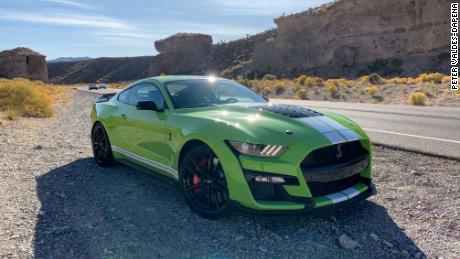
Driving the Shelby GT500, the most powerful car Ford has ever made
But it always seemed unlikely that the Ford workers would follow GM workers out on strike. There has not been a work stoppage at Ford since 1976.
And the biggest point of contention at GM -- the automaker's decision to close three US plants where work was halted earlier this year -- was not present at Ford, where no US plant closings are planned.
The union had vowed to make GM shift work back from Mexico to try to revive the plants. While GM agreed to build an electric truck planned at a date yet to be determined at a fourth plant slated for closure, it would not shift work back from Mexico to save any of the other three plants.
The workers at Ford will likely get many of the same terms as found in the GM contract. Once the union reaches a deal with one US automaker, it strives to get the other two unionized companies to follow that pattern.
Under the deal at GM, hourly workers get an $11,000 signing bonus, a 6% raise over the four-year life of the contract, an agreement to allow many temporary workers to be hired on a permanent basis, and the health care coverage left essentially unchanged despite the company's desire to have workers assume a much greater share of the cost.
If Ford workers agree to a new contract that includes those provisions, they will benefit from not losing six weeks of pay in order to receive those gains.
Once the Ford ratification vote is complete, likely in the next couple of weeks, the union will turn to the third unionized US automaker, Fiat Chrysler (FCAU). Contract talks there could be complicated by the potential announcement of a merger with French automaker PSA, the owner of Peugeot.
-- CNN Business' Vanessa Yurkevich contributed to this story

Let's block ads! (Why?)


https://www.cnn.com/2019/10/31/business/ford-uaw-deal/

2019-10-31 05:10:13Z
52780423404900

Rabu, 30 Oktober 2019

Halloween postponed: Montreal, other cities, urge trick-or-treaters to wait a day due to bad weather - CTV News

MONTREAL - Montreal's mayor is advising people to postpone their Halloween trick-or-treating until Friday with record rainfalls in the forecast.


A rainfall warning is in place for the Montreal area, with 40-50 millimetres of rain expected. The record rain for Halloween was in 2013, when 22.4 millimetres of rain fell in the region. Those conditions could bring on flash flooding and ponding on roads, Environment Canada warns.

Montreal joins Longueuil, Varennes, McMasterville, Sorel-Tracy, Mont-Saint-Hilaire, Beloeil, Magog and Candiac, among the other municipalities who are postponing Halloween until Friday due to the weather forecast for Thursday.

Montreal West officials said they are not issuing any notice suggesting trick-or-treaters postpone going door-to-door. Laval says it is not postponing its activities planned for Oct. 31, but will have police presence in residential neighbourhoods on Friday, in case trick-or-treaters delay a day.

The city of Sainte-Julie kicked off the trend Wednesday morning by officially asking its residents to delay Halloween activities by a day in order to avoid having trick-or-treaters head out during the heavy rains and strong winds forecast for Thursday.

The mayor of Sainte-Julie - a city of about 30,000 located southwest of Montreal - cited exceptional weather conditions as the reason for the postponement. (The city says it is expecting at least 40 mm of rain tomorrow and very strong winds).

"Taking into account the safety and comfort of the children and adolescents who would like to take to the streets to collect candy, we have decided to take the exceptional step of postponing (Halloween) until Friday," Sainte-Julie Mayor Suzanne Roy said in a statement. "Normally rain would not have made us change the date, but the exceptional nature of the precipitation pushed us to do it."

The city says it will communicate with its residents regularly in the coming days to update them on the status of Halloween events in the city and advise on safety precautions to be taken.

Earlier Wednesday, Environment Canada had issued special weather statements that warned of torrential rain and blustery winds in the Montreal area, as well as snow in more northerly parts of Quebec.

So many cities have postponed Halloween festivities that some - such as Sherbrooke in the Eastern Townships  - have issued releases saying Halloween will actually proceed as scheduled on Oct. 31.


from Business - Latest - Google News https://ift.tt/2WpTmWK
via IFTTT
October 30, 2019 at 10:19PM

Peugeot board approves Fiat Chrysler merger plans, says report - Driving

The board of French carmaker PSA Group has approved a plan to merge with Italian-American rival Fiat Chrysler Automobiles, a combination that would create one of the world’s largest auto manufacturers, according to people familiar with the matter.

The new board would be made up of 11 members, with six from the PSA side including Chief Executive Officer Carlos Tavares, who will lead the new company. Fiat Chairman John Elkann would take the same role at the enlarged group.

Fiat Chrysler’s directors are scheduled to meet later Wednesday to discuss the proposal, the people said. The plan authorized by PSA’s board calls for negotiations of a binding memorandum of understanding that could last several weeks, said one of the people.

A representative for PSA, the maker of Peugeot and Citroen cars, declined to comment. A Fiat spokesman wasn’t immediately available to comment.

A merger of Fiat Chrysler and PSA, the No. 2 for car sales in Europe, would create a regional powerhouse to rival Volkswagen, with a stock-market value of about US$49 billion — comparable to Japan’s Honda. The tie-up would also bring together two auto-making dynasties, the billionaire Agnelli clan in Italy and the Peugeot family of France.

The merger plan comes several months after Fiat Chrysler and PSA explored a partnership on pooling investment to build cars in Europe, and following the collapse in June of negotiations between the Fiat and French competitor Renault SA.

Automakers face tremendous pressure to pool their resources for platform development, manufacturing and purchasing as they battle through trade wars, a global slowdown and an expensive shift toward electrification and autonomous driving. Producers face the additional burden in Europe of new rules on emissions.

Against this backdrop, the pace of dealmaking has picked up. Volkswagen in July said it will work with Ford on electric and self-driving car technology, while Toyota is strengthening ties with partners such as Subaru and China’s BYD. The Indian conglomerate that owns Jaguar Land Rover has said it’s open to finding partners for the British automaker but isn’t planning on selling the embattled unit.

Tavares has sought to re-establish Peugeot’s foothold in the U.S., a market it exited in 1991. He set plans earlier this year for a return, with shipments starting from Europe or China in 2026.

Fiat Chrysler is seen as a laggard in new technologies such as electrification and autonomy, which are expected to cost automakers billions of dollars over the next decade.

The company has sought to secure its future with a larger partner for several years, dating back to late CEO Sergio Marchionne’s failed courtship of General Motors. After being rebuffed by GM in 2015, rumors of talks with other automakers have swirled with varying intensity.


from Business - Latest - Google News https://ift.tt/2N4ZrVz
via IFTTT
October 31, 2019 at 03:25AM

Apple earnings Q4 2019: Tim Cook says health will be what Apple is remembered for - Ars Technica

The new Apple Watch Series 5.
Enlarge / The Apple Watch Series 5 has an always-on display thanks to new and improved display internals.

Apple's quarterly earnings calls have fallen into a predictable pattern for the past year or two: iPhone revenues are declining year-over-year, and the Mac mostly remains stagnant, but every other one of Apple's businesses—wearables and services most notably—are ballooning.

That was the case again with Apple's Q4 2019 earnings report today; iPhones were down, but the company posted its highest revenue ever in a September quarter thanks to good performance from services like the App Store, AppleCare+, and Apple Pay, as well as strong iPad and Apple Watch sales. Total revenue was $64 billion.

Apple revealed during the proceedings that the iPhone 11 (sans Pro) is now its best-selling phone, and that iPhone revenue was $33 billion—a 9% decline over the same quarter the previous fiscal year, albeit an improvement over the 15% decline the company saw in the previous three quarters this year. (That improvement is very likely accounted for by the launch of the iPhone 11 and its ilk mid-September, just before the quarter ended.)

Mac sales were down 5%, but Apple CEO Tim Cook was quick to point out on the earnings call with investors that the company released a major update to the MacBook Air, one of its most popular computers, around this time last year but has not done so yet this year, ostensibly explaining some of the drop.

Apple is expected to refresh some of its laptops in the coming months and plans to imminently launch the pricy Mac Pro. Aimed at creative professionals, the Mac Pro's price point makes it less of a mass-market device than the MacBook Air.

Apple boasted 18% growth in services revenue, an improvement over the previous quarter that brings the 2019 fiscal year total to $46 billion. It was $12.5 billion for this quarter on its own. Among other things, this was credited to "all-time record revenues from payment services" like Apple Pay. The company alluded to the recent launches of Apple Card, Apple News+, and Apple Arcade, but it did not provide individual numbers for them during the call. Apple also said today that this was the best quarter ever for AppleCare.

The iPad saw 17% growth driven by the iPad Pro, but the big positive narrative from the company was that of wearables, which include Apple Watch and AirPods. The company saw 54% growth in that category, and the quarter in question ended before AirPods Pro were announced or released.

In an answer to an investor question, Cook let it be known that he sees wearables like the Watch and its associated health functionality as the future of the company. "There will be a day in the future that we look back and Apple's greatest contribution will be to people's health," he said.

Some investors are understandably concerned that many of Apple's growth areas are dependent on the iPhone. Users are sticking with their existing iPhones and opting going longer between upgrades than ever before, leading to ever-slowing iPhone sales. But Apple stock rose slightly after the call regardless, indicating that the market at least believes Apple still has plenty of room to grow in services and wearables in the near term before the iPhone's slowing momentum becomes a serious problem.

And in some cases, the numbers bear that out: a substantial portion of Apple's wearables revenue (which now stands toe-to-toe with the Mac) comes from customers making a first-time purchase in that category. And Cook again made vague allusions to major new products in the wearables category, which (not his words) could include the company's rumored augmented reality headset.

Despite those declining iPhone sales, Apple users probably shouldn't be too concerned about the future of the ecosystem they've invested in. The company stated earlier this year that it has an install base of 900 million iPhones globally. Whether that continues to grow is a concern for investors looking for big returns in their portfolios, but not for users; an install base that size all but ensures continued support, content, and updates for many years yet.

Looking ahead to Q1 2020, Apple projects revenue between $85.5 billion and $89.5 billion—Q1 is often a big quarter for the company, as it carries holiday sales and much of the immediate post-launch revenue from the new iPhone lineup.


from Business - Latest - Google News https://ift.tt/2WppERI
via IFTTT
October 31, 2019 at 06:15AM

Fed cuts rates by quarter point while hinting at policy pause - BNNBloomberg.ca

Federal Reserve officials reduced interest rates by a quarter-percentage point for the third time this year and hinted they may be done loosening monetary policy, at least for one meeting.

The Federal Open Market Committee altered language in its statement following the two-day meeting Wednesday, dropping its pledge to “act as appropriate to sustain the expansion,” while adding a promise to monitor data as it “assesses the appropriate path of the target range for the federal funds rate.”

“We believe monetary policy is in a good place,,” Fed Chairman Jerome Powell told a news conference following the decision. “We see the current stance of policy as likely to remain appropriate as long as incoming information about the economy remains broadly consistent with our outlook.”

As with the September statement, the FOMC cited the implications of global developments in deciding to lower the target range for the central bank’s benchmark rate to 1.5 per cent to 1.75 per cent. Powell also noted in the press conference that the risks associated with trade tensions and Brexit show signs of improving.

Treasuries weakened on the Fed’s announcement, pushing the 10-year yield up slightly to 1.81 per cent from 1.80 per cent. Stocks were slightly higher and the U.S. dollar gained. Traders also pared wagers on a fourth consecutive rate cut in December.

The tweaks to the statement suggest policy makers are prepared to leave rates on hold for some time and assess the impact on the economy of their reductions over the past three meetings.

While lower rates do little to combat the uncertain trade picture, unemployment has continued to drop, consumer spending has remained solid and lower mortgage rates have revived the housing market.

“What we continue to see is good job creation,” Powell said.

Hours before the decision, the Commerce Department reported the economy grew at a 1.9 per cent annualized pace in the third quarter, beating estimates. The better-than-expected consumer spending was partly offset by weakness in business investment.

The Fed’s cuts have also calmed markets compared to the beginning of the year when investors grew nervous that monetary policy was too tight. Pricing in fed funds futures implies investors don’t fully expect another cut until well into 2020.

The same cannot be said for President Donald Trump, who has repeatedly attacked the Fed. He complained on Tuesday that it “doesn’t have a clue!” and has called on Powell to slash rates to zero while tweeting favorably about negative rates applied by central banks in Europe and Japan.

Dissenting Votes

As with the past two cuts, Kansas City Fed President Esther George and Boston’s Eric Rosengren dissented, preferring to keep rates unchanged.

The FOMC didn’t release a new set of economic forecasts and rate projections at this meeting, so it’s unclear how many non-voters on the committee had also penciled in a reduction.

The statement again highlighted the essentially positive condition of the U.S. economy. With unemployment at a half-century low, officials continued to describe the labor market as “strong,” job gains as “solid” and household spending as rising at a “strong pace.”

At the same time, they repeated a references to “uncertainties’’ in the economic outlook. Officials also made a minor change to say business fixed investment and exports “remain weak.” The prior statement had said that they had weakened.

Faltering Factories

That softness has shown up in data from the manufacturing sector this year, though factory output rose slightly in the third quarter. Fed officials have been watching for signs that weakness in manufacturing and faltering confidence in the business sector might threaten consumer spending, particularly if the job market cools. The Labor Department will release its October employment report on Friday.

Fed officials also noted that inflation was running below their 2 per cent target and said “inflation expectations are little changed.”

Officials continued ordering the purchase of Treasury bills to boost bank reserves. The program, announced Oct. 11, is aimed at tamping down volatility in overnight funding markets by increasing the supply of cash available for short-term lending.


from Business - Latest - Google News https://ift.tt/2qYutWu
via IFTTT
October 31, 2019 at 01:01AM