Jet Airways announced late Wednesday that it was indefinitely suspending all flights after it ran out of cash, marking a swift downfall for an airline that dominated India's fast-growing aviation industry for years.
The airline was founded by Naresh Goyal, who began his career as a sales agent for Lebanese Airlines in 1967. Goyal worked for several other airlines for nearly a decade before founding his own company called Jetair in 1974 to provide sales and marketing services to foreign carriers in India.
When India liberalized its economy in 1991 and opened up its aviation sector to private players, Goyal seized his chance and Jet Airways began operating in May 1993. Over the next two decades, he grew it into one of India's top airlines, adding overseas destinations like Singapore, London and Amsterdam.
"Naresh Goyal founded the company with big ambitions and good ideals in terms of developing that airline, and it established itself with a great reputation for service quality at its peak," said John Strickland, director at aviation consultancy JLS Consulting.

But as millions more Indians started taking to the skies, newer players like SpiceJet and IndiGo burst onto the scene in the early 2000s. The no-frills model of the newer airlines allowed them to cut costs and drive down ticket prices, providing India's price-conscious first-time flyers with far cheaper alternatives than Jet Airways could offer with its premium service.
In the years that followed, the challenges grew. India's airports became increasingly congested, foreign carriers offered stiff competition on international routes, and government taxes on fuel added to costs.
"In many respects, Jet's situation reflects the challenges of the Indian aviation market altogether," Strickland said.
Despite posting mounting losses and racking up debt reportedly worth $1.2 billion, Jet Airways clung on. Abu Dhabi's national carrier, Etihad Airways, bought a 24% stake in 2013, and Jet ordered hundreds of new planes to try to keep pace with growing demand.
As recently as last year, it still accounted for nearly 20% passengers flown by Indian airlines.
But an increasingly volatile economy — India's currency plunged to record lows in 2018, driving the rising cost of oil even higher — proved too big a hurdle, and Jet began to miss payments to staff and creditors.
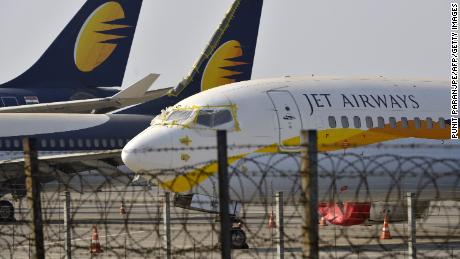
Things went from bad to worse this year, when the airline was forced to start grounding its planes because of an inability to pay aircraft leasing companies.
"Once aircraft get grounded, and you start to go into that spiral, that's really hard to get out of," said Rob Watts, CEO of aviation consulting firm Aerotask. "You have a proportion of your fleet that's not generating revenue but is still costing you money, so the more aircraft you lose, your revenue falls but your cost doesn't fall in the same manner," he added.
Last month, Goyal was finally forced to exit the airline he built over two decades as a consortium of lenders led by the government-run State Bank of India took control.
But a planned bailout by the banks didn't materialize reportedly because of concerns about the airline's long term viability, and Jet's wings were finally clipped. The banks say they're still hopeful of finding a rescue buyer for 75% of the company before May 10 but the longer the wait, the less chance Jet Airways has of surviving.
"Jet has no aircraft operating and every day it keeps building and building liabilities," said Watts. "It would need a gigantic injection of capital to restore it, probably to the extent that at this point it's better starting over."
Investors appear to share that view. Shares in Jet Airways plunged 30% on Thursday to trade at just 164 rupees ($2.40). When the company went public in 2005, they were worth 1,100 rupees ($15.80) apiece.
https://www.cnn.com/2019/04/18/business/jet-airways-collapse-naresh-goyal/index.html
2019-04-18 16:32:00Z
52780271125082