Senin, 10 Juni 2019

Tariff reversal; United Technologies and Raytheon; UK GDP - CNN

US stock futures point higher. The Dow is set to rise 85 points, or 0.3%. The Nasdaq and S&P 500 could jump 0.4% and 0.3%, respectively.
European markets opened up after stocks in Asia posted significant gains. Britain's FTSE 100 rose 0.5% in early trading, and France's CAC 40 climbed 0.2%. Hong Kong's Hang Seng shot up 2.3%, while Japan's Nikkei rallied 1.2%.
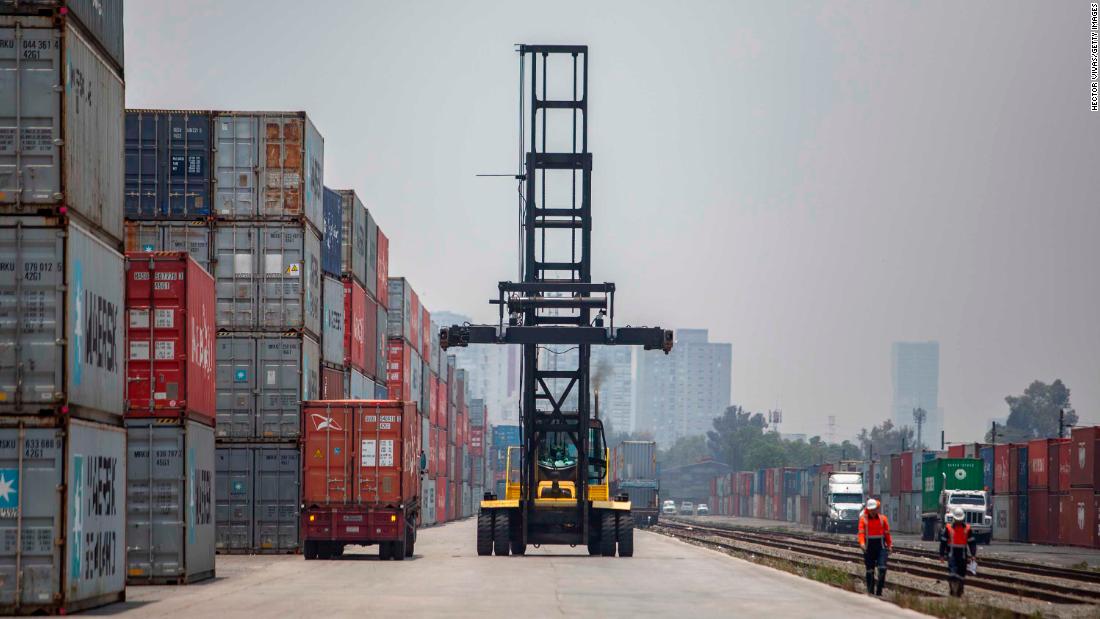
President Donald Trump on Friday called off tariffs on goods from Mexico that would have gone into effect this week.
"I am pleased to inform you that The United States of America has reached a signed agreement with Mexico," Trump tweeted Friday. "The Tariffs scheduled to be implemented by the U.S. on Monday, against Mexico, are hereby indefinitely suspended."
The tariffs, which would have started at 5% and could have eventually climbed as high as 25%, were opposed by many members of the president's own party and businesses that move goods back and forth across the border.
The reversal is good news for US stock indexes. The Dow, S&P 500 and Nasdaq are coming off their best weeks of the year, boosted by investor optimism that the Federal Reserve could be on the verge of cutting interest rates.
2. United Technologies and Raytheon: United Technologies (UTX) and Raytheon (RTN) have agreed to merge, creating an aerospace and defense powerhouse.
The companies currently have a market value of $166 billion. The deal, announced Sunday, is one of the biggest corporate mergers of 2019.
It won't include United Technologies' elevator and air conditioning units, which the company will spin off in 2020.
Shares of Raytheon (RTN) are tracking 2.8% higher in premarket trading, while stock of United Technologies (UTX) could leap 5%.
In other deal news: UK travel business Thomas Cook said Monday that it's looking at selling its tour operator business to China's Fosun. Thomas Cook shares in London rose more than 10% on the disclosure.
3. UK GDP: GDP in the United Kingdom fell by 0.4% in April as Brexit uncertainty continued to take a toll.
The Office for National Statistics pointed to a steep drop in car production due to planned shutdowns put in place around the original Brexit deadline.
It also cited broader manufacturing weakness. Stockpiling faded as the date of Britain's departure from the European Union was pushed back again.
4. Coming this week:
Monday — US job openings; Chinese trade data; UK GDP
TuesdayUber (UBER) CEO Dara Khosrowshahi at the Economic Club of Washington; Dave & Busters (PLAY) earnings; Tesla (TSLA) shareholder meeting; E3 gaming conference begins
Wednesday — US and Chinese inflation data; US oil inventories; Lululemon (LULU) earnings
Thursday — German inflation data; Tesco (TSCDF) and Broadcom (AVGO) earnings; OPEC report; European Union industrial production
Friday — US and Chinese retail sales; University of Michigan consumer sentiment

Let's block ads! (Why?)


https://www.cnn.com/2019/06/10/investing/premarket-stocks-trading/index.html

2019-06-10 09:23:00Z
52780311306007

FCA-Renault deal hopes aid European shares - Investing.com

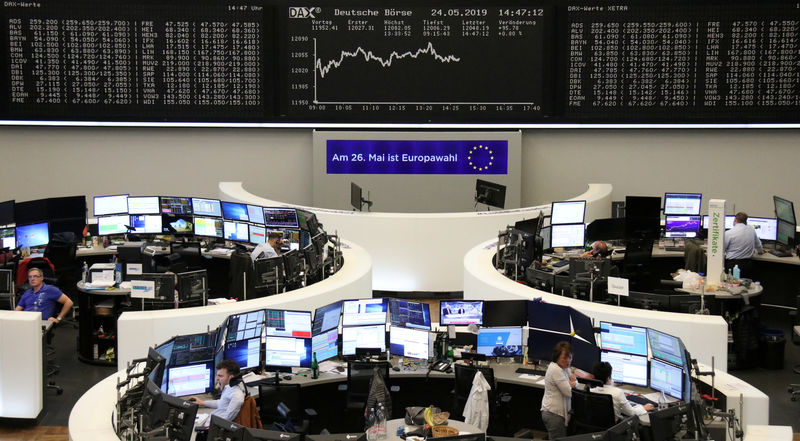
© Reuters. The German share price index DAX graph at the stock exchange in Frankfurt © Reuters. The German share price index DAX graph at the stock exchange in Frankfurt

By Amy Caren Daniel and Agamoni Ghosh

(Reuters) - Strong Chinese export data and the U.S.-Mexico deal to avoid new import tariffs bolstered the mood on European stock markets on Monday, while car company shares also got a lift from signs of moves to revive Fiat-Chrysler and Renault's merger.

The pan-regional index rose 0.4% by 0805 GMT, with trading volumes thinned out by the Whit Monday holiday in Germany, Switzerland, Austria and most Nordic countries.

The auto sector gained 0.5% on signs that Fiat Chrysler Automobiles NV and Renault SA (PA:) were looking for ways to resuscitate their collapsed merger plan and secure the approval of Nissan Motor Co.

Fiat Chrysler and Renault's shares were both up about 2% after sources close to the companies told Reuters they were back in discussions on ways to revive the deal.

"We believe it is too early to talk about negotiations being re-opened," Equita analyst Emanuele Gallazzi wrote in a note.

"Today's news together with the hypotheses discussed in various press sources relating to alternative scenarios for FCA, including GM, Hyundai and Geely, keep high the speculative appeal of the stock."

President Donald Trump on Friday retreated on last month's shock threat of a 5% import tariff on all Mexican goods in exchange for moves on immigration, providing relief to investors worried that a second major U.S. trade dispute would drive the global economy into recession.

"Markets are blowing small celebratory bubbles this morning," Deutsche Bank (DE:) analysts said in a note.

Trade tensions between the U.S. and China still lingered, with Group of 20 finance leaders saying that trade and geopolitical tensions have raised risks to improving global growth while stopping short of calling for a resolution of the conflict.

Adding to gains was some residual buying after weak U.S. nonfarm payrolls data on Friday that spurred hopes of the Federal Reserve cutting interest rates.

Concerns over the pace of growth in the world's major economies drove a nearly 6% fall in European stock markets in May, their worst month in more than two years, but have been countered since by hopes of new stimulus from central banks to head off the threat.

Among other stocks, BAE Systems (LON:) gained 1% on hopes of further deal making in the aerospace and defense space after United Technologies Corp (NYSE:) agreed on Sunday to combine its aerospace business with U.S. contractor Raytheon (NYSE:) Co, in what would be the sector's biggest ever merger.

Thomas Cook's shares jumped 15% after a report that Hong Kong's Fosun Tourism was in talks to buy its tour operating business as the British group faces breakup after issuing three profit warnings in the past year.

Ferguson Plc fell 4% after the British plumbing products distributor's third quarter revenue missed analysts' estimates.

Disclaimer: Fusion Media would like to remind you that the data contained in this website is not necessarily real-time nor accurate. All CFDs (stocks, indexes, futures) and Forex prices are not provided by exchanges but rather by market makers, and so prices may not be accurate and may differ from the actual market price, meaning prices are indicative and not appropriate for trading purposes. Therefore Fusion Media doesn`t bear any responsibility for any trading losses you might incur as a result of using this data.

Fusion Media or anyone involved with Fusion Media will not accept any liability for loss or damage as a result of reliance on the information including data, quotes, charts and buy/sell signals contained within this website. Please be fully informed regarding the risks and costs associated with trading the financial markets, it is one of the riskiest investment forms possible.

Let's block ads! (Why?)


https://www.investing.com/news/stock-market-news/european-shares-gain-on-mexico-tariff-relief-1892785

2019-06-10 08:30:00Z
52780310651257

Minggu, 09 Juni 2019

Condo developers offer free wine, avocado toast to woo buyers in slowing market - Yahoo News

French gov't hopes to fortify Renault-Nissan alliance - Japan Today

The French government's priority as a shareholder in automaker Renault SA is to fortify its alliance with Japan's Nissan, France's finance minister, Bruno Le Maire, said Sunday.

Protecting jobs and Renault's factories and technology is the top concern given the government's 15% stake in the automaker, Le Maire told reporters during a news conference after a meeting in Japan of the Group of 20 major economies.

"We are very proud of Renault as a company," Le Maire said. "The employees of Renault, the factories of Renault, research centers, are really a symbol of French industrial excellence. But when you look at what has happened in the last 20 years, we see that this quality has been reinforced by the partnership with Nissan within the alliance."

Fiat Chrysler suddenly withdrew an offer to merge with Renault this past week after the French automaker asked for more time to persuade Nissan Motor Co. to agree to the plan.

He said that consolidating the alliance with other automakers such as Fiat-Chrysler is a secondary issue, but decisions on that should be made by the companies themselves. Nissan would have to be fully committed if a merger is to be carried out.

"Renault and Nissan together, France and Japan together. We need to be committed in this second step if we want it to succeed," Le Maire said.

When asked, he said he had no plans to meet with Nissan's CEO Hiroto Saikawa.

Nissan is in a state of transition after its former chairman, Carlos Ghosn, was arrested on financial misconduct charges in November. Ghosn has been released on bail, pending his trial for alleged underreporting of his compensation and breach of trust.

The sudden proposal for a merger between the Renault-Nissan-Mitsubishi Motors alliance and Fiat Chrysler at first appeared to have come without any consultation with the Japanese side.

It had the potential to make the alliance part of one of the largest global automakers. But it also raised issues about Nissan's say in the matter: Renault owns 43% of Nissan, while Nissan has a 15% stake in Renault.

A person in Italy who has been close to the talks said both the French government and Nissan had agreed during the course of months-long negotiations that the Fiat Chrysler-Renault merger would happen first, and then the future of the alliance would be considered at a later stage.

The person said France essentially backtracked this past week when it said it wanted the backing of Nissan before agreeing to start working on the details of a potential merger.

In a statement, Fiat Chrysler cited "political conditions in France" for its withdrawal.

The French government hit back by characterizing Fiat Chrysler's behavior as "pushy," blaming it for placing "massive pressure" to quickly take the offer or leave it.

Le Maire said the alliance with Nissan has helped Renault to become one of the world's most advanced automakers due to their cooperation on platforms and other technology, such as electric vehicles and internet connectivity.

The French foreign minister said that although the government was willing to eventually reduce its stake in Renault, that was a long-term plan.

"Being the minister of the economy, I have to be sure that our employment is protected, that our factories are protected and that our technology are protected," he said.

© Copyright 2019 The Associated Press. All rights reserved. This material may not be published, broadcast, rewritten or redistributed.

from Business - Latest - Google News http://bit.ly/31m2o9e
via IFTTT
June 10, 2019 at 04:39AM

S&P 500 futures jump as trading resumes after Trump calls off tariffs on Mexico - Reuters

The Bearish Threat Within OPEC | OilPrice.com - OilPrice.com

After a prolonged oil price plunge, pushing price levels down to around $59 Brent per barrel, signs are showing that the market believes the downward trend has overshot its target. Concerns about global demand and supply have been wreaking havoc, based on assessments that the ongoing China-US trade war will put a major dent in demand. At the same time, U.S.-based oil storage volume reports showed a significant increase, killing off the bullish case for oil. Despite this, OPEC+ refused to react, simply stating that the oil cartel and its Russian supporter were not willing to take appropriate measures to quell the confidence crisis in the market. Up until now, OPEC+ has seemed to be willing to take the wrath of Washington and others for keeping to its existing production cut agreement. There are even signs that the oil producers are considering a rollover of the production cut agreement at their upcoming meeting, presumably in June but most probably in July. A strong pro-roll-over front has been building up, led by Saudi Arabia’s Minister of Energy Khalid Al Falih, UAE’s Minister Al Mazrouei, and, surprisingly, Iraq. The leading Arab oil producers are taking the long-term view that the market has not yet stabilized, crude storage volumes are still too high, and demand is yet to see a tangible drop. There are signs, however, that a conflict is brewing within the oil group – with Russian officials spreading uncertainty.

In stark contrast to the full-scale support of a production cut that was given by Russia at the St Petersburg meeting in 2018 to OPEC, Russian president Vladimir Putin is now increasing the pressure on the agreement. By stating that Russia is happy with current price levels of around $60-65 per barrel, he has broken from the Saudi-UAE angle. Putin’s remarks threaten to push OPEC into a position where it will have to address possible shortages in the market in the coming months. By referring to a lower price level in public, Putin has acknowledged that Moscow is not interested in targeting higher prices, unlike Arab producers that need higher prices to support their own government budgets and diversification packages. Putin’s comments could even be interpreted as a willingness to leave the current production cut agreement, further undermining OPEC’s strategy.

Related: Oil Prices Plunge On U.S.-China Trade War Escalation

The main question for oil analysts at present is whether Putin really stands behind his assessments. By reiterating that Russia is happy with lower prices and suggesting that the Russian government budget is based on $40 per barrel Putin is taking a risk. When analyzing the current state of the Russian economy, its global power projections and the extremely high costs of its ongoing military operations in Syria and elsewhere, higher oil and gas revenues would be a godsend. Putin’s dream of a Pax Russia cannot be built on $40 per barrel, not even on $60-65 per barrel. The Russian chess grandmaster seems to be playing on two boards at the same time. Putin’s attitude towards OPEC has always been one of ambiguity, taking the position that the oil cartel’s influence should be used to enhance Moscow’s geopolitical and economic influence. By creating a new front, some say against the USA and the EU, Moscow and OPEC have set up a marriage of convenience, built on a traditional commercial-strategic basis. OPEC+ is still very functional, but if Russian oil and gas oligarchs, the main support base of Putin at home, start to complain, the Russian tsar will need to act. It seems that the signs of political infighting have now become clear, with Russia’s minister of Energy Novak, formerly a supporter of the production cut agreement, keeping silent. In staying out of the discussion, Novak is lending credence to the idea that Russian oil companies may be running out of patience. Related: China's Biggest Weapon In The Trade War

Strategically, lower oil prices would not only to increase Russia’s market share, at the expense of former allies Venezuela and Iran, but would also help to constrain US shale. Saudi Arabia’s position on production is entirely different. Faced by high expenditure patterns due to the Kingdom’s economic diversification plans and regional military engagements, Riyadh needs a higher oil price. Change is being brought to the country slowly and with minimum risk to the regime. Higher oil prices will be vital if Saudi is to stand a chance of successfully implementing its visions.

Russia will be of particular importance in the coming weeks. Putin is facing the end of his political reign in the coming years, and growing dissent within the oil and gas sector is now noticeable. The Russian leader, maybe still hoping for a new political career, needs the support of Rosneft, Gazprom and others in order to survive and keep his legacy in place. Taking all of this into account makes the odds of Russia taking a bearish stance on oil all the more probable. It is likely that a roll-over of the agreement will not be issued, with heated discussions already happening between the main parties.  It seems that it is not Trump who will influence oil markets in the near term, but rather two Arab Crown Princes and a Tsar heading for retirement.

By Cyril Widdershoven for Oilprice.com

More Top Reads From Oilprice.com:


from Business - Latest - Google News http://bit.ly/2K7AWqy
via IFTTT
June 10, 2019 at 06:00AM

Canada ‘blew’ its chance to be global pot leader, says investment bank leader - National Post

(Bloomberg) — Canada “blew it” on cannabis legalization and is rapidly losing ground to the U.S. as a result, according to the founder of one of the top investment banks to the industry.

A lack of policy innovation, a messy patchwork of provincial regulations and severe restrictions on marketing and branding have left Canadian pot companies eating the Americans’ dust, according to Neil Selfe, founder and chief executive officer of Infor Financial Group Inc.

“I think we had a real chance to be global leaders,” Selfe said in an interview at Bloomberg’s Toronto office. Yet eight months after Canada legalized recreational cannabis, Selfe sees Canopy Growth Corp. as the only Canadian pot company he would classify as a global leader, with big U.S.-focused firms outpacing the rest even though marijuana is still illegal at the federal level.

“It’s a real consumer product in big U.S. states where it’s legal, and it isn’t that way yet in Canada despite the fact that we were first,” he said.

States like California sell multiple products, have well-known brands and even allow home delivery, but Canada’s market is restricted to dried flower and oils and branding essentially “doesn’t exist,” Selfe said.

“It’s almost like you’re buying something dirty in brown paper bags,” he said. “It’s like liquor in the ’60s.”

The non-intoxicating cannabis compound CBD is a case in point. Even though marijuana is still classified alongside heroin as one of the most harmful drugs in the U.S., the federal government legalized hemp-derived CBD in December. Big U.S. retailers like CVS Health Corp. and Walgreens Boots Alliance Inc. already sell CBD products like lotions and topicals but those aren’t yet legal in Canada. Legal CBD products such as oil and dried flower can only be sold in dispensaries.

“It’s a mess,” Selfe said.


from Business - Latest - Google News http://bit.ly/2IucWuq
via IFTTT
June 10, 2019 at 04:46AM