Kamis, 15 Agustus 2019

Asian markets roiled by recession fears, but Shanghai and Hong Kong recover - CNN

Japan's Nikkei (N225) fell 1.2%, while Australia's S&P/ASX 200 sank 2.9%. Losses deepened even more after a top Australian central banker warned that the US-China trade war is damaging global growth and risks a "self-fulfilling downturn."
The Hang Seng Index (HSI) in Hong Kong and China's Shanghai Composite Index (SHCOMP) dropped at market open, but both recovered to end higher: They advanced 0.8% and 0.3%, respectively.
In Hong Kong, property developers have been hit hard by the city's mass protests. But that was the sector that gained the most on the city's benchmark index Thursday. New World Development surged 7.8%, while MTR, the city's subway system and a major real estate developer, climbed 4.4%.
"Hong Kong stocks had been oversold and investors are buying the dip," said Ben Kwong, executive director of KGI Asia. "But that doesn't mean investors' cautious sentiment has turned around. It's just bargain hunting."
Chinese telecom companies that are listed on the Hang Seng rose, too. One of those, China Unicom, soared roughly 11% after the company said it's speeding up its 5G plans.
Major Chinese banks that trade in Hong Kong also made gains Thursday after the People's Bank of China injected about $57 billion into the financial system.
South Korea's market was closed on Thursday for a public holiday.
Thursday's sell-off came after US markets plummeted in the worst day for stocks there of 2019. That happened because the bond market, for the first time in over a decade, flashed a warning signal that has an eerily accurate track record for predicting recessions.
What is the yield curve -- and why it matters
The 10-year Treasury bond yield fell below 1.6% Wednesday, dropping just below the yield of the 2-year Treasury bond. It marked the first time since 2007 that 10-year bond yields fell below 2-year yields. The inversion of that curve has preceded every recession in modern history.
On Thursday, the US 30-year Treasury yield fell to a new record low, according to Refinitiv.
Investors were spooked Wednesday because of some bad news out of Germany and China. Germany's economy shrank in the second quarter. One analyst called Wednesday's report "the end of a golden decade for the German economy."
China on Wednesday posted its worst growth for industrial production in 17 years. The metric is important because it measures the output of key businesses in China's manufacturing, mining and utilities sectors.
"Bond markets have been flagging this move for some time, but the shift was crystallised by yesterdays run of doom and gloom European and Chinese economic data," wrote Stephen Innes, managing partner for Valour Markets Pte in Singapore, in a research note.
Australia's major index was the biggest loser early Thursday. Declines accelerated as Guy Debelle, the deputy governor of the Reserve Bank of Australia, warned of the ramifications of the US-China trade war.
"The uncertainty as to how the dispute will play out on both the trade and technology fronts means businesses are waiting to see how the uncertainty resolves rather than invest," he said, according to the text of his keynote speech to be delivered at a conference in Sydney on Thursday. "The longer businesses hold off, the weaker demand will be, which will further confirm the decision to wait. That runs the risk of a self-fulfilling downturn."

Let's block ads! (Why?)


https://www.cnn.com/2019/08/14/investing/asian-market-latest-bonds-recession/index.html

2019-08-15 09:31:00Z
CAIiELczyPoKNCHCQB0ATPaQ-I4qGQgEKhAIACoHCAowocv1CjCSptoCMPrTpgU

US Treasury yields mixed after 30-year bond falls to historic low - CNBC

U.S. Government bond prices traded mixed on Thursday as fears of a global recession drove investors to the perceived safety of government debt.

U.S. Markets Overview: Treasurys chart

At around 03:10 a.m. ET, the yield on the benchmark 10-year Treasury note, which moves inversely to price, was higher at around 1.5894%, while the yield on the 30-year Treasury bond was lower at around 2.0132%.

The 30-year Treasury bond hit a record low of 1.991% overnight, breaching the 2% threshold for the first time in its history, before paring some of its losses.

The historic drop in long-term U.S. bond yields comes less than 24 hours after the closely-watched 10-year Treasury note and the 2-year inverted. The inversion of this key part of the yield curve has previously been a reliable indicator of economic recessions.

The stock market took a huge hit in the previous session, with the Dow plunging 800 points in its fourth-largest point drop ever to a two-month low. The sell-off exacerbated an extensive flight-to-safety into government securities.

At times of market turbulence, investors tend to flee to assets expected to either retain or increase in value — such as gold, the Japanese yen and government bonds. These safe-haven assets are typically sought to limit one's exposure to losses in the event of a sharp market downturn.

Recession fears

It comes at a time when market participants are worried about a protracted U.S.-China trade war, geopolitical tensions and uncertainty over Brexit. Economic data in China and Germany this week also suggested a faltering global economy.

Stateside, investors are likely to closely monitor U.S. retail sales data for July at around 8:30 a.m. ET. The figures are thought to serve as an indicator of the strength of the world's largest economy.

The latest weekly jobless claims, industrial production data for July and business inventories for June are among some of the other data releases set to follow slightly later in the session.

The U.S. Treasury is set to auction $55 billion in 4-week bills and $40 billion in 8-week bills on Thursday.

Let's block ads! (Why?)


https://www.cnbc.com/2019/08/15/us-bonds-30-year-treasury-yield-falls-below-2percent-for-first-time-ever.html

2019-08-15 06:41:29Z
52780352289861

Rabu, 14 Agustus 2019

Is a global recession coming? Here's why analysts are worried - CTV News

Even if you don’t pay close attention to the stock market, Wednesday’s news may have caught your attention.

The main stock indexes in Canada and the U.S. both plummeted in their worst day of the year, and economic analysts are worried that a global recession could be around the corner.

There isn’t just one reason to worry. Several economic indicators from around the world have been linked to the international drop and the possibility of an extended financial decline.

A TELLTALE WARNING SIGN

Since 1957, every recession has begun after what’s called a “yield curve inversion.” That’s when the payout for 10-year bonds suddenly slips below the payout for two-year bonds.

This scenario is essentially the opposite of what happens in a healthy economy. Long-term bonds typically lead to higher yields than short-term bonds because investors are locking up their money for longer and expect more growth over a longer time period.

Basically, a yield-curve inversion indicates that investors are so nervous about the economy’s immediate future that they’d rather put their money into long-term investments.

“We are seeing investors really looking for safety in the long-term investments. They’re lending to governments at very, very cheap rates, and they’re much, much less confident about what will happen over that time period,” Karl Schamotta, chief market strategist for Cambridge Global Payments, told CTV News Channel.

This phenomenon has happened before the last seven recessions. Only twice -- in 1966 and 1998 -- has there been no recession after a yield curve inversion.

The last time a yield curve inversion happened was in August 2006, nearly a year and a half before the Great Recession in 2008.

GERMAN ECONOMY SHRINKS

The yield curve inversion came the very same day as deeply concerning news from Germany. Europe’s biggest economy shrank in the second quarter by 0.1 per cent, another indicator of a possible recession.

The economic decline has been largely credited to a slump in exports to China, which has itself has been suffering its own economic slowdown.

CHINA’S 17-YEAR LOW

In China, the industrial output growth slowed to its lowest point since 2002. Consumer spending also lagged.

To make matters worse, U.S. President Donald Trump is currently embroiled in a trade war with China’s Xi Jinping. The trade war appeared to slow down Tuesday as U.S. trade authorities slowed plans for new tariffs next month. Still, both counties have slapped billions in retaliatory tariffs against each other’s products.

In a global economy, a slowdown in one economic superpower has international repercussions.

“The trade war impacts China by slowing exports. And it impacts Germany by slowing demand in China for Germany’s exports. So everything from automobiles to intermediate products … has fallen off. You’ve seen demand plummet,” Schamotta said.

The slowdown could scare off investors even further.

“You’re looking at two economies decelerating very quickly and that is worsening the global environment and making it much less attractive for investors to be putting money in the financial markets,” Schamotta said.

WHAT ABOUT CANADA?

Canadians are seriously at risk in the event of a global recession, Schamotta said.

“We’re really sort of the victims in all of this,” he said.

Canadian households are carrying large amounts of debt. A recent Statistics Canada report found that household debt grew faster than income in the fourth quarter of 2018.

Schamotta described this level of debt as “ridiculously large” and suggested that Canadians could have a long way to fall in the event of a global recession.

“We’re in a situation where we’re not able to ride out the storm as well as we might have been historically,” he said.


from Business - Latest - Google News https://ift.tt/2Kx3CYN
via IFTTT
August 15, 2019 at 08:11AM

Hedge fund manager Bill Ackman reveals a new stake in Warren Buffett's Berkshire Hathaway - CNBC

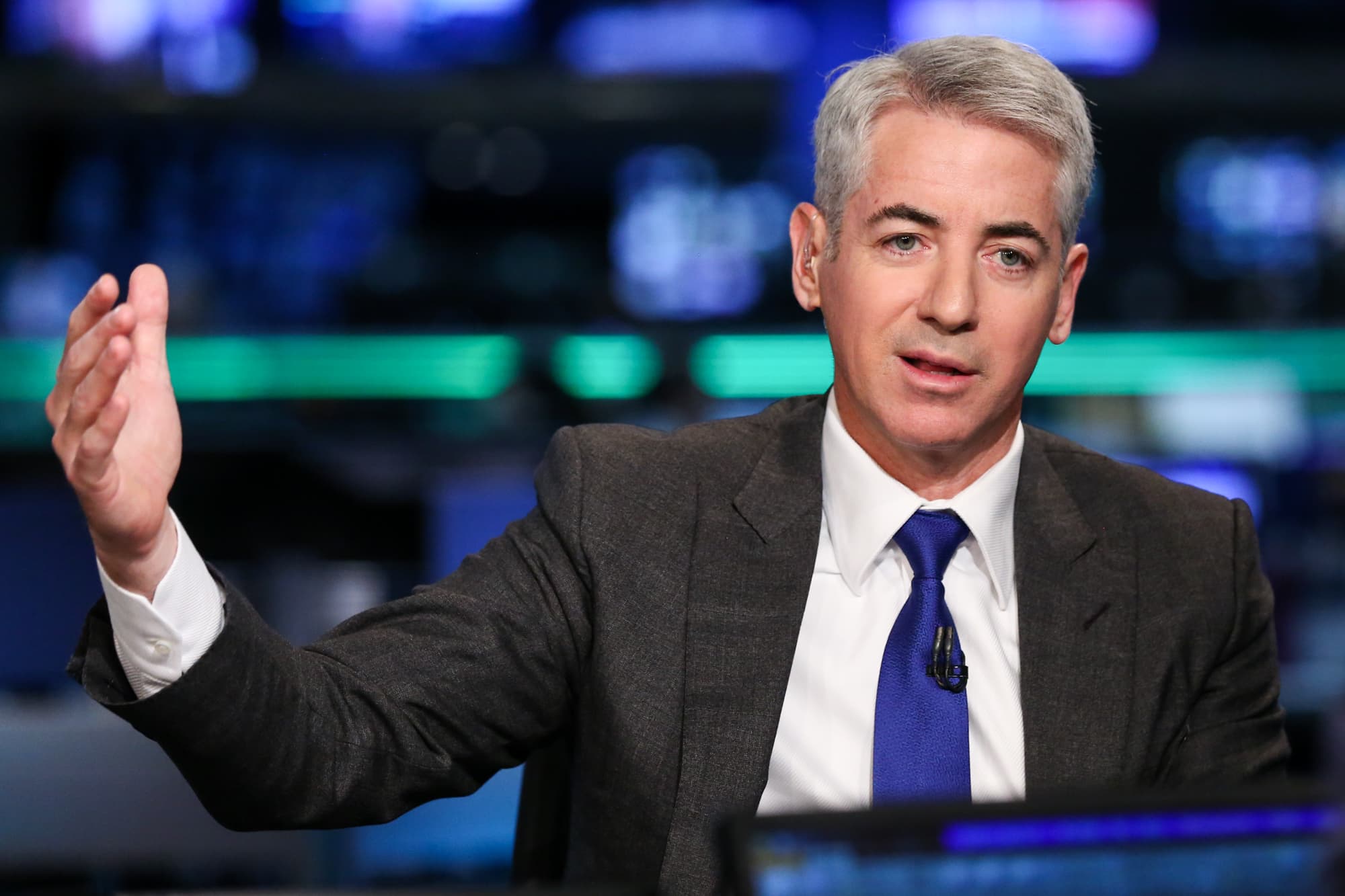
Bill Ackman, founder and CEO of Pershing Square Capital Management.

Adam Jeffery | CNBC

Billionaire hedge fund manager Bill Ackman's Pershing Square Capital took a new stake in Warren Buffett's Berkshire Hathaway, according to a new regulatory filing.

Pershing Square bought roughly 3.5 million shares of Class B shares, worth about $685 million at Wednesday's close. This is the first new position for Ackman's fund since it bought Starbucks last year.

Ackman was on track for a record year halfway through 2019. The net asset value of his publicly traded vehicle, Pershing Square Holdings, rose 47.6% through August, according to a regular update to the fund's website. The returns far outperformed the broader market. The S&P 500 was up 13% in the same time frame.

Pershing Square's recent rally is thanks to a handful of stock picks, including Chipotle Mexican Grill, Starbucks and Howard Hughes Corp. Ackman manages the public vehicle's portfolio though investment firm Pershing Square Capital Management.

In early 2018, the fund's assets were down by roughly half from their $20 billion peak in 2015. Pershing Square's net asset value dropped by 4% in 2017, compared to a nearly 20% rally in the S&P 500 that year.

Berkshire's Class B shares have been dropping since May, and are down about 7% this month.

Meanwhile, Berkshire Hathaway has been loading up on shares of Amazon. The Omaha, Nebraska-based holding company announced an 11% increase in its Amazon stake in a regulatory filing Wednesday. Buffett first announced an investment in the e-commerce giant in May.


from Business - Latest - Google News https://ift.tt/2TxD8co
via IFTTT
August 15, 2019 at 03:55AM

Canopy Growth books $1.3B loss as soaring expenses offset revenue - Article - BNN - BNNBloomberg.ca

SMITH FALLS, Ont. - Canopy Growth Corp. (WEED.TO) reported a net loss of nearly $1.3 billion as higher expenses offset revenue growth in the first quarter.

Canopy reported Wednesday it lost $1.28 billion during the three months ended June 30, its fiscal first quarter of 2020, compared with a loss of $91 million in the first quarter of fiscal 2019.

The loss equalled $3.70 per share, compared with a loss of 40 cents per share in the prior year. The surge in revenue was offset by a 215 per cent increase in operating expenses to $229.2 million.

The company based in Smith Falls, Ont., said the increased loss is mainly due to a non-cash loss of $1.18 million on the extinguishment of warrants held by alcohol giant Constellation Brands Inc., which invested $5 billion last November.

It also saw a significant decrease in quarter-over-quarter gross margins, or the spread between sale price and costs, as the company has been focused on investing in rapid expansion.

Gross margin before fair value impacts in cost of sales in the quarter was $13.2 million, or 15 per cent of net revenue. In the same quarter of 2019, that metric amounted to $11.1 million, or 43 per cent of net revenue.

The company said the difference was mainly due to the impact of $16.2 million in operating costs relating to facilities not yet producing cannabis or had under-utilized capacity. It also cited a shift in the product mix away from higher-margin products as inventories evened out.

Both Canopy's loss and revenue were worse than analysts had expected.

Analysts had predicted the company would book a loss of 70 cents per share on $107.1 in revenue, according to financial data firm Refinitiv.

The company generated $90.5 million in net revenues, up from $25.9 million a year earlier, before recreational marijuana was legal in Canada.

Most of the additional revenues in the quarter came from the sale of recreational marijuana that was legalized last October. Medical cannabis revenues decreased five per cent, with a 39 per cent drop in Canada offset by a large growth in international sales.

The revenue increase was driven by a record harvest of more than 40,000 kilograms - the first full-scale harvest since retrofitting its large greenhouses - that amounted to 183 per cent more product than in the fourth quarter.

5 questions with former Canopy Growth chairman and co-CEO Bruce Linton

Bruce Linton, former chairman and co-CEO of Canopy Growth, sits down with BNN Bloomberg for five questions into his personal life.

“Our recent harvests are proof that our focus on operational excellence is working, and we look forward to showing both our Canadian and U.S. customers what we've been working on behind the scenes to prepare for the next wave of products coming later this year,” stated interim CEO Mark Zekulin, who was appointed in July upon the termination of Bruce Linton as co-chief executive officer.

Linton was abruptly ousted from both the top job and the board of the cannabis company he grew into a dominant global player after Canopy reported a wider-than-expected fourth-quarter net loss, despite a jump in net revenue that beat market estimates.

Linton had been the public face of the company he co-founded in 2013 in a former chocolate factory in Smiths Falls, Ont., which had approximately 3,200 employees as of March 31. It is now the biggest pot company in the world by market value, at more than $18 billion.

Cannabis Canada is BNN Bloomberg’s in-depth series exploring the stunning formation of the entirely new – and controversial – Canadian recreational marijuana industry. Read more from the special series here and subscribe to our Cannabis Canada newsletter to have the latest marijuana news delivered directly to your inbox every day.


from Business - Latest - Google News https://ift.tt/2KCKXuV
via IFTTT
August 15, 2019 at 05:46AM

WeWork reveals loss, revenue growth as it prepares IPO - CBC News

Canada Goose loss smaller than feared thanks to demand for $1,000 parkas in Europe and Asia - Financial Post

Canada Goose Holdings Inc on Wednesday posted quarterly loss that was smaller than analysts had feared, as the company sold costlier jackets and parkas to department stores and opened five new retail outlets.

The luxury apparel company has been spending on its direct-to-consumer business, including its e-commerce and company-owned retail outlets, as it looks to rely less on struggling department stores for sales.

Revenue from wholesale business, however, rose 68.8 per cent in the reported quarter, as some customers in Europe and Asia requested earlier order shipments compared to last year, and due to its acquisition of footwear maker Baffin last November.

Direct-to-consumer revenue rose 50 per cent.

U.S.-listed shares of luxury apparel company fall 2.5 per cent to US$42.10 in trading before the bell.

Canada Goose, known for its $1,000 parkas, has also ventured into wool and lighter layers as well as spring and summer wear due to warmer weather and other reasons including fur ban in California and growing consumer distaste for fur.

“The affinity and desire we have seen for our seasonally relevant lightweight offerings tells us our product expansion is working,” Canada Goose said in its statement.

However, the company’s lightweight jackets are not as profitable as its iconic red parkas which, coupled with a higher proportion of sales going to department stores, led Canada Goose’s gross profit margins to fall 57.5 per cent from 64 per cent and miss analysts’ estimates of 61.6 per cent.

Net loss widened to $29.4 million, or 27 cents per share, in the quarter ended June 30, from a loss of $18.7 million, or 17 Canadian cents per share, a year earlier.

Excluding items, Canada Goose lost 21 cents per share, compared with analysts’ average estimate for a loss of 24 Canadian cents, according to IBES data from Refinitiv.

Revenue rose 59.1 per cent to $71.1 million, while analysts had expected $54.38 million, according to IBES data from Refinitiv.

© Thomson Reuters 2019


from Business - Latest - Google News https://ift.tt/2TwM6XJ
via IFTTT
August 14, 2019 at 07:41PM