Rabu, 11 September 2019

Many hurdles yet for TMX - BC News - Castanet.net

Barbara Gard calls her three-hectare property, nestled below the forested peak of Sumas Mountain, a "miniature Stanley Park." Its lush trees and flowing creek reminded her of Vancouver's majestic park, and she immediately knew she wanted to call it home.

But she said her peaceful retreat in Abbotsford now feels more like a nightmare. Gard is among thousands of landowners along the Trans Mountain pipeline expansion route who have not yet granted the Crown corporation access, and she said her dealings with the project's owners over the years have shattered her mental health.

"It's caused me emotional devastation," said Gard, a 64-year-old school psychologist on medical leave from work. "They are killing me through stress and legal fees."

Numerous hurdles remain before significant construction can begin on the massive project. Trans Mountain Corp. has not signed agreements with 33 per cent of landowners, no part of the detailed route has been approved, about half of the necessary permits are outstanding and it must meet dozens of conditions with the Canada Energy Regulator, formerly the National Energy Board.

Further, it faces resistance in southwest B.C., where landowners are digging in their heels, Indigenous groups are filing legal challenges and protesters are planning to ramp up activity.

The federal Liberal government bought the pipeline for $4.5 billion last year. The parliamentary budget officer has said that if the expansion is not complete by the end of 2021, it would be fair to conclude the government overpaid for the asset.

The government said the expanded pipeline will now be operational by mid-2022.

"If all goes according to the government's plan and hopes, then that is a realistic timeline," said David Wright, an assistant law professor with the University of Calgary. "But there's the significant caveat that not a lot has gone as hoped or planned from the government's perspective in the last couple years."

There are more than 2,500 tracts of private, Crown or Indigenous land to which Trans Mountain must gain access to build the expansion. As of July, some 1,730 — or 67 per cent — of owners had signed agreements granting the corporation entry.

Eighty-three per cent of landowners in Alberta and eastern B.C. have signed, but in the B.C. Interior and Fraser Valley, that number drops to 54 per cent. In the Lower Mainland, just 14 per cent of landowners have signed agreements.

The current Trans Mountain pipeline already runs through Gard's property. Her frustration with the pipeline's owners began in 2011, when she alleges workers sheared some 232 trees on her land, 80 of which they cut down entirely. The corporation denied any wrongdoing and the debate over the damage has dragged on for eight years, she said.

Gard said the corporation has not offered her fair compensation for the risk that the expansion poses to her property's delicate ecosystem or has it explained how it will restore vegetation and protect wildlife. The process feels extremely unbalanced, where she's facing off against the corporation's trained negotiators and legal team, she added.

Robin Scory, another landowner in the Fraser Valley who has not yet signed an agreement, said that the pipeline's owners have offered him "lowball" sums that are only a fraction of the property's value. Streams on his land run directly into the Fraser River and the corporation has not explained how it would mitigate the impacts of a spill, he said.

"It's a disaster waiting to happen. I'm not against the pipeline and I'm not a 'pay me millions of dollars' kind of guy, but it's just so badly run," Scory said.


from Business - Latest - Google News https://ift.tt/308H6Kq
via IFTTT
September 11, 2019 at 05:14AM

Restaurants Canada gives B.C. a ‘C’ grade for liquor policies - CityNews Vancouver

VANCOUVER (NEWS 1130) –  The industry group Restaurants Canada is giving British Columbia a “C” grade for its liquor policies, but it adds progress is being made. Slowly.

Right now, the province still controls the distribution of liquor to licensed establishments, and bar owners who want to buy bottles from private retailers are still out of luck, at least for now.

A report last year from wine lawyer Mark Hicken listed two dozen ways the province could improve the liquor industry. But Mark von Schellwitz with Restaurants Canada says the industry hasn’t seen enough action in the most essential areas.

“Many of our members would like to buy – especially single bottle picks and unique liquor products – from their local private liquor store, and right now that’s not possible at all in British Columbia,” von Schellwitz says.

RELATED: Review of B.C.’s liquor distribution system set for new year

He says his organization doesn’t like that the province is phasing out the liquor server wage, arguing it makes it harder to retain back-of-house staff who don’t earn tips.

Out of all the provinces, B.C. ranks right in the middle of the pack when it comes to liquor, and von Schellwitz says it has a lot of catching up to to with its neighbour to the east.

“Alberta, next door, is best in class. They have a fully privatized, wholesale price. People have many choices of where they can purchase the product.”

New Brunswick and Newfoundland and Labrador are at the bottom of the list with a D minus.

Von Schellwitz says he is hopeful the province will still follow through on the recommendations of the Hicken report.


from Business - Latest - Google News https://ift.tt/2ZUpdnt
via IFTTT
September 11, 2019 at 12:48AM

Forest industry cuts continue in B.C. as Teal-Jones halts harvesting on coast - CBC News

Large Crude Inventory Draw Lifts Oil Prices | OilPrice.com - OilPrice.com

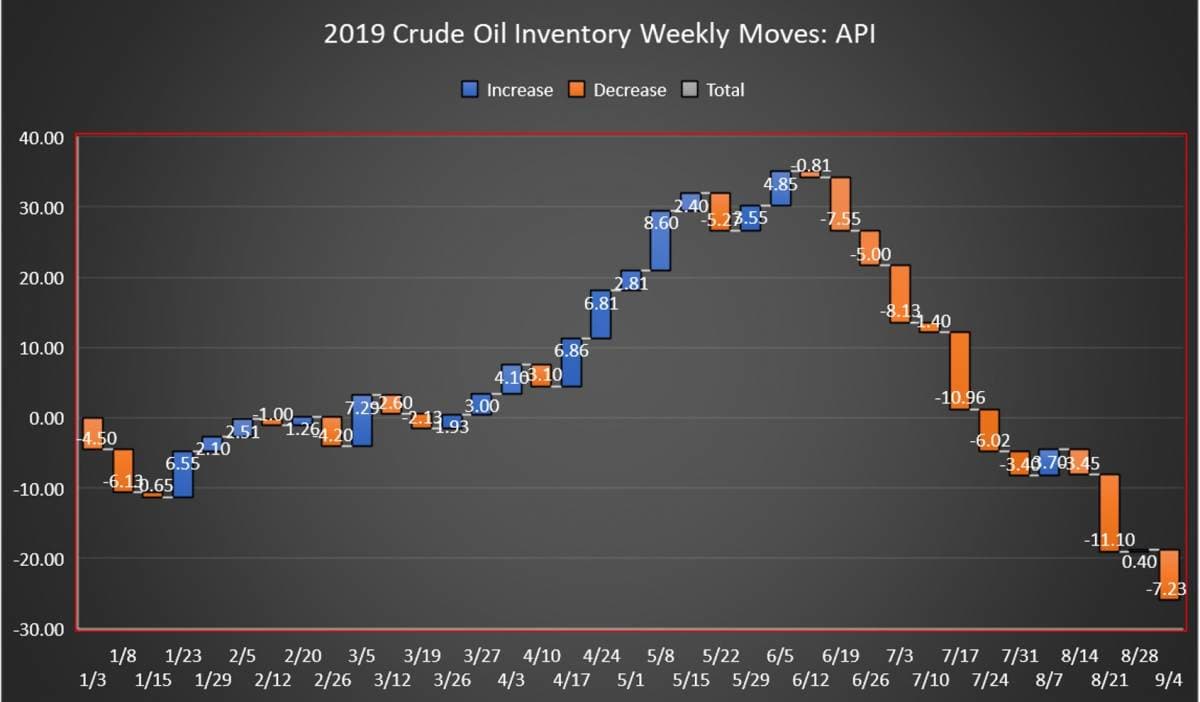
The American Petroleum Institute (API) has estimated a large crude oil inventory draw of 7.227 million barrels for the week ending September 5, compared to analyst expectations of a 2.6-million barrel draw.

The inventory build this week takes away from last week’s build in crude oil inventories of 401,000 barrels, according to API data. The EIA estimated that week that there was an inventory draw instead, of 4.8 million barrels.

After today’s inventory move, the net draw for the year is 25.90 million barrels for the 37-week reporting period so far, using API data.

Oil prices were trading up for the sixth day in a row on Tuesday prior to the data release after signs from OPEC point to an extension of its production cut agreement. OPEC is expected to meet later this week to discuss how the cartel should proceed to best meet its objective of rebalance the oil market.

But oil prices sank sharply later in the day on news that President Trump had fired John Bolton, on fresh fears that Iran and the United States may smooth things over, eventually freeing Iranian crude oil for export.

At 10:05am EDT, WTI was trading up $0.19 (+0.33%) at $58.04—nearly $2 up from last week. Brent was trading up $0.39 (+0.62%) at $62.98, or a bit over $2 per barrel above last week’s levels.  

The API this week reported a large draw of 4.460 million barrels of gasoline for week ending September 5. Analysts predicted a draw in gasoline inventories of 900,000 barrels for the week.

Distillate inventories rose by 618,000 barrels for the week, while inventories at Cushing fell by 1.359 million barrels barrels.

US crude oil production as estimated by the Energy Information Administration showed that production for the week ending August 30 returned to the 12.4 million bpd mark, falling slightly off its all-time high in the week prior of 12.5 million bpd.

At 4:39pm EDT, WTI was trading at $57.63, while Brent was trading at $62.54.

By Julianne Geiger for Oilprice.com

More Top Reads From Oilprice.com:


from Business - Latest - Google News https://ift.tt/32zgi7B
via IFTTT
September 11, 2019 at 03:44AM

Selasa, 10 September 2019

Flight 'sucks up geese' - BC News - Castanet.net

A Swoop airline flight headed to Edmonton from Abbotsford was forced to return to Abbotsford after the plane hit a flock of geese shortly after take-off Tuesday morning.

CTV News is reporting the flight took off just after 8 a.m. but was forced to pull a u-turn after hitting the birds, "one of the engines sucked up some geese and the smell was them, well, getting cooked."

Swoop indicates no one was injured as a result of the incident and a statement says all passengers, "were offloaded without incident" after the bird strike.Alternative arrangements are being made for the passengers travelling to Edmonton.

-with files from CTV News Vancouver


from Business - Latest - Google News https://ift.tt/2A8zddo
via IFTTT
September 11, 2019 at 01:14AM

West Fraser Timber sawmills cutting production by up to 25% in B.C. - CBC News

Canadian dollar posts six-week high, buoyed by Bank of Canada’s steady rate stance - The Globe and Mail

The Canadian dollar strengthened to a near six-week high against the U.S. dollar on Tuesday, supported by improvement in risk appetite and a less dovish Bank of Canada policy announcement last week than some investors had expected.

The Bank of Canada held interest rates steady last Wednesday and made no mention of future cuts despite easing this year by some of its global peers, including the U.S. Federal Reserve.

Chances of a rate cut at the central bank’s next meeting on Oct. 30 have slumped to about 15 per cent from nearly 70 per cent before last week’s rate decision, money market data showed.

Story continues below advertisement

We are seeing “position unwinding, given that people were looking for a dovish Bank of Canada meeting,” said Mark McCormick, North American head of FX strategy at TD Securities. “The other thing is that we are getting more momentum because risk appetite is improving as well.”

The S&P 500 fell on Tuesday but has rallied as much as 5.9 per cent since August. Canada’s bond yields are higher than many major issuers of sovereign debt, so its currency tends to benefit from a pick-up in the flow of global capital.

At 3:57 p.m., the Canadian dollar was trading 0.1 per cent higher at 1.3151 to the greenback, or 76.04 U.S. cents. The currency touched its strongest intraday level since July 31 at 1.3134.

Gains for the loonie coincided with data from the national housing agency showing that Canadian housing starts unexpectedly rose in August, climbing 1.9 per cent from July. Separate data from Statistics Canada showed that the value of Canadian building permits increased by 3.0 per cent in July from June.

“The construction side of the Canadian housing market still looks rock solid,” Robert Kavcic, a senior economist at BMO Capital Markets, said in a note.

Meanwhile, the price of oil, one of Canada’s major exports, was put under pressure by U.S. President Donald Trump’s firing of national security adviser John Bolton, which raised speculation of a return of Iranian crude exports to the market. U.S. crude oil futures settled 0.8 per cent lower at $57.40 a barrel.

Canadian government bond prices were lower across the yield curve in sympathy with U.S. Treasuries and German Bunds. The 10-year yield touched its highest intraday level since Aug. 1 at 1.435 per cent.

Story continues below advertisement

Canadian Prime Minister Justin Trudeau will formally launch the campaign for an Oct. 21 national election on Wednesday, sources from his Liberal party said.

Be smart with your money. Get the latest investing insights delivered right to your inbox three times a week, with the Globe Investor newsletter. Sign up today.


from Business - Latest - Google News https://ift.tt/2AalIKh
via IFTTT
September 10, 2019 at 08:47PM