Kamis, 12 September 2019

ECB cuts rates, restarts QE to fight slowdown as Draghi era ends - BNNBloomberg.ca

The European Central Bank cut interest rates further below zero and will start open-ended bond purchases as President Mario Draghi overcame critics of his stimulus policies to make a final run at reflating the euro-area economy.

The Governing Council reduced the deposit rate to minus 0.5 per cent from minus 0.4 per cent, and will buy debt at 20 billion euros (US$22 billion) a month starting Nov. 1. Banks will get exemptions from the negative rate for some of their deposits after an outcry from lenders about the squeeze on profitability. Draghi will hold a press conference at 2:30 p.m. in Frankfurt.

The ECB now plans to keep rates at their present or lower levels until its outlook for inflation “robustly” converges to its goal of just below 2 per cent, having previously expected borrowing costs to stay unchanged until mid-2020. It also scrapped a 10-basis point rate premium it previously attached to long-term loans.

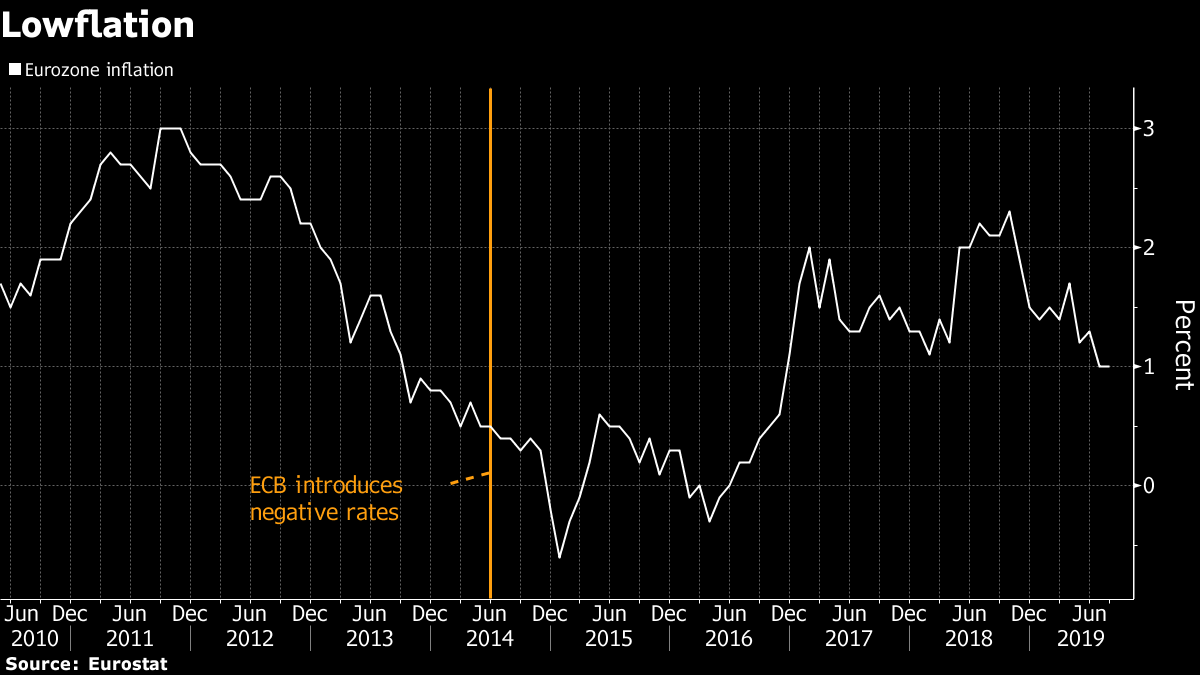
The announcement of a new stimulus package is a remarkable turn of events, just nine months after the ECB signaled it was done with ever-looser policy. Now inflation is running at barely half the goal of just under two per cent, and the manufacturing sector is in a contraction that risks spreading to the rest of the economy.

Hours before the decision, industrial-production figures showed the third quarter off to a weak start with euro-zone output dropping 0.4 per cent in July, more than expected. The decline was led by Germany, which is on the verge of a recession as a global slowdown in trade caused by the U.S.-China standoff and the uncertainties surrounding Brexit hurts its exporters.
Embedded Image

The approval of such broad measures is a win for Draghi in his penultimate meeting before he steps down next month. Governors from core economies including Germany and the Netherlands pushed back against the resumption of quantitative easing, saying it should be a last resort in case the outlook worsens.

Central banks around the world are easing to combat the spreading weakness, with the U.S. Federal Reserve likely to lower rates next week for the second time this year. The International Monetary Fund reduced its global growth outlook in July.

Still, there are doubts the ECB’s latest measures will prove as effective as hoped. Longer-term bond yields have already fallen sharply because of the economic slowdown, and another round of debt purchases might not exert much more downward pressure.

--With assistance from Fergal O'Brien, Jeannette Neumann, Piotr Skolimowski, Zoe Schneeweiss, Jana Randow, Lukas Strobl, Craig Stirling, Brian Swint, Aaron Eglitis, Alexander Kell, Raymond Colitt, Iain Rogers and Nicholas Comfort.


from Business - Latest - Google News https://ift.tt/2Agsv5b
via IFTTT
September 12, 2019 at 07:10PM


Hudson’s Bay posts deeper loss with streamlining efforts still in ‘early stages’ - The Globe and Mail

Aurora Cannabis misses own guidance with weaker revenues in fourth quarter - Yahoo Canada Finance

NewsBreak - Oil Drops as OPEC Agrees to Cut Oil Output; Gold Surges - Investing.com

© Reuters. © Reuters.

Investing.com - Oil prices slumped on Thursday after and ask Iraq and Nigeria to bring production down in an attempt to prevent a glut as U.S. production soars.

• The Organization of the Petroleum Exporting Countries and its allies met on Thursday ahead of policy discussions in Vienna in December.

• Iraq, OPEC's second-largest oil producer, pledged to reduce output by 175,000 barrels per day (bpd) by October, while Nigeria agreed to cut 57,000 bpd.

• fell 1.6% to $54.83 a barrel as of 8:45 AM ET (12:45 GMT).

•, the benchmark for oil prices outside the U.S., slumped 1.9% to $59.66.

• Meanwhile, surged 1.8% to $1,529.25 after the on deposits and announced it is restarting its bond-purchasing program.

Disclaimer: Fusion Media would like to remind you that the data contained in this website is not necessarily real-time nor accurate. All CFDs (stocks, indexes, futures) and Forex prices are not provided by exchanges but rather by market makers, and so prices may not be accurate and may differ from the actual market price, meaning prices are indicative and not appropriate for trading purposes. Therefore Fusion Media doesn`t bear any responsibility for any trading losses you might incur as a result of using this data.

Fusion Media or anyone involved with Fusion Media will not accept any liability for loss or damage as a result of reliance on the information including data, quotes, charts and buy/sell signals contained within this website. Please be fully informed regarding the risks and costs associated with trading the financial markets, it is one of the riskiest investment forms possible.


from Business - Latest - Google News https://ift.tt/30b4gjd
via IFTTT
September 12, 2019 at 07:56PM

Why negative interest rates in the U.S. would be the real ‘bonehead’ move - Financial Post

Another day, another salvo in the one-sided feud between Donald Trump and his handpicked chair of the Federal Reserve. To add to calling Powell and the Fed “a much bigger problem than China” and absolutely clueless (in various forms) over the past few months, the President of the United States on Wednesday took to labelling his monetary policymakers “Boneheads” — in a tweet, of course.

We already know that Trump is as fond of bashing Powell as he is of unnecessary quotation marks and odd capitalization. New for this week, however, was that Trump managed to scapegoat the Fed while running a couple of newish policy ideas up the old Twitter flagpole: one, that the Fed should embrace zero or negative interest rates, and, two, that the government should refinance its debt to take advantage of those super-low rates.

News coverage of the tweets pointed out that, as recently as last month, Trump was saying that he didn’t favour negative interest rates for the U.S. But it’s not like he wasn’t already a fan of sub-zero rates for other economies. Germany’s issuance of a zero-coupon, 30-year note in August, which had a yield of -0.11 per cent, drew his praise as an example of a country “actually being paid to borrow money.” What a deal!

As for the notion of taking advantage of low rates to “refinance” government debt, Trump was pumping that one back during the 2016 election campaign; his onetime nominee for a Federal Reserve seat, Stephen Moore, recently penned an op-ed supporting the idea, as well.

Getting paid to borrow must make the debtor inside Trump salivate at the possibilities

And hey, why not? Getting paid to borrow must make the debtor inside Trump — who has a history of debt restructurings in his private-sector career — salivate at the possibilities. In a stroke, a zero-ish rate could spark the economy up into that three- or four- or five-per-cent growth range he has long touted. It would probably devalue the greenback, too, making U.S. exports more competitive. (In Trump’s worldview, every other country with negative rates is trying to manipulate their currencies down, so why not join the club?) Meanwhile, refinancing the U.S. federal debt — which now stands at US$22 trillion, and is increasing by more than US$1 trillion a year under Trump — would lower the nation’s debt burden and give the administration room to borrow even more.

To Trump, apparently, this is clearly the sweetheart deal to end all sweetheart deals. But like much of what he proposes (Mexico paying for his wall, China paying for his tariffs, GDP growth paying for his corporate tax cuts), it’s too sweetheart-y to be true. Governments “getting paid to borrow money” isn’t the only thing negative rates do, after all. They also create a whole bunch of new risks.

Let’s leave aside the obvious problem that negative rates now would leave the Fed nowhere to cut if there were an actual recession. One thing that Trump seems not to recognize — and which makes his Twitter musing all the more irresponsible — is that perceptions matter. The Federal Reserve’s policy rate is higher than other central banks’ now not because Jerome Powell is a sucker, but because the U.S. economy is perceived to be strong by the investors of the world. Money flows into the States because it’s viewed as the largest, most dynamic and safest economy in the world, not because rates are high. The Fed hasn’t lowered rates to zero (or below) because it hasn’t had to, unlike (arguably) Europe and Japan.

Now, imagine the reaction if the Fed suddenly went to zero or below: that would be a pretty clear sign the U.S. economy is far worse off than anyone imagines at the moment. That wouldn’t be good for an economy that relies so heavily on credit. Businesses and investors wouldn’t likely say to themselves, hey, let’s get this party started! They’re more likely to look elsewhere for opportunity. When Japan turned to negative rates in 2016, the market’s inflation expectations went down — which is pretty much the opposite of what sub-zero rates are supposed to do.

The empirical reality is that sub-zero interest rates just don’t work when it comes to kick-starting growth, or at least they haven’t yet in Europe or Japan. One concern is that they function as a tax on banks, decreasing their interest margins. Depending on how low they go, and for how long, that might actually work against credit formation, which, again, is pretty much exactly the opposite of what they are supposed to do.

Not to mention that negative rates screw over savers and seniors who would like to live off risk-free income. You would think Trump might want to count on their support come 2020.

Oh well, at least he could “refinance” government debt. But it’s not clear how that would work in practice. Trump has never really got into the details, and his descriptions of what he means are often garbled, but it seems that he’s proposing that the Treasury department issue more long-term debt (like 30-year, 100-year, or whatever) and “lock in” today’s low rates (or tomorrow negative rates). But at what cost? Moving up the average duration of U.S. government debt might save a few bucks in interest payments, but it could also be a disruptive force in a liquid, complex bond market fuelled by Treasury issuances all along the duration spectrum.

And if rates go below zero, there might not be very much demand for those ultra-long bonds Trump seems to like. Those German 30-years he liked so much? The president neglected to mention that investors bought less than half of the planned two-billion-euro issue — making it technically a failed auction.

Even if Trump somehow gets his way on rates and debt refinancing, he might end up finding that nobody is buying what he’s selling.


from Business - Latest - Google News https://ift.tt/2NZ4hoe
via IFTTT
September 12, 2019 at 08:53PM

ECB cuts key rate, relaunches QE to shore up eurozone economy - MarketWatch

The European Central Bank delved deep into its tool box on Thursday, cutting its deposit interest rate further into negative territory, launching a new round of monthly bond purchases and taking other steps to stimulate a flagging eurozone economy.

In outgoing ECB President Mario Draghi’s next-to-last meeting, the central bank, as expected, delivered a 10 basis point cut to the deposit rate that banks pay to park excess reserves with it. The move pushed the rate to minus 0.5%.

In a news conference following the decision, Draghi said stubbornly low inflation, which remains well below the ECB’s target of near but just below 2%, was the main driver for the decision.

Draghi said risks to the eurozone outlook had increased as a result of prolonged global trade disputes and concerns about the prolonged process involving the U.K. exit from the European Union. Risks of a eurozone recession remained “small,” he said, but had increased since the ECB’s last meeting.

Economists had been less certain whether the ECB would also move to relaunch its quantitative easing program at its September meeting, but policy makers did so. The ECB said it would begin buying 20 billion euros a month worth of securities beginning Nov. 1.

Doubts had emerged in the runup to the meeting after a handful of ECB officials, in public remarks and media interviews, had questioned the need for relaunching asset purchases. Draghi, in a news conference following the decision, said there had been broad support for the rate cut and an extension of the central bank’s forward guidance on rates, but acknowledged more “diversity” of views on relaunching bond purchases. Still, there was a broad consensus in favor of the entire package.

Moreover, economists were describing the ECB’s asset-buying plan as “open-ended” QE, with policy makers pledging to continue purchases “as long as necessary to reinforce the accommodative impact of its policy rates” and to end shortly before the ECB begins to raise key interest rates.

“Today’s decisions have anchored and enshrined the Draghi legacy in future ECB decisions. ‘Whatever it takes’ has just been extended by ‘as long as it takes,’ said Carsten Brzeski, chief economist at ING Germany, referring to Draghi’s famous 2012 pronouncement at the height of the eurozone debt crisis that the ECB would do “whatever it takes” to preserve the euro.

Among other steps taken by the ECB on Thursday, policy makers extended the so-called forward guidance on rates, saying they would remain at “present or lower levels” until the inflation outlook “robustly” converges with the bank’s target inflation rate of near but just below 2%. Previously, the ECB said it intended rates to remain at present or lower levels through the first half of next year.

The ECB also made adjustments to its targeted long-term refinancing operations to further encourage lending and, in a bid to ease pressure on bank profitability from a lower deposit rate, announced it would introduce a tiered system that would exempt a chunk of excess reserves parked by banks with the ECB from the negative rate.

See: The ECB’s challenge: Pushing rates further into negative territory without wrecking eurozone banks

The decision drew the attention of U.S. President Donald Trump, who has previously accused the ECB of working to undercut the dollar. On Thursday, he used the decision as an excuse to again bash the U.S. Federal Reserve via Twitter:

Asked about the tweet, Draghi responded that ECB policy makers “do not target the exchange rate, period.”

Read: Trump complains ECB rate cut will hurt U.S. and Mnuchin doesn’t disagree

The euro EURUSD, +0.5268%  fell to a two-year low versus the U.S. dollar in the wake of the decision, but later rebounded following a round of U.S. economic data and after a news report said Trump administration officials were weighing an interim trade deal with China. The pan-Euroepan Stoxx 600 index SXXP, +0.20%  was up 0.2%.

U.S. stocks pushed higher, with the S&P 500 SPX, +0.41%  up 0.5%, while the Dow Jones Industrial Average DJIA, +0.34%  rose around 110 points, or 0.4%.

The bond-buying decision sent European bond yields sinking, dragging on U.S. Treasury yields. But yields soon rebounded into positive territory as trade-deal hopes appeared to take center stage. Yields and bond prices move in opposite directions.

Let's block ads! (Why?)


https://www.marketwatch.com/story/ecb-cuts-key-rate-restarts-qe-as-it-attempts-to-revive-eurozone-economy-2019-09-12

2019-09-12 14:14:00Z
52780380052099

145 business leaders implore Senate to act on gun violence, saying doing nothing is ‘simply unacceptable’ - The Washington Post


Companies have come under pressure to act on gun violence after recent mass shootings, including two at Walmart stores. (Mario Tama/Getty Images/Bloomberg News)

The chief executives of 145 U.S. companies pressed Senate leaders to expand background checks to all firearms sales and implement stronger “red flag” laws, marking the latest push by corporate America to pressure Congress to take meaningful action on gun violence.

Signatories to a letter sent Thursday include the heads of major retailers, tech firms, financial institutions, including Levi Strauss, Twitter, Uber, Dick’s Sporting Goods, Yelp, Bain Capital and Reddit. The letter pointed to mass shootings in recent weeks — including those in El Paso; Dayton, Ohio; and Gilroy, Calif. — but also called out a broader epidemic of gun violence that kills 100 Americans each day and wounds hundreds more.

“As leaders of some of America’s most respected companies and those with significant business interests in the United States, we are writing to you because we have a responsibility and obligation to stand up for the safety of our employees, customers and all Americans in the communities we serve across the country,” the executives wrote.

“Doing nothing about America’s gun violence crisis is simply unacceptable and it is time to stand with the American public on gun safety,” they continued.

Corporate America has increasingly weighed in on — or been forced to reckon with — pressing social and political issues facing the country and the world, including immigration and abortion. On gun violence, companies including retailers and banks have considered whether to overhaul their policies or distance themselves from the vast firearm industry — or not. Gun sellers have come under acute pressure to limit the sales of firearms, especially since 24 people were killed at two separate shootings in Walmart stores in the past two months.

A recent Washington Post-ABC News poll found that Americans across party and demographic lines overwhelmingly support expanded background checks for gun buyers and allowing law enforcement to temporarily seize weapons from troubled individuals. The poll found that 86 percent of Americans support implementing “red flag” provisions allowing guns to be taken from people judged to be a danger to themselves or others. And 89 percent support expanding federal background checks to cover private sales and gun-show transactions.

Specifically, Thursday’s letter urged the Senate to pass a bill requiring background checks on all gun sales plus a strong red-flag law that would allow courts to issue lifesaving extreme-risk protection orders. The House has passed gun-control bills, but they have stalled in the Senate.

“Since Congress established the background check system 25 years ago, background checks have blocked more than 3.5 million gun sales to prohibited purchasers like convicted felons and domestic abusers,” the letter states.

But in the subsequent decades, the background check law “has not been updated to reflect how guns are bought and sold today,” the company executives wrote. They said the Senate should follow actions taken by the House to pass bipartisan legislation to update the background checks law, “helping to keep guns out of the hands of people who shouldn’t have them.”

The leaders also wrote that expanding red-flag laws would “enable families and law enforcement nationwide to intervene when someone is at serious risk of hurting themselves or others.”

Walmart, the largest employer in the country, did not sign Thursday’s letter. But last week, the company wrote a separate letter to Congress urging for a debate over reauthorizing an assault weapons ban. Walmart also announced it would stop selling ammunition for military-style weapons and no longer allow customers to openly carry firearms in stores. Other retailers also changed their open-carry policies, including Kroger, CVS and Walgreens.

Let's block ads! (Why?)


https://www.washingtonpost.com/business/2019/09/12/ceos-implore-senate-act-gun-violence-saying-doing-nothing-is-simply-unacceptable/

2019-09-12 11:21:51Z
52780381311800