Jumat, 11 Oktober 2019

U.S. suspends plans to hike tariffs Tuesday on Chinese imports - CBC.ca

The Trump administration is suspending a tariff hike on $250 billion in Chinese imports that was set to take effect Tuesday, and China agreed to buy $40 billion to $50 billion in U.S. farm products as the world's two biggest economies reached a cease-fire in their 15-month trade war.

The White House said the two sides made some progress on the thornier issues, including China's lax protection of foreign intellectual property. But more work will have to be done on key differences in later negotiations, including U.S. allegations that China forces foreign countries to hand over trade secrets in return for access to the Chinese market.

The U.S. and Chinese negotiators have so far reached their tentative agreement only in principle. No documents have been signed.

President Donald Trump announced the trade truce in a White House meeting with the top Chinese negotiator, Vice Premier Liu He. The news followed two days of talks in Washington.

"You're very tough negotiators," Trump said to the Chinese delegation.

Trump has yet to drop plans to impose tariffs Dec. 15 on an additional $160 billion in Chinese products, a move that would extend the sanctions to just about everything China ships to the United States. The December tariffs would cover a wide range of consumer goods, including clothes, toys and smartphones and would likely be felt by American shoppers.

While providing scant details of just what was agreed to Friday, the White House said Beijing has pledged to be more transparent about how it sets the value of its currency, the yuan. The Trump administration has accused China of manipulating the yuan lower to give its exporter a price advantage in foreign markets.

China has agreed to open its markets to U.S. banks and other financial services providers, Treasury Secretary Steven Mnuchin said.

Earlier Friday, China announced a timetable for carrying out a promise to allow full foreign ownership of some finance businesses, starting with futures traders on Jan. 1, as Beijing tries to make its slowing economy more competitive and efficient.

Ownership limits will be ended for mutual fund companies on April 1 and for securities firm on Dec. 1, the China Securities Regulatory Commission said. Until now, foreign investors have been limited to owning 51 per cent of such businesses.

Economic toll

For now, the two sides have come to "almost a complete agreement" on both financial services and currency issues, Mnuchin said.

The trade war has inflicted an economic toll on both countries. U.S. manufacturers have been hurt by rising costs from the tariffs and by uncertainty over when and how the trade hostilities may end.

"They're trying to de-escalate," said Timothy Keeler, a former chief of staff at the Office of the U.S. Trade Representatives. "I think it serves both sides' interests because both sides were feeling pain."

Stock prices had been up substantially all day, mainly in anticipation of a significant trade agreement. But once the White House announced the contours of the tentative accord, the market shed some of its gains. The Dow Jones industrial average, which had risen more than 500 points at its high, closed up 319.

The U.S. and Chinese negotiators did not deal this week with a dispute over the Chinese telecommunications giant Huawei. The U.S. has imposed sanctions on Huawei, saying it poses a threat to U.S. national security because its equipment can be used for espionage. Trump has said he was willing to use Huawei as a bargaining chip in the trade talks.

The United States still has in place tariffs on more than $360 billion worth of Chinese imports and is set to hit an additional $160 billion in December. What changed Friday was that Trump suspended plans to raise the existing tariffs on $250 billion in Chinese products from 25 per cent to 30 per cent next week.

"This is an encouraging first phase," said Craig Allen, president of the U.S.-China Business Council. "We await word on how implementation will be measured and in what timeframe, as well as details on scheduling subsequent phases"

Agreement skeptics

Among the skeptics of Friday's agreement is Derek Scissors, a China expert at the American Enterprise Institute, who suggested that the deal amounted to merely a temporary pause in the conflict.

"The president is acting as if a lot of Chinese concessions have been nailed down, and they just haven't," Scissors said.

The two countries were close to a more comprehensive deal in early May. But talks stalled after the U.S. accused China of reneging on earlier commitments. Trump acknowledged that Friday's deal has yet to be put down on paper but said that wouldn't be a problem.

"China wants it badly, and we want it also," Trump said. "We should be able to get that done over the next four weeks."

Gregory Daco, an economist at Oxford Economics, said the partial nature of the deal won't relieve much of the uncertainty surrounding trade policy that has discouraged many American companies from investing in new equipment and expanding.

"For businesses this will mean less damage, not greater certainty," Daco said in a research note.

Daco has estimated that the trade fight will cut U.S. growth by about 0.6 percentage point in 2020. Friday's pact might reduce that slightly to 0.5 percentage point, he said. "While market reacted positively to the news, we caution that beyond the promises and niceties, the deal doesn't address key underlying issues," Daco wrote.

The two countries are deadlocked primarily over the Trump administration's assertions that China deploys predatory tactics — including outright theft — in a sharp-elbowed drive to become the global leader in robotics, self-driving cars and other advanced technology.

Beijing has been reluctant to make the kind of substantive policy reforms that would satisfy the administration. Doing so would likely require scaling back China's aspirations for technological supremacy, which it sees as crucial to its prosperity.


from Business - Latest - Google News https://ift.tt/2phEbCc
via IFTTT
October 12, 2019 at 04:55AM

Canada adds 54K jobs in September, unemployment dips to 5.5% - Global News

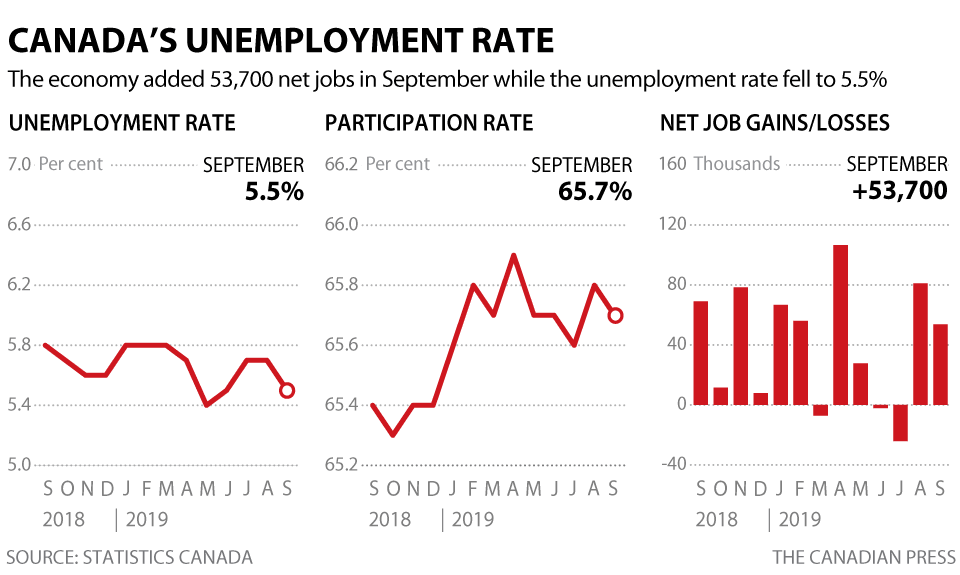
The Canadian economy added a stronger-than-expected 53,700 net jobs in September, with all the gains coming in full-time work and largely driven by the services sector, Statistics Canada data said on Friday in one of its last major economic data releases before a national election.

The national unemployment rate fell to 5.5 per cent from the 5.7 per cent seen in August, while wages for permanent employees rose 4.3 per cent year-over-year. Analysts in a Reuters poll had forecast a gain of 10,000 jobs and an unemployment rate of 5.7 per cent.

CANADIAN UNEMPLOYMENT

Friday’s employment figures will likely be welcomed by Canadian Prime Minister Justin Trudeau, whose governing Liberals are facing a tight re-election campaign against the opposition Conservatives. Canadians vote on Oct. 21.

Story continues below advertisement

Ontario, Canada’s largest province and a key political battleground in an election that has largely focused on economic issues, gained a net 41,100 jobs in September, far outpacing its other provincial and territorial counterparts.

READ MORE: Ridings to watch: ‘The GTA is where this election is going to be won and lost’

Statscan said the services sector gained 49,400 jobs in September, mostly in the healthcare and social assistance sectors, while the goods-producing sector saw an increase of 4,300, because of the construction industry. Meanwhile, the number of full-time jobs rose by 70,000, while part-time jobs fell by 16,300.

Canada’s central bank has not moved interest rates since October 2018, even as some of its counterparts – including the U.S. Federal Reserve – have eased. The Bank of Canada has said the Canadian economy is showing a welcome degree of resilience against negative shocks, in part, because of a strong labor market.

© 2019 Reuters


from Business - Latest - Google News https://ift.tt/2OEPXBC
via IFTTT
October 11, 2019 at 08:01PM

Payments giants abandon Facebook's Libra cryptocurrency - BBC News

Facebook had said it hoped to launch Libra in 2020Image copyright Getty Images
Image caption Facebook had said it hoped to launch Libra in 2020

Mastercard, Visa, eBay and payments firm Stripe have pulled out of Facebook’s embattled cryptocurrency project, Libra.

Their move, first reported in the Financial Times, follows the withdrawal of PayPal, announced last week.

It represents a huge blow to the social network’s plans to launch what it envisions as a global currency.

The project has drawn heavy scrutiny from regulators and politicians, particularly in the US.

Facebook chief executive Mark Zuckerberg will appear before the House Committee on Financial Services on 23 October to discuss Libra and its planned roll-out.

Regulators have raised multiple concerns over Libra, including the risk it may be used for money laundering.

Mercado Pago, a payments firm serving mostly Latin America, also pulled out. It means of the six payments-related firms first involved in Libra, just one, PayU, remains. Netherlands-based PayU did not respond to the BBC's request for comment on Friday.

In a statement released on Friday, eBay said it “respected” the Libra project.

“However, eBay has made the decision to not move forward as a founding member. At this time, we are focused on rolling out eBay’s managed payments experience for our customers.”

A spokesperson for Stripe said the firm supported the aim of making global payments easier.

"Libra has this potential. We will follow its progress closely and remain open to working with the Libra Association at a later stage.”

A spokesperson for Visa said: "We will continue to evaluate and our ultimate decision will be determined by a number of factors, including the Association's ability to fully satisfy all requisite regulatory expectations."

The Libra Association, set up by Facebook to manage the project, said of the departing companies: "We appreciate their support for the goals and mission of the Libra project.

"Although the makeup of the Association members may grow and change over time, the design principle of Libra's governance and technology, along with the open nature of this project ensures the Libra payment network will remain resilient.

"We look forward to the inaugural Libra Association Council meeting in just 3 days and announcing the initial members of the Libra Association.”

Facebook's executive in charge of its Libra effort wrote on Twitter that losing the firms was "liberating".

"I would caution against reading the fate of Libra into this update," wrote David Marcus, who before joining Facebook was PayPal's president.

"Of course, it's not great news in the short term, but in a way it's liberating. Stay tuned for more very soon. Change of this magnitude is hard. You know you're on to something when so much pressure builds up."

Last week, PayPal said it would no longer be part of the Libra Association, but did not rule out working on the project in future - prompting a strong reaction from the Association.

"Commitment to that mission is more important to us than anything else," it said in a statement. "We're better off knowing about this lack of commitment now."

_____

Follow Dave Lee on Twitter @DaveLeeBBC

Do you have more information about this or any other technology story? You can reach Dave directly and securely through encrypted messaging app Signal on: +1 (628) 400-7370


from Business - Latest - Google News https://ift.tt/315mKlB
via IFTTT
October 12, 2019 at 06:14AM

GM appeals directly to employees as strike losses pile up - CANOE

General Motors Co took the unusual step of appealing directly to employees in a blog post on Friday that laid out the terms of its latest offer aimed at ending a month-long strike.

While emphasizing GM’s commitment to the collective bargaining process, the letter, signed by Executive Vice-President for Global Manufacturing Gerald Johnson, circumvents United Auto Workers (UAW) leadership and points to frustration at a lack of progress on ending a conflict that has already cost the company more than $1 billion.

GM also boosted the amount it plans to invest in its U.S. plants to $8.3 billion, up from its previous offer of $7 billion, a source familiar with the company’s offer said.

Of the new total, $7 billion would be invested directly in GM plants, with the rest going to joint ventures including a potential battery plant near the Lordstown, Ohio, factory that has been idled.

“The strike has been hard on you, your families, our communities, the company, our suppliers and dealers,” GM’s letter read, saying the latest offer increased compensation and promised a path to full-time jobs for temporary workers.

“We have advised the Union that it’s critical that we get back to producing quality vehicles for our customers. (…) Our offer builds on the winning formula we have all benefited from over the past several years.”

A UAW spokesman declined to comment on the new GM offer.


from Business - Latest - Google News https://ift.tt/2Bfb5Xf
via IFTTT
October 11, 2019 at 09:23PM

The close: TSX slips despite robust jobs data - The Globe and Mail

Global stocks and the euro rallied on Friday on signs of progress in U.S.-China trade talks and hopes that Britain was moving closer to a smooth exit from the European Union.

The MSCI world equity index was on track for its first weekly rise in four. Frankfurt’s main stock index, seen as sensitive to trade wars because of its export-oriented components, ended up 2.9 per cent for its biggest daily gain since January 4.

The improved appetite for riskier assets carried from Thursday and improved after U.S. President Donald Trump said “good things” were happening during high-level China-U.S. trade talks and spoke of “warmer feelings.”

Story continues below advertisement

U.S. officials signaled good news was coming after a second day of trade talks with China ended, boosting investor hopes that the world’s two largest economies would agree to cool the fires of their 15-month tariff war.

However, investors said they were hoping for, at best, a deal limited in scope, and noted that rhetoric had in the past failed to translate into meaningful moves.

“We have been here before, where we have seen positive talk. It’s possible they will be able to do a smaller deal around tariffs, where there is some room for movement,” said Mike Bell, global market strategist at J.P. Morgan Asset Management.

Sterling jumped nearly 2 per cent versus the dollar for a second day, putting it on track for its largest weekly gain in more than two years after the EU Brexit negotiator reported a “constructive” meeting with his British counterpart.

Sterling was last trading at $1.2657, up 1.74 per cent.

Canada’s main stock index finished flat despite robust domestic jobs data.

The Toronto Stock Exchange’s S&P/TSX composite index was unofficially down 7.52 points, or 0.05 per cent, at 16,415.16.

Story continues below advertisement

Five of the index’s 11 major sectors were higher.

The energy sector climbed 1.9 per cent on the back of higher oil prices, lifted by a report of an attack on an Iranian oil tanker.

Energy stocks also got a boost from shares of Tourmaline Oil Corp, which jumped 11 per cent and were the largest percentage gainers on the TSX, after the company announced it would form a infrastructure energy company called Topaz Energy Corp.

The financials sector gained 0.7 per cent and the industrials sector 0.3 per cent.

The materials sector, which includes precious and base metals miners, lost 2.4 per cent, as demand for riskier bets dented demand for gold. Utilities were down 1.2 per cent.

The Canadian dollar strengthened to a one-month high against its U.S. counterpart on Friday after domestic data showing a much bigger-than-expected jobs gain in September supported bets for the Bank of Canada to keep interest rates on hold this month.

Story continues below advertisement

The Canadian economy added 53,700 jobs in September, the second straight month of robust jobs gains, Statistics Canada data showed. Analysts had forecast a gain of 10,000 jobs

“A huge labour market print has helped the loonie take more ground against the U.S. dollar today,” Simon Harvey, FX market analyst for Monex Europe and Monex Canada, said in a note. “Markets are now pricing a Bank of Canada rate cut at the end of the month as a slim probability.”

Chances of a Bank of Canada interest rate cut at the October 30 policy decision dipped to 7 per cent from 9 per cent before the data, the overnight index swaps market indicated.

The central bank has kept its benchmark rate on hold at 1.75 per cent this year even as other central banks, including the Federal Reserve and the European Central Bank, have eased.

The Canadian dollar was trading 0.8 per cent higher at 1.3184 to the greenback, or 75.85 U.S. cents. The currency, which was up 0.9 per cent for the week, touched its strongest intraday level since Sept. 11 at 1.3171.

Stocks on Wall Street followed Asia and Europe.

Story continues below advertisement

“Over the last couple of months, we have seen (companies)taking a hit from the uncertainty around trade and markets will be looking for any clues to remove that,” said Scott Brown, chief economist at Raymond James in St. Petersburg, Florida.

“It is still going to be a one step forward, two steps backward tone with the (trade) talks, but there are hopes of a de-escalation.”

The Dow Jones Industrial Average rose 317.65 points, or 1.2 per cent, to 26,814.32, the S&P 500 gained 31.88 points, or 1.09 per cent, to 2,970.01 and the Nasdaq Composite added 106.27 points, or 1.34 per cent, to 8,057.04.

The pan-European STOXX 600 index rose 2.31 per cent and MSCI’s gauge of stocks across the globe gained 1.77 per cent.

Emerging market stocks rose 1.82 per cent. MSCI’s broadest index of Asia-Pacific shares outside Japan closed 1.81 per cent higher, while Japan’s Nikkei rose 1.15 per cent.

The Federal Reserve said it would begin buying about $60 billion per month in Treasury bills to ensure “ample reserves” in the banking system, a program that will continue at least until the second quarter of 2020.

Story continues below advertisement

The dollar fell toward its session lows after the Fed announcement.

The dollar index fell 0.38 per cent, with the euro up 0.31 per cent to $1.1038.

The Japanese yen weakened 0.46 per cent versus the greenback at 108.50 per dollar as its global safe-haven luster faded.

In commodities, oil prices rose after Iranian media said a state-owned oil tanker had been attacked in the Red Sea near Saudi Arabia, raising the prospect of supply disruptions, but bearish oil demand forecasts are seen keeping a lid on gains.

U.S. crude rose 2.35 per cent to $54.81 per barrel and Brent was last at $60.58, up 2.5 per cent on the day.

The Fed announcement triggered a steepening of the U.S. yield curve, with the spread between 10-year and three-month yields on track to end the session in positive territory for the first time since May.

Story continues below advertisement

Benchmark 10-year notes last fell 29/32 in price to yield 1.7552 per cent, from 1.656 per cent late on Thursday.

The 2-year note last fell 6/32 in price to yield 1.6199 per cent, from 1.53 per cent late on Thursday.

Reuters


from Business - Latest - Google News https://ift.tt/35nRMsB
via IFTTT
October 11, 2019 at 04:42PM

Canada added 54,000 jobs in September, StatsCan says - CBC.ca

The economy added 54,000 jobs in September, bringing the unemployment rate down to 5.5 per cent from 5.7 per cent, according to Statistics Canada.

The gains were mostly in full-time work, the agency's Labour Force Survey says.

There are 456,000 more jobs in Canada than a year ago, bringing employment up 2.4 per cent.

The rate of employment grew in Ontario and Nova Scotia, but held steady in the rest of the country. Growth was evenly split between men and women of core working age between 24 and 54.

Employment in health care and social assistance accounted for 30,000 of the new jobs. Year over year, employment in this sector has grown by 108,000. 

There were also notable gains in accommodation and food services, which grew by 23,000 jobs last month.

"Canada posted another strong overall increase in employment in September," said Brendon Bernard, economist for job site Indeed Canada, in a written statement. "Gains were driven by the more volatile self-employment and public sectors, while the number of private sector employees fell-back after a spike in August.

"The increase was large enough to bump up the working-age employment rate 0.2 percentage points to 74.7 per cent, edging out May as the highest rate on record."

Big gains for Ontario, Nova Scotia

Most of the growth was concentrated in Ontario, where there were 41,000 new, mostly full-time jobs last month, bringing the unemployment rate down to 5.3 per cent.

In Nova Scotia, employment grew by 3,200 jobs, bringing the higher-than-average unemployment rate to 7.2 per cent. 

Employment was little changed in other provinces, but there were improvements in the unemployment rate in Newfoundland and Labrador (down 1.6 percentage points to 11.5 per cent) and Alberta (down 0.6 percentage points to 6.6 per cent).

Wages also saw a bump in September. The average hourly rate rose to $28.13 from $27.66, an increase of 2.6 per cent.

"Wage growth was a bit of a positive surprise in today's numbers. Hourly earnings growth rose at perhaps exaggerated rates earlier in the second quarter, but looked to be easing last month," said Bernard. "However the pace reaccelerated in September to 4.3 per cent from a year earlier.

"Should other wage metrics follow, it could be a signal that Canadian incomes are ready to show progress in step with the quantity of jobs."

Reason to 'wait and see' on interest rates?

James Marple, senior economist for TD Economics, said "we're running out of superlatives to describe Canadian job market performance."

While global economic uncertainty stemming from factors like the U.S.-China trade war continues to cloud the outlook, Marple said the Canadian labour market is sending a different signal.

"Ongoing healthy growth, with a wide dispersion across regions, alongside accelerating wage gains should give pause to expectations for the Bank of Canada to follow its peers in reducing interest rates. If anything, this puts the central bank back in wait-and-see mode."

In August, the labour market report found Canada added 81,100 jobs, most of them part time. 

This is the last report from the national statistician's monthly Labour Force Survey before Canadians head to the polls Oct. 21.


from Business - Latest - Google News https://ift.tt/2Mwsz6C
via IFTTT
October 11, 2019 at 09:49PM

US, China start talks aiming for mini deal to ease tariff pain - BNNBloomberg.ca

The U.S. and China began two days of talks aimed at easing hostilities in their 18-month trade war, with both sides signaling cautious optimism in securing a partial deal that could lead to a temporary truce on tariffs.

Vice Premier Liu He and the rest of the high-level Chinese team arrived at the office of U.S. Trade Representative Robert Lighthizer at around 9 a.m. in Washington.

Here’s a rundown of developments:

  • President Donald Trump said in a Twitter post that he plans to meet with Liu on Friday, adding that it’s a “big day of negotiations with China. They want to make a deal, but do I?”
  • The White House is looking at rolling out a previously agreed currency pact with China as part of an preliminary deal that could also see a planned tariff increase next week suspended, people familiar with the discussions told Bloomberg.
  • Separately, Bloomberg is reporting that China plans to ask the U.S. to lift sanctions on its biggest shipping company, citing people familiar with the matter.
  • A Chinese official said Wednesday the country was still open to reaching a partial trade deal with the U.S. that may include large purchases of American commodities, but added that success was contingent on Trump halting further tariffs.
  • Trump last week approved licenses for some American companies to sell nonsensitive goods to Huawei Technologies Co., the New York Times reported, citing people familiar with the move. While Trump committed to the move after meeting President Xi Jinping in June, no licenses have been issued yet.
  • U.S. stocks were up 0.7 per cent at 10 a.m. in New York, the Bloomberg Dollar Spot Index was down 0.2 per cent and the yield on 10-year Treasuries rose for a second day.

The currency accord, which the U.S. said had been agreed to earlier this year before trade talks broke down, would be part of what the White House considers to be a first-phase agreement with Beijing. It would be followed by more negotiations on core issues like intellectual property and forced technology transfers, the people said.

The internal deliberations come as the countries hold the first face-to-face talks between senior officials since July.

People familiar with the Chinese delegation’s arrangements said negotiators are currently scheduled to leave on Friday evening, though there could be changes depending on how the talks progress.

What Our Economists Say:

“An agreement on exchange rates could be a practical, face-saving way for both sides to reach a mini-deal that helps de-escalate trade tensions. In practice, though, it would probably have limited implications on China’s exchange rate policy -- barring an (unlikely) Plaza Accord type of commitment.”

--Chang Shu and David Qu

The discussions around an interim deal come as the Trump administration this week further ramped up pressure on Beijing by blacklisting Chinese technology firms over their alleged role in oppression in the far west region of Xinjiang, as well as placed visa bans on officials linked to the mass detention of Muslims. At the same time, a fight over free speech between China and the NBA, triggered by a tweet backing Hong Kong’s protesters, has underscored the heated tensions.

The window for such an agreement is closing before the U.S. plans to raise duties to 30 per cent from 25 per cent on about US$250 billion of Chinese imports on Oct. 15. Additional duties are set to take effect Dec. 15.

Embedded Image
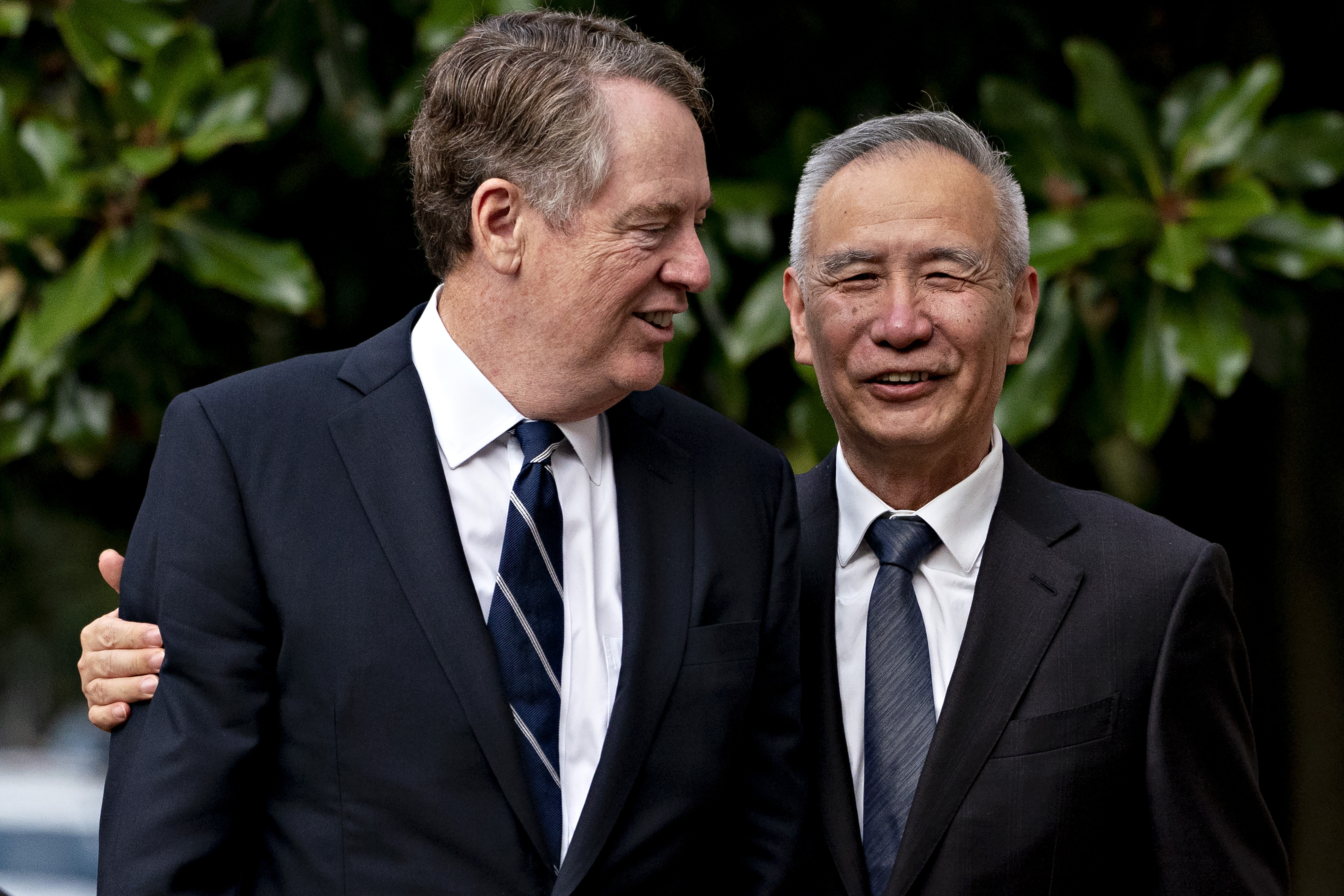
Liu He, China's vice premier, right stands with Robert Lighthizer, U.S. trade representative, while arriving for a meeting at the Office of the U.S. Trade Representative in Washington, D.C., U.S., on Thursday, Oct. 10, 2019. Chinese and American negotiators are set to start meeting again in Washington on Thursday in the latest round of their so-far fruitless talks to strike a trade deal. (Andrew Harrer/Bloomberg)

Showing progress with a currency pact and other matters could serve as a reason to delay next week’s tariff hike. Bloomberg News last month reported the White House was discussing plans for an interim deal.

Still, Trump on Monday said he preferred a complete trade agreement with China. “My inclination is to get a big deal. We’ve come this far. But I think that we’ll just have to see what happens. I would much prefer a big deal. And I think that’s what we’re shooting for,” he said.

A White House spokesman declined to comment. A Treasury spokesman didn’t respond to a request for comment. China’s Ministry of Commerce did not immediately respond to fax about the high-level talks.

Manipulation Label

No details were made public about the U.S.-China currency pact reached in February that Mnuchin at the time called the “strongest” ever. Broader trade negotiations between the two countries broke down in May after the U.S. accused China of backtracking on its commitments. Then, in August, the Trump administration formally declared China a currency manipulator.

According to people familiar with the currency language, the pact largely resembles what the U.S. agreed to in a new trade agreement with Mexico and Canada and also incorporates transparency commitments included in Group of 20 statements.

Still, Lighthizer cautioned earlier this year that the currency agreement hinges on the overall enforcement of the trade deal. “There’s no agreement on anything until there’s agreement on everything. But the reality is we have spent a lot of time on currency, and it’ll be enforceable,” he said in congressional testimony on Feb. 27.

The U.S. Treasury, which is in charge of monitoring potential currency manipulators, is expected to publish its next report on the foreign-exchange policies of major trading partners around mid-October.

Liu met with a small group of business executives and separately with International Monetary Fund officials Wednesday afternoon, people familiar with the meetings said.

--With assistance from Saleha Mohsin, Livia Yap, Angus Whitley, Miao Han, Steven Yang and William Edwards.


from Business - Latest - Google News https://ift.tt/35sjq7y
via IFTTT
October 10, 2019 at 09:22PM