(Bloomberg) -- Terms of Trade is a daily newsletter that untangles a world embroiled in trade wars. Sign up here.
The U.S. and China agreed on the outlines of a partial trade accord Friday that President Donald Trump said he and his counterpart Xi Jinping could sign as soon as next month.
As part of the deal, China would significantly step up purchases of U.S. agricultural commodities, agree to certain intellectual-property measures and concessions related to financial services and currency, Trump said Friday at the White House. In exchange, the U.S. will delay a tariff increase due next week as the deal is finalized, though new levies scheduled for December haven’t yet been called off.
The agreement marks the largest breakthrough in the 18-month trade war that has hurt the economies of both nations. Importantly, Trump said the deal was the first phase of a broader agreement. The president indicated he could sign a deal with Xi at an upcoming November summit in Chile.
While the limited agreement may resolve some short-term issues, several of the thorniest disputes remain outstanding. U.S. goals in the trade war center around accusations of intellectual-property theft, forced technology transfer and complaints about Chinese industrial subsidies.
Xi told Trump in a letter -- which the White House distributed on Friday -- that it’s important the countries work together to address each others’ concerns. “I hope the two sides will act in the principle and direction you and I have agreed to, and work to advance China-U.S. relations based on coordination, cooperation and stability,” the letter said.
Chinese state news agency Xinhua said negotiators made efforts toward a final agreement, but stopped short of calling Friday’s outcome a deal. The Editor-in-Chief of China’s most prominent state-run newspaper Global Times, Hu Xijin, noted on Twitter that official reports from China didn’t mention Trump’s goal of signing the deal next month, which indicates Beijing wants to keep expectations low.
Phase Two
The Trump administration also said issues related to Huawei Technologies Co. aren’t part of Friday’s deal and will be a separate process. The Chinese telecommunications equipment maker, which was placed on an export blacklist in May, will be discussed in a second phase of the negotiations, the president told reporters later Friday.
Equities advanced globally Friday amid growing conviction that the world’s two biggest economies would negotiate a trade truce, though U.S. stocks pared gains after Trump’s announcement near the close of trading. Trump tweeted earlier Friday that if the countries did reach an agreement, he would be able to sign it without a lengthy congressional approval process.
Trump’s announcement drew a wary welcome from even Republicans on Capitol Hill.
“After so much has been sacrificed, Americans will settle for nothing less than a full, enforceable and fair deal with China,” Senate Finance Committee Chairman Chuck Grassley said in a statement after the announcement. “Farmers in Iowa know far too well that the trade war has caused real financial pain in the heartland. But we need to know more about this deal and follow-through from China will be key.”
On Thursday and earlier Friday, Liu and U.S. Trade Representative Robert Lighthizer held the first senior-level discussions between Washington and Beijing since a previous agreement fell apart in May and tariffs were raised in the months after.
What Our Economists Say
“Past experience is that U.S.–China trade agreements aren’t worth the paper they are written on, and this one hasn’t even been written down. For now, though, indications on trade are a little more positive. If that persists, it could help put a floor under sliding global growth.”
Tom Orlik and Yelena Shulyatyeva, Bloomberg Economics
Click here for the full note
The U.S. was threatening to increase tariffs on Tuesday on about $250 billion of Chinese imports to 30% from 25%. More duties on $160 billion of Chinese products were targeted for Dec. 15.
The threat of those import taxes on U.S. consumers, falling around the holiday season, raised the prospect that the U.S. economy would slide toward a recession heading into Trump’s 2020 reelection bid. The American manufacturing industry, which Trump vowed in 2016 to revitalize, is already contracting in part because of the trade war.
The Trump administration said that as part of the deal, China would scale its purchases of U.S. farm goods over two years to an annual total of $40 billion to $50 billion. Trump encouraged U.S. farmers to buy more land and Deere & Co. tractors in response.
China in recent weeks had already discussed buying more U.S. products such as soybeans, pork and wheat. Some traders remained skeptical that buying soybeans from the U.S. represented a significant breakthrough in the overall trade talks, Bloomberg reported Friday.
Earlier Friday, Trump indicated in a Twitter post that if the countries did reach an agreement, he would be able to sign it quickly.
Senator Ronald Wyden, the ranking Democrat on the Finance Committee that has jurisdiction over trade policy, pushed back on Trump’s tweet in a statement Friday to Bloomberg News: “Donald Trump should know that any meaningful trade deal is only legitimate because of the authority granted to him by Congress, and that authority can be taken away,” he said.
Under the U.S. Constitution, Congress holds power over international trade. For decades, it has legally delegated trade-negotiating authority to the executive branch. Lawmakers in recent months have grown increasingly wary of what they see as Trump’s abuse of that authority and discussed ways to claw it back, citing the president’s many unilateral tariff measures and a lack of transparency in negotiations.
(Updates with remarks from Chinese officials in sixth paragraph)
--With assistance from Jennifer Jacobs, Ye Xie, Isis Almeida, Scott Lanman, Sophie Caronello and Sarah McGregor.
To contact the reporters on this story: Jenny Leonard in Washington at jleonard67@bloomberg.net;Saleha Mohsin in Washington at smohsin2@bloomberg.net;Josh Wingrove in Washington at jwingrove4@bloomberg.net;Shawn Donnan in Washington at sdonnan@bloomberg.net
To contact the editors responsible for this story: Margaret Collins at mcollins45@bloomberg.net, Kevin Whitelaw
For more articles like this, please visit us at bloomberg.com
An estimated 44.5 million retired workers receive monthly income in the form of Social Security benefits. If you work and pay Social Security taxes, then chances are, those benefits will be an important source of income for you once your career comes to an end. But if you rely on those benefits too heavily and neglect your savings as a result, you may be in for an unpleasant reality check as soon as your golden years kick off.
Currently, 50% of married seniors and 70% of unmarried seniors get 50% or more of their income from Social Security, while for 21% of married seniors and 45% of unmarried retirees, those benefits represent 90% or more of their income. But when we look at how much money that actually translates into, it's easy to see why Social Security alone isn't enough to sustain the typical senior.
IMAGE SOURCE: GETTY IMAGES.
The average retiree on Social Security today collects $1,471 a month, or $17,652 a year. Meanwhile, the average senior aged 65 and over spends $46,000 a year on living expenses, reports the Bureau of Labor Statistics. Clearly, there's a pretty wide gap between those two numbers, and it's for this reason that planning to live on Social Security alone in retirement is a truly bad idea. If that's your intent, consider this your wakeup call to start building savings and come up with a backup plan.
What will your expenses look like in retirement?
Many people expect their living costs to drop dramatically once they retire, but many seniors don't see all that substantial a decline. And when we think about the things seniors generally spend money on, that makes sense.
Seniors require housing, transportation, food, clothing, utilities, and modest forms of leisure, like cable TV, just like working folks do. Furthermore, retirees tend to face higher healthcare costs than workers, especially when we consider the various out-of-pocket expenses associated with Medicare. And that's why most seniors can't get by on just 40% of their former income, which is what Social Security is designed to pay the average earner. Retirement just plain costs too much money.
The solution? Save as much as you can while you're working. If you start out young, you can get away with contributing smaller amounts to a retirement savings plan and growing your balance with the right investments. If you're already older, you'll need to make more sizable contributions to build a solid level of savings.
Check out the following table, which illustrates how your savings efforts might pan out, depending on the window of time you have to work with and the amount of money you sock away in a retirement plan each month:
Age You Start Saving
Monthly Retirement Plan Contribution
Total Savings by Age 65 (Assumes a 7% Average Annual Return)
30
$400
$663,000
35
$500
$567,000
40
$600
$455,000
45
$700
$344,000
50
$800
$241,000
CALCULATIONS BY AUTHOR.
The less time you give yourself to sock away funds for retirement, the less wealth you stand to amass. In our table, increasing monthly contributions doesn't help compensate for delayed savings. That's because by putting off your savings, you miss out on years of critical investment growth. And if you're wondering about the 7% return used above, it's actually a couple of percentage points below the stock market's average yearly performance.
Of course, building savings isn't the only way to supplement your Social Security benefits. You can also get a part-time job in retirement or monetize a hobby. In fact, your retirement income can come from a variety of sources. Just make sure your plan is not to have all of it come from Social Security.
Rep. Bill Huizenga (R-MI) discusses the current state of the General Motors strike and its impact on the economy.
The United Auto Workers board voted on Saturday to bump up workers' strike pay by $25 a week and allow them to take part-time jobs and still qualify for the benefit.
Continue Reading Below
The decision comes as the UAW's nationwide strike against General Motors is a few days away from its one-month mark.
Starting on Sunday, workers who perform picket duty will get $275 a week in strike pay. Strike pay was $250 a week and was already set to rise to $275 in 2020.
"UAW members and their families are sacrificing for all of us," union president Gary Jones said in a statement. "We are all standing together for our future. This action reflects the UAW commitment and solidarity to all of our members and their families who are taking a courageous stand together to protect our middle-class way of life."
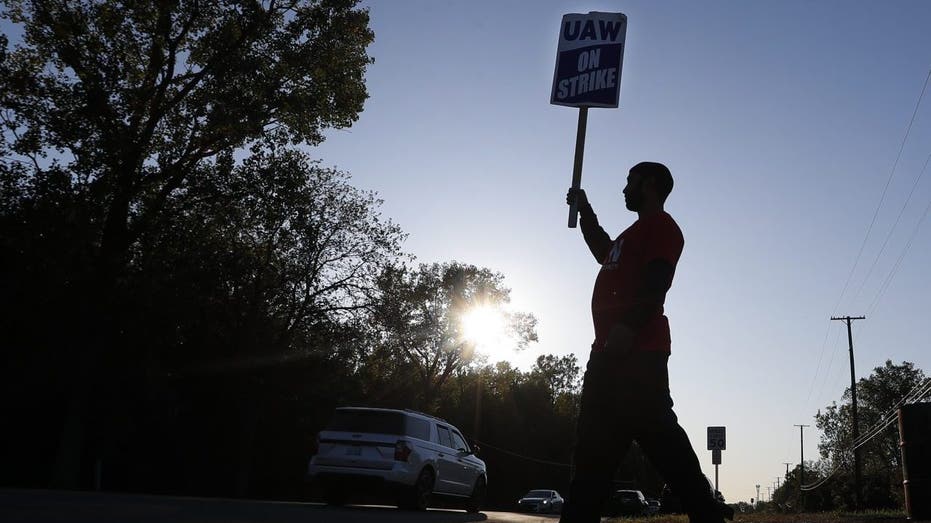
A member of the United Auto Workers walks the picket line at the General Motors Romulus Powertrain plant in Romulus, Mich., Wednesday, Oct. 9, 2019. (AP Photo/Paul Sancya)
The looser standards will also apply to UAW-represented Aramark janitorial employees who work at GM facilities and walked off the job a day before autoworkers did the same.
Previously, if workers performed outside work earning more than $250 a week, they forfeited the strike pay. Those workers still qualified for specified health care benefits available through the UAW Strike and Defense Fund.
Elon Musk shared new details about SpaceX's planned Mars-capable crewed launch system, called Starship, on September 28.
SpaceX is developing and launching Starship prototypes next to Boca Chica Village, a small neighborhood of retiree-age residents in South Texas.
Citing concerns about safety and disruptions, the rocket company recently offered to buy out everyone's homes in the area. But most residents initially balked at the deal.
While he was in town for his highly anticipated talk, Musk, the founder and CEO of SpaceX, met privately with some of the residents.
Villagers who attended the meeting described it as "awkward," "tense," and "heated," but ultimately productive in that they felt Musk — and SpaceX — listened to their complaints.
Hours after fans cheered him on-stage in South Texas, Elon Musk walked into a morass: a private meeting with perturbed locals whose properties that SpaceX, the rocket company Musk founded, had recently offered to buy out.
Residents say Musk attentively listened to their concerns and squashed some of their fears about the buyout process. But they described their roughly half-hour encounter with the tech mogul as "awkward," "tense," "heated," "confused," and "exhausting" — though it ended with handshakes, selfies, and some sense of progress.
Musk heard out his tough audience just before midnight on Saturday, September 28, during a visit to Boca Chica. The remote strip of land is located at the southeastern tip of the state, and it's where SpaceX is building a private launch site and spaceport.
But it's also where about 20 retiree-age residents live in the formerly sleepy residential neighborhood of Boca Chica Village, some of them for decades.
"We weren't playing nice with him. We made it clear we were not happy," said one resident to Business Insider. The person attended the private meeting but asked not to be named.
Why Musk met with villagers in southeastern Texas
A prototype of SpaceX's Starship, called Mk 1, rocket is seen at the company's South Texas launch facility in Boca Chica on September 28, 2019. Future versions of Starship are designed to be massive enough to take people to the moon, Mars, and beyond.
Loren Elliott/Getty Images
Musk's main task for the trip was delivering a highly anticipated update on SpaceX's plans for a next-generation rocket system, called Starship.
"The critical breakthrough that's needed for us to become a space-faring civilization is to make space travel like air travel," Musk said during his presentation while standing before a 16-story steel prototype.
Critical to making such a breakthrough, though, is room to safely build, test, and launch such Starship prototypes — vehicles which Musk has said last year might explode (though this is a risky reality of any rocket-test program). SpaceX has mostly used Boca Chica for this work, and Musk's presentation, which featured a new Starship launch visualization showing off big plans for the coastal site, underscored the company's hopes for its nascent spaceport.
"I think it's definitely possible that the first crewed mission on Starship could leave from Boca [Chica]," Musk said.
However, SpaceX has set up its rocket skunkworks close to residents' homes. The company built its launch pad just 1 1/2 miles from properties on the eastern edge of the community — twice as close as NASA permitted spectators to get to its space shuttles in Florida.
An overview of the Boca Chica area in south Texas circa 2017.
Google Earth
"[I]t has become clear that expansion of spaceflight activities as well as compliance with Federal Aviation Administration and other public safety regulations will make it increasingly more challenging to minimize disruption to residents of the Village," the company's cover letter said.
A prototype of SpaceX's Starship vehicle is pictured behind a home in Boca Chica Village, Texas, on September 28, 2019. SpaceX is attempting to buy out the residents of this community in order to expand spaceflight activities.
Loren Elliott/Getty ImagesBut SpaceX's seemingly generous pitch — three times an appraised value for each home — alarmed many if not most residents.
Some told Business Insider that they planned to permanently retire in the area and weren't interested in moving.
Nearly everyone had concerns about the offer's base appraisals, claiming they were abnormally low, and thus even a three-fold offer wouldn't come close to paying for a comparable coastal home in South Texas. (Some residents described the appraisals as "lowball" and "drive-by," since they did not evaluate the interior of homes.
Residents also told Business Insider that property comparisons, which were used to inform value, relied on properties that SpaceX purchased under duress, as well as suburban homes in Brownsville that didn't compare to their bucolic coastal setting.)
Some who wanted to stay said they feared a eminent domain process led by Cameron County, in which Boca Chica is based, may eventually force them out to make way for SpaceX's out-of-this-world ambitions.
With tensions peaking and Musk in town, SpaceX decided to put their CEO and a cadre of residents into a room to work things out.
SpaceX stopped one resident from trying to record the meeting. But according to interviews with five people who were in the room, here's what happened.
Residents said at first they 'felt like we'd been set up'
Elon Musk unveiled the 164-foot-tall Starship Mark 1 prototype in Boca Chica, Texas, on September 28, 2019.
SpaceX/YouTube
Days before Musk's Starship presentation, SpaceX invited village residents to come. Around 10 people RSVP'd, and SpaceX picked them up with a shuttle. Helping corral and greet everyone was a senior legal counsel for the company from Washington, DC, as well as a government and business-affairs liaison who worked on-site in Boca Chica.
The last shuttle drove into SpaceX's work yard compound shortly before 8 p.m., where workers had finished assembling a 16-story prototype of Starship's spaceship the day before. Residents say their handlers directed them to a sandbagged area just a few yards to the left of a small riser, which Musk stepped onto and spoke for about 40 minutes.
Immediately after he walked off-stage, SpaceX cued the residents to head to the shuttle, which they expected to drop them off at their homes less than a mile away. But once everyone had boarded, SpaceX invited the residents to join them at Stargate: a two-story technology park funded by the University of Texas Rio Grande Valley facility (which SpaceX uses as a launch control center).
"They turned around and said, 'Well, we're going to take you over here to the Stargate, upstairs, and we're going to have a special guest come meet you there,'" said Patricia Mitchell, who's owned a home in the village since 2005 with her husband, Walter.
SpaceX workers rush to and from UTRGV's Stargate facility to a launchpad during tests.
Dave Mosher/Business InsiderThey arrived to a spread of wine, beer, cookies, chips, and other snacks. The group got comfortable on couches, chairs, and stools awaiting their "special guest," whom they could only presume was Musk.
As the residents were settling in at Stargate, Musk returned to the stage at SpaceX's work yard to take questions from media. Christian Davenport of The Washington Post asked about SpaceX's long-term plans for the Boca Chica site.
"It will definitely get fancier than it currently is. The reason it's not fancier is because it would have taken too long to build the buildings," Musk said. "I think it will be a lot more buildings and a lot more stuff. Way more stuff than is currently here."
An illustration of SpaceX's planned 39-story-tall Starship rocket system at a launch site in Boca Chica, Texas.
SpaceX/YouTube
Later on, Jeff Foust of Space News asked about the future of residents in light of the FAA's apparent safety concerns.
"We're going to make sure that the risks to the public is extremely, vanishingly small. Almost nothing, basically," Musk said. "I don't see any fundamental obstacles. We are working with the residents of Boca Chica Village because we think oh, it's time, it's going to be quite disruptive to their — to living in Boca Chica Village. Because it'll end up needing to get cleared for safety a lot of times."
He added: "I think the actual danger to Boca Chica Village is low but is not tiny. So therefore we want super-tiny risk. Probably over time, [it's] better to buy out the villagers. And we've made an offer to that effect."
Most residents in the room at Stargate didn't learn about the Q&A or Musk's comments — the clearest yet from the company regarding the villagers' futures — until just before 11 p.m.
"We would have rather been down there or streaming. We just weren't savvy enough," said Maria Pointer, who was there with her husband, Ray.
"Everybody felt like we'd been set up," Walter Mitchell said. "We had questions we wanted to ask right there and have media exposure."
As some residents in the room played back streaming video of the Q&A session, agitated at having missed the remarks — and at being in their second hour of waiting for Musk — SpaceX's senior legal counsel addressed the room. She announced that Musk would arrive in about 15 to 20 minutes, noting that anyone who needed to leave could be driven home. She also opened the floor to concerns or questions to pass along.
"She invited a dialogue at that time," one resident said of the moment. "And suddenly everyone wants to unload on her."
Residents began heatedly questioning the "non-negotiable" wording in their buyout offers. They also brought up what some described to Business Insider as an "aggressive" two-week deadline to accept the deal, as well as what seemingly everyone felt was an undervaluation of their properties.
"We all felt that deadline, and three times, and 'not negotiable' — we felt that was a threat," Walter Mitchell said.
As the complaints petered out, a few residents left. One person forgot her pain medication, and her husband followed her out. Another left from exhaustion. Silence came over the room just before Musk walked in, which was sometime around 11:20 p.m.
'Nobody knew how to talk to this guy'
SpaceX CEO Elon Musk gives an update on the next-generation Starship spacecraft at the company's Texas launch facility on September 28, 2019 in Boca Chica near Brownsville, Texas.
Loren Elliott/Getty ImagesMusk arrived with an entourage of about five or six people, and immediately walked up to the residents, most of whom were sitting in a small semicircle of chairs and a couch. Everyone stood up, and Musk shook their hands, then he started speaking about why SpaceX picked Boca Chica to be the company's private spaceport.
"He talked about the regulations in Florida and why it was better for them to be here rather than in Florida, because things could get done a bit faster," Mr. Pointer said.
After a few minutes of opening remarks, Musk paused and there was a brief pause.
"It was pretty awkward. Nobody knew how to talk to this guy," Mrs. Pointer said. "You could tell people were feeling excited or flattered."
But Mr. Pointer apparently broke the silence. In an interview with Business Insider, he said he wasted little time expressing to Musk how he thought the appraisals and SpaceX's buyout offer process generally was unfair.
"I said I thought it was unconscionable that we were having to see ourselves — in so many words — dispossessed with a short-notice letter and the sword of Damocles over our heads concerning eminent domain. Those aren't my exact words, but that's certainly what I wanted to get out," Mr. Pointer said. "And then the Mitchells chimed in with their feelings about that as well — similar feelings — and then everyone started going at it."
The Mitchells explained how the offer they received for their property, which the couple planned to pass down to their children, wouldn't buy them a somewhat comparable setup in nearby South Padre Island, the nearest beachside real-estate market (though a much hotter one as a popular tourist destination).
"He was very polite and listened to what we had to say on that matter," Mr. Pointer said. "He just absorbed it and waited for the next blow."
When someone brought up the "non-negotiable" issue with the buyout offer letter, Musk chimed in with an edit.
"He goes, 'It's negotiable.' And everyone goes, 'It is negotiable?'" Mrs. Pointer said. "It surprised us and floored us."
While the three-fold number was not negotiable to be fair to everyone, Musk apparently explained, SpaceX would consider new appraisals that addressed residents' concerns. Shortly after that, two residents said they asked about eminent domain and whether or not those who chose to stay would eventually be forced out for reasons of safety or convenience.
"He said that he didn't want to do that, that's not what he wanted to do," Mr. Pointer said. "But that's not an answer to the question."
Two other residents allegedly said that they "didn't mind" SpaceX's presence and inquired about staying, according to others in the room. (One of residents previously described himself to Business Insider as "the biggest SpaceX fan in Texas," so much so that he moved to Boca Chica in 2015 to retire amid the company's launch site.)
Residents brought up a community meeting SpaceX held in 2015, not too long after the company had broken ground on its launch site. According to residents, officials allegedly said the company would — during temporary launch evacuations under a previous (and now-abandoned) plan — house residents in hotels in Brownsville, about 20 miles west of Boca Chica.
Walter Mitchell made himself clear: "There are people here that want to keep their property," Mitchell said he told Musk. "I said, 'You guys said in that meeting that you would take us and put us in hotels.' I said, 'Can that work? And they can keep their property?'"
"Well, if they don't mind frequent shuttles to a hotel frequently, we could probably do that," Musk responded according to Mitchell.
Residents also brought up other grievances and needs: a request for soundproof windows, a more courteous and helpful on-site contact with the company, and more transparency from the company about its activities.
Free Teslas and selfies
After airing their complaints and feeling heard by Musk, residents told Business Insider the "heated" and "exhausting" mood of the room began to change. That shift appears to have happened when the Mitchells cracked a joke: Could Musk throw a free Tesla electric car into everyone's buyout offer?
"We started laughing, almost all of us," a resident said, though Musk then explained that even as CEO he is required to buy his own vehicles from the company.
From there, residents said the previously "heated" conversation shuffled between a mix of joking and technical explanations. The SpaceX fan struck up a conversation about metals used in Starship. Musk apparently also described a long-term plan to move away from land-based launch pads and instead use offshore platforms near Boca Chica Beach to fly Starship with less risk to the ground.
"He mentioned that they have to take off right offshore, but they have to land somewhere, right? And you can't do that on land in the middle of Paris, I think he said," Mrs. Pointer recalled. "So you have to have offshore facilities everywhere."
As the conversation loosened up a bit more, an aide called an end to the meeting.
"He shook everyone's hand, and at the end of it, everyone took selfies," Mr. Pointer said of Musk (though he noted that he himself did not).
'I don't think we were supposed to live next to a rocket ship yard'
Maria Pointer looks on from her front yard in Boca Chica, Texas, as SpaceX workers assemble a prototype of a spaceship called Starship Mark 1 next door on September 27, 2019.
Jonathan Newton/The Washington Post via Getty Images
Residents returned home after midnight and began to soak in what had transpired.
"I don't feel like I'm on the dark side of the moon as much as I was before," Mrs. Pointer said. "I feel like they are seriously learning where all the fault lines were, where all the gaps were, where things were just falling through because they move so fast, and we don't move that fast."
Residents say SpaceX has not only extended its buyout offer deadlines, but also dispatched an appraiser to more fully evaluate their homes and consider properties in coastal areas. If those assessments come back with a more fair valuation, multiple residents who initially said they'd decline the deal told Business Insider they would reconsider selling to SpaceX.
But some residents say they still feel doubtful and pained about their futures. For instance, the Pointers have invested years of work into their Boca Chica property to make it a customized and comfortable retirement homestead, not just a winter home or Airbnb (as some residents use their properties).
"I appreciate where he's going. I understand the Mars thing — I got it — and I'm happy with everyone going forward with that. I think that's an important thing to do; he's doing a good thing, and that's fine," Mr. Pointer said. "But as far as I'm concerned — for me? — he's ruining my life and my situation out here. That being said, I just have to move on under the circumstances."
Mrs. Pointer later added: "I just don't think this is our life. I don't think we were supposed to live next to a rocket ship yard."
SpaceX did not return multiple requests comment for this story ahead of its publication.
Hip hop billionaire Jay-Z is investing in a Kelowna company.
Pela, maker of world’s first compostable phone case, today announced it has closed a $5M round of funding. Marcy Venture Partners, the consumer focused VC fund co-founded by JAY-Z, Jay Brown, and Larry Marcus led the round with Toronto-based Kensington Capital.
Photo: Beyonce and Jay Z / Shutterstock
The capital is being used to fuel rapid expansion of the company’s leading products in phone protection and drive towards a more sustainable future.
“Pela has incredible values and offers incredible value in its products,” said Larry Marcus, Co-Founder and Managing Director of MVP, “Matt Bertulli and the team are tapped into the tuned-in, conscious and discerning consumer that cares about what they buy. Their products offer a powerful combination of utility, design and sustainability.”
“Part of what excited us about partnering with Marcy Venture Partners is their experience in identifying and amplifying cultural trends,” said CEO of Pela, Matt Bertulli. “To us, there’s nothing more important than continuing to be a leader in a large global movement toward sustainable consumerism and we’re very excited to have the support of MVP.”
Global consumer trends are showing that sustainability is no longer a niche market. According to a recent survey conducted by Nielsen, 81 per cent of global consumers say it’s extremely important that companies implement programs to help improve the environment.
“The mobile phone industry is a great example of where quite a bit can be done to create better, more environmentally friendly products,” said Bertulli. “Put simply, as a consumer you can protect your phone and the planet. There doesn’t need to be a compromise.”
Pela says it is excited to be part of the change to see consumers making smart choices when it comes to choosing which products to support.
Pela was founded in 2011 by environmental consultant, Jeremy Lang after a family vacation to Hawaii. Lang says, “I was shocked to see the level of plastic pollution that was washed up on the shores and decided to come up with a solution.” After much research, trial and error, Lang created a material called Flaxstic™, a unique blend of plant-based biopolymer mixed with flax shive, an annually renewable waste byproduct of the flax oilseed harvest in Canada.
from Business - Latest - Google News https://ift.tt/2IM5ADn
via IFTTT
October 12, 2019 at 08:30PM
Facebook’s plan to introduce its own cryptocurrency, Libra, next year has faced another serious setback, after Visa, Mastercard, eBay and Stripe became the latest companies to pull out from the project.
In statements following their decision, the companies said that they were still interested in the cryptocurrency as a secure digital payment method, but have chosen to focus their resources on other projects for the time being.
Facebook declined to comment about the companies’ exit, while the Libra Association said that it was focused on “moving forward and continuing to build a strong association” of businesses that will accept the currency.
The move comes just a week after PayPal announced its withdrawal from the Geneva-based Libra Association, which is charged with managing the Facebook-led global currency. Mercadopago and PayU are now the only two payments companies continuing to back Facebook’s digital cash.
The social media giant unveiled plans last summer to launch Libra by June 2020. However, the project faces serious regulatory hurdles. France and Germany both stated last month that they would attempt to block Libra from operating in Europe, saying it posed risks to EU states’ sovereignty.
Like this story? Share it with a friend!
from Business - Latest - Google News https://ift.tt/33wU6M9
via IFTTT
October 12, 2019 at 06:41PM